
Verwandte Artikel zu Financial Instrument Pricing Using C++ (Wiley Finance)
Inhaltsangabe
An integrated guide to C++ and computational finance
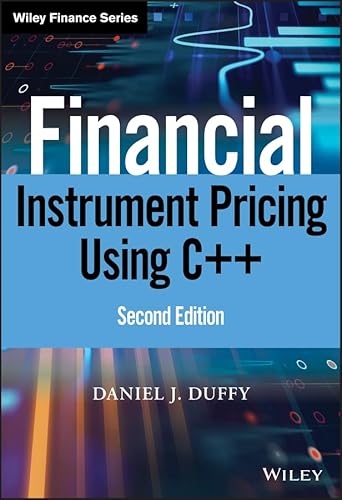
This complete guide to C++ and computational finance is a follow-up and major extension to Daniel J. Duffy's 2004 edition of Financial Instrument Pricing Using C++. Both C++ and computational finance have evolved and changed dramatically in the last ten years and this book documents these improvements. Duffy focuses on these developments and the advantages for the quant developer by:
- Delving into a detailed account of the new C++11 standard and its applicability to computational finance.
- Using de-facto standard libraries, such as Boost and Eigen to improve developer productivity.
- Developing multiparadigm software using the object-oriented, generic, and functional programming styles.
- Designing flexible numerical algorithms: modern numerical methods and multiparadigm design patterns.
- Providing a detailed explanation of the Finite Difference Methods through six chapters, including new developments such as ADE, Method of Lines (MOL), and Uncertain Volatility Models.
- Developing applications, from financial model to algorithmic design and code, through a coherent approach.
- Generating interoperability with Excel add-ins, C#, and C++/CLI.
- Using random number generation in C++11 and Monte Carlo simulation.
Duffy adopted a spiral model approach while writing each chapter of Financial Instrument Pricing Using C++ 2e: analyse a little, design a little, and code a little. Each cycle ends with a working prototype in C++ and shows how a given algorithm or numerical method works. Additionally, each chapter contains non-trivial exercises and projects that discuss improvements and extensions to the material.
This book is for designers and application developers in computational finance, and assumes the reader has some fundamental experience of C++ and derivatives pricing.
HOW TO RECEIVE THE SOURCE CODE
Once you have purchased a copy of the book please send an email to the author dduffyATdatasim.nl requesting your personal and non-transferable copy of the source code. Proof of purchase is needed. The subject of the mail should be “C++ Book Source Code Request”. You will receive a reply with a zip file attachment.
Die Inhaltsangabe kann sich auf eine andere Ausgabe dieses Titels beziehen.
Über die Autorin bzw. den Autor
DANIEL J. DUFFY started the company Datasim in 1987 to promote C++ as a new object-oriented language for developing applications in the roles of developer, architect and requirements analyst to help clients design and analyse software systems for Computer Aided Design (CAD), process control and hardware- software systems, logistics, holography (optical technology) and computational finance. He used a combination of top-down functional decomposition and bottom-up object-oriented programming techniques to create stable and extendible applications. Prior to Datasim, he worked on engineering and financial applications in oil and gas and semiconductor industries using a range of numerical methods (for example, the finite element method [FEM]) on mainframe and mini-computers.
Duffy has BA (Mod), MSc and PhD degrees in pure, numerical and applied mathematics and has been active in promoting partial differential equation (PDE) and finite difference methods (FDM) to applications in computational finance. He was responsible for the introduction of the Fractional Step ("Soviet Splitting") method and the Alternating Direction Explicit (ADE) method in computational finance.
He is the originator of two very popular and leading C++ online courses (both C++98 and C++11/14/17) on www.quantnet.com in cooperation with Quantnet LLC and Baruch College (CUNY), NYC. He also trains quants, developers and designers around the world. Duffy can be contacted at dduffy@datasim.nl. In his spare time, he tries to keep in shape by workouts in the dojo.
Von der hinteren Coverseite
The New Way C++ Does Computational Finance
The goal of Financial Instrument Pricing Using C++, Second Edition, is to apply modern C++ language and design features to the creation of efficient and robust applications. This book not only documents these developments, but also highlights the advantages for the quant developer:
- Comprehensive and detailed exposition of improved and new C++ syntax; extensive examples and application code
- Using C++11 libraries for random number generation, concurrency, STL and more
- Overhaul of object-oriented design patterns and porting them to a multiparadigm programming model
- IEEE 754 and multiprecision; interfacing C++ with .NET and C#
- Modern PDE/FDM: ADE; Soviet Splitting and Method of Lines, (Parallel) Monte Carlo and lattice methods
- Support for numerical libraries
- Machine-readable code
Daniel Duffy used a spiral model approach in writing each chapter of this book: analyse a little, design a little, and code a little. Each cycle ends with a working prototype in C++ and shows how a given algorithm or numerical method works. Additionally, each chapter contains non-trivial exercises and projects that discuss improvements and extensions to the material. This book is for designers and application developers in computational finance, and assumes the reader has some fundamental experience of C++ and derivatives pricing.
Aus dem Klappentext
This complete guide to C++ and computational finance is a follow-up and major extension to Daniel J. Duffy's 2004 edition of Financial Instrument Pricing Using C++. This second edition discusses the latest developments in C++11 (and later versions), modern multithreaded and parallel software libraries and a repeatable process to design applications using system decomposition in conjunction with software design patterns based on a mix of the object-oriented, generic (template) and functional programming models. This C++ machinery is then used to create applications in computational finance such as state-of-art PDE/FDM, Monte Carlo and optimisation. In particular, standard C++ is leveraged as far as possible to create robust, efficient and maintainable code. Functionality from libraries such as Boost, Quantlib and Eigen is also used.
Useful for finance professionals who wish to write new applications or to upgrade existing applications to C++11, it is also an ideal companion for MSc/MFE students at universities. Each chapter is accompanied by detailed exercises and full working code is provided for all chapters (those who are interested in a personal copy of the code need to approach the author directly).
For queries concerning training and support, please visit www.datasim.nl.
„Über diesen Titel“ kann sich auf eine andere Ausgabe dieses Titels beziehen.
Suchergebnisse für Financial Instrument Pricing Using C++ (Wiley Finance)

Foto des Verkäufers
Financial Instrument Pricing Using C++
Anbieter: GreatBookPrices, Columbia, MD, USA
Verkäuferbewertung 5 von 5 Sternen

Zustand: As New. Unread book in perfect condition. Bestandsnummer des Verkäufers 8746482
Gebraucht kaufen
EUR 99,09
EUR 2,28 Versand
Versand innerhalb von USA
Versand innerhalb von USA
Anzahl: Mehr als 20 verfügbar
Beispielbild für diese ISBN
Financial Instrument Pricing Using C++ (Wiley Finance)
Anbieter: Kennys Bookshop and Art Galleries Ltd., Galway, GY, Irland
Verkäuferbewertung 5 von 5 Sternen
Zustand: New. ? C++ is one of the best languages for the development of financial engineering and instrument pricing applications. ? This book applies C++ to the design and implementation of classes, libraries and latest applications for option and derivative pricing models. Series: Wiley Finance Series. Num Pages: 160 pages. BIC Classification: KFFM; UF; UMZ. Category: (P) Professional & Vocational. Dimension: 244 x 170. . . 2018. 2nd. Hardcover. . . . . Bestandsnummer des Verkäufers V9780470971192
Neu kaufen
EUR 100,23
EUR 9,50 Versand
Versand von Irland nach USA
Versand von Irland nach USA
Anzahl: 15 verfügbar
Foto des Verkäufers
Financial Instrument Pricing Using C++
Anbieter: GreatBookPrices, Columbia, MD, USA
Verkäuferbewertung 5 von 5 Sternen
Zustand: New. Bestandsnummer des Verkäufers 8746482-n
Neu kaufen
EUR 113,77
EUR 2,28 Versand
Versand innerhalb von USA
Versand innerhalb von USA
Anzahl: Mehr als 20 verfügbar
Beispielbild für diese ISBN
Financial Instrument Pricing Using C++
Anbieter: Books Puddle, New York, NY, USA
Verkäuferbewertung 4 von 5 Sternen

Zustand: New. Bestandsnummer des Verkäufers 2696994220
Neu kaufen
EUR 115,66
EUR 3,44 Versand
Versand innerhalb von USA
Versand innerhalb von USA
Anzahl: 1 verfügbar
Foto des Verkäufers
Financial Instrument Pricing Using C++
Anbieter: GreatBookPricesUK, Woodford Green, Vereinigtes Königreich
Verkäuferbewertung 5 von 5 Sternen
Zustand: New. Bestandsnummer des Verkäufers 8746482-n
Neu kaufen
EUR 108,38
EUR 17,53 Versand
Versand von Vereinigtes Königreich nach USA
Versand von Vereinigtes Königreich nach USA
Anzahl: Mehr als 20 verfügbar
Foto des Verkäufers
Financial Instrument Pricing Using C++
Anbieter: GreatBookPricesUK, Woodford Green, Vereinigtes Königreich
Verkäuferbewertung 5 von 5 Sternen
Zustand: As New. Unread book in perfect condition. Bestandsnummer des Verkäufers 8746482
Gebraucht kaufen
EUR 110,17
EUR 17,53 Versand
Versand von Vereinigtes Königreich nach USA
Versand von Vereinigtes Königreich nach USA
Anzahl: Mehr als 20 verfügbar
Beispielbild für diese ISBN
Financial Instrument Pricing Using C++ (Wiley Finance)
Anbieter: Ubiquity Trade, Miami, FL, USA
Verkäuferbewertung 5 von 5 Sternen
Zustand: New. Brand new! Please provide a physical shipping address. Bestandsnummer des Verkäufers 9780470971192
Neu kaufen
EUR 127,02
EUR 2,59 Versand
Versand innerhalb von USA
Versand innerhalb von USA
Anzahl: Mehr als 20 verfügbar
Beispielbild für diese ISBN
Financial Instrument Pricing Using C++ (Wiley Finance)
Anbieter: Kennys Bookstore, Olney, MD, USA
Verkäuferbewertung 5 von 5 Sternen
Zustand: New. ? C++ is one of the best languages for the development of financial engineering and instrument pricing applications. ? This book applies C++ to the design and implementation of classes, libraries and latest applications for option and derivative pricing models. Series: Wiley Finance Series. Num Pages: 160 pages. BIC Classification: KFFM; UF; UMZ. Category: (P) Professional & Vocational. Dimension: 244 x 170. . . 2018. 2nd. Hardcover. . . . . Books ship from the US and Ireland. Bestandsnummer des Verkäufers V9780470971192
Neu kaufen
EUR 125,08
EUR 9,06 Versand
Versand innerhalb von USA
Versand innerhalb von USA
Anzahl: 15 verfügbar