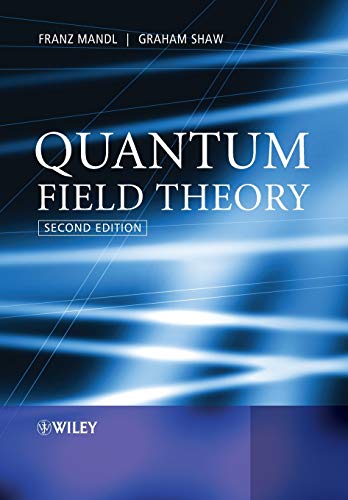
Inhaltsangabe
Following on from the successful first (1984) and revised (1993) editions, this extended and revised text is designed as a short and simple introduction to quantum field theory for final year physics students and for postgraduate students beginning research in theoretical and experimental particle physics.
The three main objectives of the book are to:
Explain the basic physics and formalism of quantum field theory
To make the reader proficient in theory calculations using Feynman diagrams
To introduce the reader to gauge theories, which play a central role in elementary particle physics.
Thus, the first ten chapters deal with QED in the canonical formalism, and are little changed from the first edition. A brief introduction to gauge theories (Chapter 11) is then followed by two sections, which may be read independently of each other. They cover QCD and related topics (Chapters 12-15) and the unified electroweak theory (Chapters 16 - 19) respectively. Problems are provided at the end of each chapter.
New to this edition:
Five new chapters, giving an introduction to quantum chromodynamics and the methods used to understand it: in particular, path integrals and the renormalization group.
The treatment of electroweak interactions has been revised and updated to take account of more recent experiments.
Die Inhaltsangabe kann sich auf eine andere Ausgabe dieses Titels beziehen.
Über die Autorin bzw. den Autor
Franz Mandl is the author of Quantum Field Theory, 2nd Edition, published by Wiley.
Graham Shaw is the author of Quantum Field Theory, 2nd Edition, published by Wiley.
Von der hinteren Coverseite
Following on from the successful first (1984) and revised (1993) editions, this extended and revised text is designed as a short and simple introduction to quantum field theory for final year physics students and for postgraduate students beginning research in theoretical and experimental particle physics.
The three main objectives of the book are to:
* Explain the basic physics and formalism of quantum field theory
* To make the reader proficient in theory calculations using Feynman diagrams
* To introduce the reader to gauge theories, which play a central role in elementary particle physics.
Thus, the first ten chapters deal with QED in the canonical formalism, and are little changed from the first edition. A brief introduction to gauge theories (Chapter 11) is then followed by two sections, which may be read independently of each other. They cover QCD and related topics (Chapters 12-15) and the unified electroweak theory (Chapters 16 - 19) respectively. Problems are provided at the end of each chapter.
New to this edition:
* Five new chapters, giving an introduction to quantum chromodynamics and the methods used to understand it: in particular, path integrals and the renormalization group.
* The treatment of electroweak interactions has been revised and updated to take account of more recent experiments.
Aus dem Klappentext
Following on from the successful first (1984) and revised (1993) editions, this extended and revised text is designed as a short and simple introduction to quantum field theory for final year physics students and for postgraduate students beginning research in theoretical and experimental particle physics.
The three main objectives of the book are to:
* Explain the basic physics and formalism of quantum field theory
* To make the reader proficient in theory calculations using Feynman diagrams
* To introduce the reader to gauge theories, which play a central role in elementary particle physics.
Thus, the first ten chapters deal with QED in the canonical formalism, and are little changed from the first edition. A brief introduction to gauge theories (Chapter 11) is then followed by two sections, which may be read independently of each other. They cover QCD and related topics (Chapters 12-15) and the unified electroweak theory (Chapters 16 - 19) respectively. Problems are provided at the end of each chapter.
New to this edition:
* Five new chapters, giving an introduction to quantum chromodynamics and the methods used to understand it: in particular, path integrals and the renormalization group.
* The treatment of electroweak interactions has been revised and updated to take account of more recent experiments.
„Über diesen Titel“ kann sich auf eine andere Ausgabe dieses Titels beziehen.
Weitere beliebte Ausgaben desselben Titels

Suchergebnisse für Quantum Field Theory, Second Edition

Beispielbild für diese ISBN
Quantum Field Theory
Verlag:
Wiley & Sons, Incorporated, John, 2010
ISBN 10: 0471496847
ISBN 13: 9780471496847
Gebraucht
Softcover
Anbieter: Better World Books Ltd, Dunfermline, Vereinigtes Königreich
Verkäuferbewertung 5 von 5 Sternen

Zustand: Good. 2nd Edition. Ships from the UK. Former library book; may include library markings. Used book that is in clean, average condition without any missing pages. Bestandsnummer des Verkäufers 53410603-20
Gebraucht kaufen
EUR 32,92
Versand:
EUR 9,15
Von Vereinigtes Königreich nach USA
Anzahl: 1 verfügbar
Beispielbild für diese ISBN
Quantum Field Theory
Anbieter: PBShop.store UK, Fairford, GLOS, Vereinigtes Königreich
Verkäuferbewertung 5 von 5 Sternen
PAP. Zustand: New. New Book. Shipped from UK. Established seller since 2000. Bestandsnummer des Verkäufers FW-9780471496847
Neu kaufen
EUR 46,30
Versand:
EUR 6,72
Von Vereinigtes Königreich nach USA
Anzahl: 15 verfügbar
Foto des Verkäufers
Quantum Field Theory
Anbieter: GreatBookPrices, Columbia, MD, USA
Verkäuferbewertung 5 von 5 Sternen
Zustand: New. Bestandsnummer des Verkäufers 1546170-n
Neu kaufen
EUR 50,89
Versand:
EUR 2,26
Innerhalb der USA
Anzahl: Mehr als 20 verfügbar
Foto des Verkäufers
Quantum Field Theory (Paperback)
Verlag:
John Wiley & Sons Inc, New York, 2010
ISBN 10: 0471496847
ISBN 13: 9780471496847
Neu
Paperback
Anbieter: Grand Eagle Retail, Bensenville, IL, USA
Verkäuferbewertung 5 von 5 Sternen
Paperback. Zustand: new. Paperback. Following on from the successful first (1984) and revised (1993) editions, this extended and revised text is designed as a short and simple introduction to quantum field theory for final year physics students and for postgraduate students beginning research in theoretical and experimental particle physics. The three main objectives of the book are to: Explain the basic physics and formalism of quantum field theory To make the reader proficient in theory calculations using Feynman diagrams To introduce the reader to gauge theories, which play a central role in elementary particle physics. Thus, the first ten chapters deal with QED in the canonical formalism, and are little changed from the first edition. A brief introduction to gauge theories (Chapter 11) is then followed by two sections, which may be read independently of each other. They cover QCD and related topics (Chapters 12-15) and the unified electroweak theory (Chapters 16 - 19) respectively. Problems are provided at the end of each chapter. New to this edition: Five new chapters, giving an introduction to quantum chromodynamics and the methods used to understand it: in particular, path integrals and the renormalization group. The treatment of electroweak interactions has been revised and updated to take account of more recent experiments. Following on from the successful first (1984) and revised (1993) editions, this extended and revised text is designed as a short and simple introduction to quantum field theory for final year physics students and for postgraduate students beginning research in theoretical and experimental particle physics. Shipping may be from multiple locations in the US or from the UK, depending on stock availability. Bestandsnummer des Verkäufers 9780471496847
Foto des Verkäufers
Quantum Field Theory
Anbieter: GreatBookPrices, Columbia, MD, USA
Verkäuferbewertung 5 von 5 Sternen
Zustand: As New. Unread book in perfect condition. Bestandsnummer des Verkäufers 1546170
Gebraucht kaufen
EUR 60,93
Versand:
EUR 2,26
Innerhalb der USA
Anzahl: Mehr als 20 verfügbar
Foto des Verkäufers
Quantum Field Theory
Anbieter: GreatBookPricesUK, Woodford Green, Vereinigtes Königreich
Verkäuferbewertung 5 von 5 Sternen
Zustand: New. Bestandsnummer des Verkäufers 1546170-n
Neu kaufen
EUR 46,29
Versand:
EUR 17,16
Von Vereinigtes Königreich nach USA
Anzahl: 3 verfügbar
Beispielbild für diese ISBN
Quantum Field Theory
Anbieter: Ria Christie Collections, Uxbridge, Vereinigtes Königreich
Verkäuferbewertung 5 von 5 Sternen
Zustand: New. In. Bestandsnummer des Verkäufers ria9780471496847_new
Neu kaufen
EUR 51,43
Versand:
EUR 13,71
Von Vereinigtes Königreich nach USA
Anzahl: Mehr als 20 verfügbar
Beispielbild für diese ISBN
Quantum Field Theory
Anbieter: Kennys Bookshop and Art Galleries Ltd., Galway, GY, Irland
Verkäuferbewertung 5 von 5 Sternen
Zustand: New. 2010. 2nd Edition. Paperback. Following on from the successful first (1984) and revised (1993) editions, this extended and revised text is designed as a short and simple introduction to quantum field theory for final year physics students and for postgraduate students beginning research in theoretical and experimental particle physics. Num Pages: 492 pages, black & white illustrations, figures. BIC Classification: PHQ. Category: (P) Professional & Vocational; (U) Tertiary Education (US: College). Dimension: 243 x 168 x 28. Weight in Grams: 844. . . . . . Bestandsnummer des Verkäufers V9780471496847
Beispielbild für diese ISBN
Quantum Field Theory
Anbieter: Majestic Books, Hounslow, Vereinigtes Königreich
Verkäuferbewertung 4 von 5 Sternen

Zustand: New. pp. 492. Bestandsnummer des Verkäufers 8148779
Neu kaufen
EUR 61,57
Versand:
EUR 7,44
Von Vereinigtes Königreich nach USA
Anzahl: 3 verfügbar
Foto des Verkäufers
Quantum Field Theory
Anbieter: Rarewaves.com USA, London, LONDO, Vereinigtes Königreich
Verkäuferbewertung 5 von 5 Sternen
Paperback. Zustand: New. Following on from the successful first (1984) and revised (1993) editions, this extended and revised text is designed as a short and simple introduction to quantum field theory for final year physics students and for postgraduate students beginning research in theoretical and experimental particle physics. The three main objectives of the book are to: Explain the basic physics and formalism of quantum field theory To make the reader proficient in theory calculations using Feynman diagrams To introduce the reader to gauge theories, which play a central role in elementary particle physics. Thus, the first ten chapters deal with QED in the canonical formalism, and are little changed from the first edition. A brief introduction to gauge theories (Chapter 11) is then followed by two sections, which may be read independently of each other. They cover QCD and related topics (Chapters 12-15) and the unified electroweak theory (Chapters 16 - 19) respectively. Problems are provided at the end of each chapter. New to this edition: Five new chapters, giving an introduction to quantum chromodynamics and the methods used to understand it: in particular, path integrals and the renormalization group. The treatment of electroweak interactions has been revised and updated to take account of more recent experiments. Bestandsnummer des Verkäufers LU-9780471496847
Neu kaufen
EUR 69,15
Versand:
Gratis
Von Vereinigtes Königreich nach USA
Anzahl: 1 verfügbar