
Verwandte Artikel zu Introduction to Bose-Einstein Correlations and Subatomic...
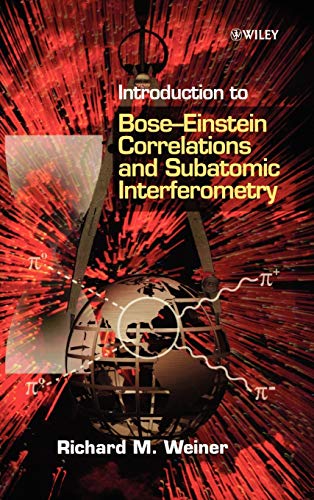
Introduction to Bose-Einstein Correlations and Subatomic Interferometry (Speech and Hearing Series) - Hardcover
Inhaltsangabe
The first textbook on Bose-Einstein correlations and their applications, an interdisciplinary topic bridging particle physics and quantum physics, and currently the centre of considerable interest in high energy physics. Besides its fundamental importance for particle physics, this phenomenon constitutes the main tool for the determination of sizes and lifetimes of particle sources.
The contents of this book are divided into the following chapters, each of which concludes with exercises designed to test the reader's understanding of the concepts and theories included therein:
The Foundations; Hadron Interferometry; Currents; Sources; Applications to Ultrarelativistic Nucleus-Nucleus Collisions; Correlations and Multiplicity Distributions; Photos versus Hadrons.
It provides the first systematic analysis and comparison of the different theoretical approaches to the subject and will be invaluable to theorists and experimentalists in particle and nuclear physics, quantum optics and astrophysics.
Die Inhaltsangabe kann sich auf eine andere Ausgabe dieses Titels beziehen.
Über die Autorin bzw. den Autor
Richard M. Weiner is a professor of theoretical physics at the University of Marburg in Marburg, Germany and an associate of the Laboratoire de Physique Théorique at Paris-Sud 11 University in Orsay, France.
Von der hinteren Coverseite
The macrocosm and the microcosm have many common features. When two energetic particles or nuclei collide a 'fireball' is created which decays into other particles. This fireball consists of quarks and gluons and is similar to the fireball of which the early universe was made when quarks and gluons moved freely in a quark-gluon plasma. The size and lifetime of this fireball is of fundamental interest for our understanding of subatomic physics and of the evolution of the cosmos. Its determination currently plays an essential role in the ongoing search of the quark-gluon plasma in the laboratory. As explained in this book, the space-time characteristics of the fireball (and other properties of sources of elementary particles) can be determined by using the method of intensity interferometry which is also applied in astronomy for the determination of star sizes. This method is based on the quantum effect of Bose-Einstein correlations, an effect which leads also to Bose-Einstein condensates responsible for lasers, superfluids and superconductors. It is for this reason that interest in the subject has seen such remarkable growth in recent years. Despite this interest, Introduction to Bose-Einstein Correlations and Subatomic Interferometry is the first textbook dedicated to the Bose-Einstein correlations and their applications.
The contents of this book are divided into the following chapters, each of which concludes with exercises designed to test the reader's understanding of the concepts and theories included therein: The Foundations; Hadron Interferometry; Currents; Sources; Applications to Ultrarelativistic Nucleus-Nucleus Collisions; Correlations and Multiplicity Distributions; Photons versus Hadrons.
The book addresses itself to graduate students with a background in quantum mechanics, and to theorists and experimentalists in particle and nuclear physics, quantum optics and astrophysics.
Aus dem Klappentext
The macrocosm and the microcosm have many common features. When two energetic particles or nuclei collide a 'fireball' is created which decays into other particles. This fireball consists of quarks and gluons and is similar to the fireball of which the early universe was made when quarks and gluons moved freely in a quark-gluon plasma. The size and lifetime of this fireball is of fundamental interest for our understanding of subatomic physics and of the evolution of the cosmos. Its determination currently plays an essential role in the ongoing search of the quark-gluon plasma in the laboratory. As explained in this book, the space-time characteristics of the fireball (and other properties of sources of elementary particles) can be determined by using the method of intensity interferometry which is also applied in astronomy for the determination of star sizes. This method is based on the quantum effect of Bose-Einstein correlations, an effect which leads also to Bose-Einstein condensates responsible for lasers, superfluids and superconductors. It is for this reason that interest in the subject has seen such remarkable growth in recent years. Despite this interest, Introduction to Bose-Einstein Correlations and Subatomic Interferometry is the first textbook dedicated to the Bose-Einstein correlations and their applications.
The contents of this book are divided into the following chapters, each of which concludes with exercises designed to test the reader's understanding of the concepts and theories included therein: The Foundations; Hadron Interferometry; Currents; Sources; Applications to Ultrarelativistic Nucleus-Nucleus Collisions; Correlations and Multiplicity Distributions; Photons versus Hadrons.
The book addresses itself to graduate students with a background in quantum mechanics, and to theorists and experimentalists in particle and nuclear physics, quantum optics and astrophysics.
„Über diesen Titel“ kann sich auf eine andere Ausgabe dieses Titels beziehen.
Suchergebnisse für Introduction to Bose-Einstein Correlations and Subatomic...

Beispielbild für diese ISBN
Introduction to Bose--Einstein Correlations and Subatomic Interferometry
Anbieter: BennettBooksLtd, Los Angeles, CA, USA
Verkäuferbewertung 5 von 5 Sternen

hardcover. Zustand: New. In shrink wrap. Looks like an interesting title! Bestandsnummer des Verkäufers Q-0471969222
Neu kaufen
EUR 190,06
EUR 6,00 Versand
Versand innerhalb von USA
Versand innerhalb von USA
Anzahl: 1 verfügbar
Beispielbild für diese ISBN
Introduction to Bose - Einstein Correlations and Subatomic Interferometry (eng)
Anbieter: Brook Bookstore On Demand, Napoli, NA, Italien
Verkäuferbewertung 5 von 5 Sternen
Zustand: new. Bestandsnummer des Verkäufers 0693a18c5ebb8298c2b6a6108164c28f
Neu kaufen
EUR 269,33
EUR 6,80 Versand
Versand von Italien nach USA
Versand von Italien nach USA
Anzahl: Mehr als 20 verfügbar
Beispielbild für diese ISBN
Introduction to Bose - Einstein Correlations and Subatomic Interferometry
Anbieter: PBShop.store UK, Fairford, GLOS, Vereinigtes Königreich
Verkäuferbewertung 5 von 5 Sternen
HRD. Zustand: New. New Book. Shipped from UK. Established seller since 2000. Bestandsnummer des Verkäufers FW-9780471969228
Neu kaufen
EUR 272,97
EUR 5,87 Versand
Versand von Vereinigtes Königreich nach USA
Versand von Vereinigtes Königreich nach USA
Anzahl: 15 verfügbar
Foto des Verkäufers
Introduction to Bose-Einstein Correlations and Subatomic Interferometry
Anbieter: GreatBookPrices, Columbia, MD, USA
Verkäuferbewertung 5 von 5 Sternen
Zustand: New. Bestandsnummer des Verkäufers 35355-n
Neu kaufen
EUR 284,84
EUR 2,28 Versand
Versand innerhalb von USA
Versand innerhalb von USA
Anzahl: Mehr als 20 verfügbar
Foto des Verkäufers
Introduction to Bose-Einstein Correlations and Subatomic Interferometry
Anbieter: GreatBookPricesUK, Woodford Green, Vereinigtes Königreich
Verkäuferbewertung 5 von 5 Sternen
Zustand: New. Bestandsnummer des Verkäufers 35355-n
Neu kaufen
EUR 272,96
EUR 17,53 Versand
Versand von Vereinigtes Königreich nach USA
Versand von Vereinigtes Königreich nach USA
Anzahl: Mehr als 20 verfügbar
Beispielbild für diese ISBN
Introduction to Bose - Einstein Correlations and Subatomic Interferometry
Anbieter: Ria Christie Collections, Uxbridge, Vereinigtes Königreich
Verkäuferbewertung 5 von 5 Sternen
Zustand: New. In English. Bestandsnummer des Verkäufers ria9780471969228_new
Neu kaufen
EUR 279,58
EUR 14,00 Versand
Versand von Vereinigtes Königreich nach USA
Versand von Vereinigtes Königreich nach USA
Anzahl: Mehr als 20 verfügbar
Foto des Verkäufers
Introduction to Bose-Einstein Correlations and Subatomic Interferometry
Anbieter: GreatBookPrices, Columbia, MD, USA
Verkäuferbewertung 5 von 5 Sternen
Zustand: As New. Unread book in perfect condition. Bestandsnummer des Verkäufers 35355
Gebraucht kaufen
EUR 309,69
EUR 2,28 Versand
Versand innerhalb von USA
Versand innerhalb von USA
Anzahl: Mehr als 20 verfügbar
Beispielbild für diese ISBN
Introduction to Bose - Einstein Correlations and Subatomic Interferometry (Speech and Hearing Series)
Anbieter: Kennys Bookshop and Art Galleries Ltd., Galway, GY, Irland
Verkäuferbewertung 5 von 5 Sternen
Zustand: New. Bose-Einstein correlations arise as a consequence of the quantum statistical interference of particles with integer spin. Their importance is of a both theoretical and practical nature. This text gives a systematic analysis and comparison of the different theoretical approaches to the subject. Num Pages: 232 pages, Ill. BIC Classification: PHN; PHP. Category: (P) Professional & Vocational; (UP) Postgraduate, Research & Scholarly; (UU) Undergraduate. Dimension: 229 x 161 x 19. Weight in Grams: 496. . 2000. 1st Edition. hardcover. . . . . Bestandsnummer des Verkäufers V9780471969228
Neu kaufen
EUR 309,74
EUR 9,50 Versand
Versand von Irland nach USA
Versand von Irland nach USA
Anzahl: Mehr als 20 verfügbar
Foto des Verkäufers
Introduction to Bose-Einstein Correlations and Subatomic Interferometry
Anbieter: GreatBookPricesUK, Woodford Green, Vereinigtes Königreich
Verkäuferbewertung 5 von 5 Sternen
Zustand: As New. Unread book in perfect condition. Bestandsnummer des Verkäufers 35355
Gebraucht kaufen
EUR 309,48
EUR 17,53 Versand
Versand von Vereinigtes Königreich nach USA
Versand von Vereinigtes Königreich nach USA
Anzahl: Mehr als 20 verfügbar
Beispielbild für diese ISBN
Introduction to Bose - Einstein Correlations and Subatomic Interferometry
Anbieter: California Books, Miami, FL, USA
Verkäuferbewertung 4 von 5 Sternen

Zustand: New. Bestandsnummer des Verkäufers I-9780471969228
Neu kaufen
EUR 337,05
Versand gratis
Versand innerhalb von USA
Versand innerhalb von USA
Anzahl: Mehr als 20 verfügbar