
Inhaltsangabe
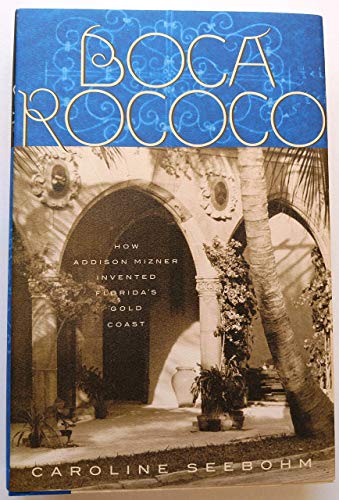
The author recreates the life of the visionary artist and architect who recreated the Palm Beach skyline in the 1920s by catering to the excesses of his wealthy, flamboyant clients. 12,500 first printing.
Die Inhaltsangabe kann sich auf eine andere Ausgabe dieses Titels beziehen.
Über die Autorin bzw. den Autor
Caroline Seebohm is the author of <b>No Regrets: The Life of Marietta Tree</b> and <b>The Man Who Was Vogue: The Life and Times of Condé Nast</b> as well as several illustrated books on art and architecture.
Aus dem Klappentext
ng tale of the artist, adventurer, and visionary whose innovative architecture transformed Palm Beach and whose dramatic rise and fall mirrors the larger-than-life excesses of the 1920s. <br><br>Addison Mizner’s Mediterranean-style mansions―with their stucco walls, tiled roofs, and Moorish accents―are much-admired Florida icons. In <b>Boca Rococo</b>, renowned author and biographer Caroline Seebohm introduces the flamboyant genius behind these pastel palaces.<br><br>Mizner was a leading San Francisco society figure in the 1890s, joined the Alaska Gold Rush, traveled to China, and made his way to an exploding turn-of-the-century New York. No formal training but huge natural talent established him as architect of the rich and famous. The getaways he designed made Palm Beach America’s most elegant resort―and fed his dream of developing a “Venice-on-the-Ocean” in nearby Boca Raton. Mizner’s plans ended with the collapse of Florida’s r
Auszug. © Genehmigter Nachdruck. Alle Rechte vorbehalten.
Chapter 1
"I AM GETTING TO BE A PERFECT CHILD ABOUT YOU."
Tuesday, April 28, 1891. San Francisco.
I Addison Mizner commence a diary at the age of 18 on the above date. I am at present a student at Mr. Bates School, San Rafael. I am not all to geather a bad schollar but my one and most serious faling is my bad spelling as perhapse you will notice before you have read many lines. For the last weeak I have been off on sick leave staying with my Sister Mrs. Horace B. Chase alias Minie Mizner. I came to the city yesterday and hapened to see the president Harison who is visiting San Francisco. He is the most miserable looking dish-faced thing I ever saw.
Thus the young Addison Mizner made his first diary entry, demonstrating his typical candor, brio, and atrocious spelling in an elegant slanting hand. After the description of Benjamin Harrison, Mizner reinforced his impression of the president by drawing a nasty little portrait.
He had always made drawings, in his schoolbooks, on scraps of paper, in letters. The sketches are not always first-rate, particularly his renderings of people, who tend to have too-short arms or legs, but they show a mind receptive to visual impressions, perhaps more so than most school boys of his age. Addison himself does not seem to have found this compulsion significant. Indeed, he spent much of his life avoiding or abandoning the talent that ultimately made him famous.
As for his spelling, it remained hopeless throughout his life (but inventive: "sewerside" for "suicide," as one example). The reason for this failing was his education, which was decidedly spotty. Addison Cairns Mizner was the seventh of eight children (only one of them female, the above-mentioned Minnie, whose real name was Mary Isabella). This meant that his mother was pregnant or just out of pregnancy for roughly sixteen years of her married life. This marathon might have worn down some women, but not Ella Watson Mizner, who could probably have entered a triathlon even after her childbearing years were over. The size of the family did mean, however, that by the time Addison and his younger brother, Wilson, came along, the parental grip on the Mizner boys had weakened, and their education suffered.
Addison's father was Lansing Bond Mizner, the eldest of three children, who started life in Walnut Grove, Illinois, on December 5, 1825. The name Mizner, like its young heir, fell victim to various spellings throughout the nineteenth century. Lansing's grandfather was Lawrence Mizener, who came from Germany and settled in Mendham, New Jersey, in the early 1790s. (Perhaps the best-known American with that name, literary critic and F. Scott Fitzgerald expert Arthur Mizener, was also a descendant of immigrants from Germany.) The name began to lose its first e sometime before Lawrence's death in 1795, for in his will the name is spelled both ways seemingly at random. Lawrence's wife, Sarah, who died in Geneva, New York, in 1820, chose not to use the e, but it lingered for a while and was finally retired for good in the next generation.1
The origins of the name Mizner remain obscure. Much later in his life, Addison was asked by a Palm Beach matron if his name was Jewish. In the anti-Semitic Palm Beach of the 1920s, the suggestion was not pleasing from a career point of view, and while himself having the most eclectic friendships, he denied it. There is no evidence that he was lying. His brother Henry, who became the family genealogist, researched the name in both England and Germany, finding it attached to Protestant families. Not surprisingly, given his interests, Addison had more elevated ambitions for his antecedents, toying with a connection to Meissen, the Dresden porcelain maker, and Juste Meissonier, a leading eighteenth-century French Rococo designer.
The name may have lacked romance, but Addison's American ancestors compensated by becoming prominent members of midwestern society. Lansing's father was Henry Caldwell Mizner, a lawyer in Harrisonville, Illinois, whose two brothers were both generals in the U.S. Army. Henry was born after his father died, and as Henry himself died when Lansing was four, both father and son grew up fatherless. Lansing's mother was Mary Stevenson Cairns, daughter of Dr. Caldwell Cairns, one of the framers of the Illinois constitution, and niece of Shadrach Bond, the first governor. (The Caldwells were Huguenots who had emigrated to Scotland in 1598.) After Henry's death in 1829, Mary married General James Semple, an Illinois politician. In 1837 Semple was appointed minister to New Granada (now Colombia and Panama), and in 1840 Lansing moved with the rest of the family to Bogotá, where he learned to speak fluent Spanish.
Returning to Illinois in 1843 at the age of eighteen, Lansing started law school at Shurtleff College, in Alton, Illinois, but spent only two years there before volunteering for the Mexican War. At the age of twenty, he was appointed captain and commissary agent for his company. According to his proud son Addison, at the critical battle of Buena Vista in February 1847, Lansing was the only man there who could speak both Spanish and English and thus played a vital role in negotiating the Mexican's surrender.2
The young war hero then returned to Illinois, but it seems that after his wartime adventures, life back home palled, for when he received a letter from his stepfather's brother, General Robert Baylor Semple, inviting him to come to the pioneering land of California, he jumped at the chance. Semple was already deeply involved in real estate in Benicia, Solano County, thirty miles north of San Francisco, a fledgling coastal city that for a while held out the promise of becoming the capital of burgeoning California. Benicia was named after the wife of Semple's partner, General Mariano Guadalupe Vallejo, who owned much of the land.
Semple was excited by the potential of the region and wrote to Lansing, "Now, my dear boy, if you have finished your studies and can get to this country, with a small library and your knowledge of the Spanish language, and my influence, you can make ten thousand dollars a year in the practice of law."3 That was a lot of money in those days, and Lansing did not hesitate. Arriving in 1849 by way of New Orleans and Panama, he discovered not only that a large percentage of the male population of Benicia had departed to join the gold rush farther north but that his resourceful stepuncle was working as a printer and a dentist when he was not selling lots in Benicia on the side at eighteen dollars each.4 When Lansing completed his law studies in California (he was admitted to the bar in 1850), he promptly went into business with Semple. His first entrepreneurial step, after purchasing several pieces of land and building a house, was to organize a mule stage to carry passengers from Benicia to Sacramento.5
Lansing Mizner was a handsome, energetic man of imposing height. (All his sons were well over six feet tall.) Boys whose fathers die young assume early responsibilities within the family, and Lansing used this experience to good advantage in the receptive climate of California (which became a state in 1850). His impressive family background of generals, lawyers, diplomats, and politicians gave him entree into high-level state circles, and his fluency in Spanish was a huge advantage in a region where Spanish was the dominant language. He was well liked by his colleagues, and when the Republicans of Solano County recommended that he become lieutenant governor of the state, they described him as "a gentleman of fine talents, splendid address and captivating manners, and . . . one of the most popular public speakers in the State."6...
„Über diesen Titel“ kann sich auf eine andere Ausgabe dieses Titels beziehen.
Weitere beliebte Ausgaben desselben Titels

Suchergebnisse für Boca Rococo: How Addison Mizner Invented Florida's...

Beispielbild für diese ISBN
Boca Rococo: How Addison Mizner Invented Florida's Gold Coast
Verlag:
Clarkson Potter (edition ), 2001
ISBN 10: 0609605151
ISBN 13: 9780609605158
Gebraucht
Hardcover
Anbieter: BooksRun, Philadelphia, PA, USA
Verkäuferbewertung 5 von 5 Sternen

Hardcover. Zustand: Fair. With dust jacket. The item might be beaten up but readable. May contain markings or highlighting, as well as stains, bent corners, or any other major defect, but the text is not obscured in any way. Bestandsnummer des Verkäufers 0609605151-7-1-29
Gebraucht kaufen
EUR 5,34
Versand gratis
Versand innerhalb von USA
Versand innerhalb von USA
Anzahl: 1 verfügbar
Beispielbild für diese ISBN
Boca Rococo : How Addison Mizner Invented Florida's Gold Coast
Verlag:
Crown Publishing Group, The, 2001
ISBN 10: 0609605151
ISBN 13: 9780609605158
Gebraucht
Hardcover
Anbieter: Better World Books, Mishawaka, IN, USA
Verkäuferbewertung 5 von 5 Sternen
Zustand: Good. First Edition Stated / First Printing. Former library copy. Pages intact with minimal writing/highlighting. The binding may be loose and creased. Dust jackets/supplements are not included. Includes library markings. Stock photo provided. Product includes identifying sticker. Better World Books: Buy Books. Do Good. Bestandsnummer des Verkäufers 5361282-6
Gebraucht kaufen
EUR 6,75
Versand gratis
Versand innerhalb von USA
Versand innerhalb von USA
Anzahl: 2 verfügbar
Beispielbild für diese ISBN
Boca Rococo: How Addison Mizner Invented Florida's Gold Coast
Anbieter: ThriftBooks-Dallas, Dallas, TX, USA
Verkäuferbewertung 5 von 5 Sternen
Hardcover. Zustand: Very Good. No Jacket. May have limited writing in cover pages. Pages are unmarked. ~ ThriftBooks: Read More, Spend Less. Bestandsnummer des Verkäufers G0609605151I4N00
Gebraucht kaufen
EUR 7,26
Versand gratis
Versand innerhalb von USA
Versand innerhalb von USA
Anzahl: 1 verfügbar
Beispielbild für diese ISBN
Boca Rococo: How Addison Mizner Invented Florida's Gold Coast
Verlag:
Clarkson Potter October 2001, 2001
ISBN 10: 0609605151
ISBN 13: 9780609605158
Gebraucht
Hardcover
Anbieter: Books End Bookshop, Syracuse, NY, USA
Verkäuferbewertung 4 von 5 Sternen

Hardcover. Zustand: Very Good. Zustand des Schutzumschlags: Very Good. First Edition; First Printing. Spine bumped. Light rubbing on DJ. Embossed by previous owner. ; 9.1 X 6.1 X 1.1 inches; 304 pages. Bestandsnummer des Verkäufers 460091
Gebraucht kaufen
EUR 17,55
EUR 5,11 Versand
Versand innerhalb von USA
Versand innerhalb von USA
Anzahl: 1 verfügbar
Foto des Verkäufers
Boca Rococo; How Addison Mizner Invented Florida's Gold Coast
Verlag:
Clarkson Potter, 2001
ISBN 10: 0609605151
ISBN 13: 9780609605158
Gebraucht
Hardcover
Erstausgabe
Anbieter: Cragsmoor Books, Cragsmoor, NY, USA
Verkäuferbewertung 5 von 5 Sternen
Hardcover. Zustand: Near Fine. Zustand des Schutzumschlags: Near Fine. 1st Edition. Cream bds., blue backstr. w. gilt lettering. Dj. unclipped. Remnant of address sticker on ffep. Frontis. Illus. w. b/w plates. Xvii, 284pp. incl. index. Except for sticker remnants, appears MINT. Bestandsnummer des Verkäufers ABE-1681846534437
Gebraucht kaufen
EUR 21,94
EUR 3,41 Versand
Versand innerhalb von USA
Versand innerhalb von USA
Anzahl: 1 verfügbar
Beispielbild für diese ISBN
Boca Rococo How Addison Mizner Invented Florida's Gold Coast
Verlag:
Clarkson Potter, New York, 2001
ISBN 10: 0609605151
ISBN 13: 9780609605158
Gebraucht
Hardcover
Erstausgabe
Anbieter: Crossroad Books, Eau Claire, WI, USA
Verkäuferbewertung 5 von 5 Sternen
Hardcover. Zustand: Very Good. Zustand des Schutzumschlags: Very Good. First Edition; First Printing. Light bumping on spine extremities. Board corners bumped. Else binding clean. Remainder dot on page top edges. Else pages clean.1/2" chip on top corner of front DJ panel. Light rubbing on DJ spine extremities and fold corners. Else DJ clean. ; B&W Photographs; BIH20D; 284 pages. Bestandsnummer des Verkäufers 55152
Gebraucht kaufen
EUR 23,70
EUR 4,69 Versand
Versand innerhalb von USA
Versand innerhalb von USA
Anzahl: 1 verfügbar
Beispielbild für diese ISBN
Boca Rococo: How Addison Mizner Invented Florida's Gold Coast
Verlag:
Clarkson Potter, 2001
ISBN 10: 0609605151
ISBN 13: 9780609605158
Gebraucht
Hardcover
Erstausgabe
Anbieter: Enterprise Books, Chicago, IL, USA
Verkäuferbewertung 4 von 5 Sternen
Hardcover, illus. Zustand: As New. Zustand des Schutzumschlags: As New. First Edition; First Printing. Book and DJ As New. NO notes No markings of ANY kind. DJ not price clipped ($35) ; 285 pages. Bestandsnummer des Verkäufers 60860
Gebraucht kaufen
EUR 22,39
EUR 6,39 Versand
Versand innerhalb von USA
Versand innerhalb von USA
Anzahl: 1 verfügbar
Beispielbild für diese ISBN
Boca Rococo: How Addison Mizner Invented Florida's Gold Coast
Verlag:
Clarkson Potter, 2001
ISBN 10: 0609605151
ISBN 13: 9780609605158
Gebraucht
Hardcover
Erstausgabe
Anbieter: SELG Inc. Booksellers, New York, NY, USA
Verkäuferbewertung 4 von 5 Sternen
Hardcover. Zustand: Fine. Zustand des Schutzumschlags: Fine. First Edition. Hardcover with dust jacket. Stated First Edition. 1st printing (complete number line). Clean and tight. No markings. Illustrated with black and white photographs. Ships in a box. Fast shipping from NYC! Bestandsnummer des Verkäufers 071820203
Gebraucht kaufen
EUR 43,88
EUR 3,40 Versand
Versand innerhalb von USA
Versand innerhalb von USA
Anzahl: 1 verfügbar
Beispielbild für diese ISBN
Boca Rococo: How Addison Mizner Invented Florida's Gold Coast
Verlag:
Clarkson Potter, U.S.A., 2001
ISBN 10: 0609605151
ISBN 13: 9780609605158
Gebraucht
Hardcover
Erstausgabe
Signiert
Anbieter: Sellsbooks, Indio, CA, USA
Verkäuferbewertung 5 von 5 Sternen
Hardcover. Zustand: As New. Zustand des Schutzumschlags: As New. 1st Edition. First Printing. Flat-signed by author on Title page with NO inscription. Mottled tan and blue paper boards with gold foil-stamped spine. AS NEW & UNREAD. NO flaws - NO rem mark or ex-lib. Includes numerous B&W glossy pictures. DJ is AS NEW and also has NO Flaws. Price intact: $35.00. Signed by Author(s). Bestandsnummer des Verkäufers 003530
Gebraucht kaufen
EUR 43,88
EUR 4,47 Versand
Versand innerhalb von USA
Versand innerhalb von USA
Anzahl: 1 verfügbar
Beispielbild für diese ISBN
Boca Rococo: How Addison Mizner Invented Florida's Gold Coast
Anbieter: GoldBooks, Denver, CO, USA
Verkäuferbewertung 5 von 5 Sternen
Hardcover. Zustand: new. New Copy. Customer Service Guaranteed. Bestandsnummer des Verkäufers 96V55_22_0609605151
Neu kaufen
EUR 55,42
EUR 4,69 Versand
Versand innerhalb von USA
Versand innerhalb von USA
Anzahl: 1 verfügbar