
Verwandte Artikel zu The Craft of the Cocktail: Everything You Need to Know...
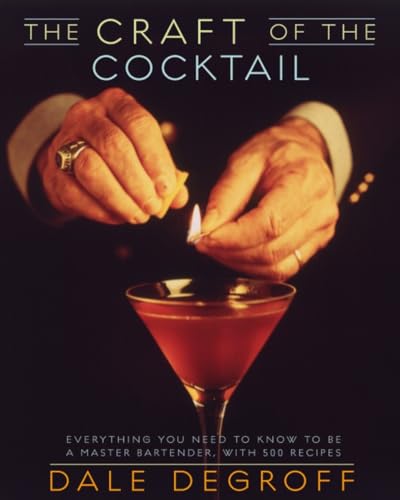
The Craft of the Cocktail: Everything You Need to Know to Be a Master Bartender, with 500 Recipes - Hardcover
Inhaltsangabe
The first real cookbook for cocktails, featuring 500 recipes from the world's premier mixologist, Dale DeGroff.
Covering the entire breadth of this rich subject, The Craft of the Cocktail provides much more than merely the same old recipes: it delves into history, personalities, and anecdotes; it shows you how to set up a bar, master important techniques, and use tools correctly; and it delivers unique concoctions, many featuring DeGroff’s signature use of fresh juices, as well as all the classics.
It begins with the history of spirits, how they’re made (but without too much boring science), the development of the mixed drink, and the culture it created, all drawn from DeGroff’s vast library of vintage cocktail books. Then on to stocking the essential bar, choosing the right tools and ingredients, and mastering key techniques—the same information that DeGroff shares with the bartenders he trains in seminars and through his videos. And then the meat of the matter: 500 recipes, including everything from tried-and-true classics to of-the-moment originals. Throughout are rich stories, vintage recipes, fast facts, and other entertaining asides.
Beautiful color photographs and a striking design round out the cookbook approach to this subject, highlighting the difference between an under-the-bar handbook and a stylish, full-blown treatment. The Craft of the Cocktail is that treatment, destined to become the bible of the bar.
Die Inhaltsangabe kann sich auf eine andere Ausgabe dieses Titels beziehen.
Über die Autorin bzw. den Autor
DALE DeGROFF has been called “the Billy Graham of the holy spirits” by the London Tribune and “a master” by Martha Stewart, and is widely acknowledged to be the preeminent mixologist in the world. He’s been featured in dozens of magazines and newspapers, including The New York Times, The New Yorker, GQ, Entertainment Weekly, Penthouse, Food & Wine, and Forbes; his television appearances include Martha Stewart Living and Today. For twelve years, Dale ran the bar at New York City’s Rainbow Room and now serves as a consultant for such top restaurants as Balthazar. He has taught at the Culinary Institute of America (and stars in their bartending video) and the Institute for Culinary Education, among other venues. Dale grew up in Westerly, Rhode Island, and now lives on Long Island.
Visit Dale DeGroff at www.kingcocktail.com.
Von der hinteren Coverseite
Cocktails are bigger than ever, and this is the first real cookbook for them, covering the entire breadth of this rich subject. The Craft of the Cocktail provides much more than merely the same old recipes: it delves into history, personalities, and anecdotes; it shows you how to set up a bar, master important techniques, and use tools correctly; and it delivers unique concoctions, many featuring Dale DeGroff's signature use of fresh juices, as well as all the classics.
Aus dem Klappentext
e bigger than ever, and this is the first real cookbook for them, covering the entire breadth of this rich subject. The Craft of the Cocktail provides much more than merely the same old recipes: it delves into history, personalities, and anecdotes; it shows you how to set up a bar, master important techniques, and use tools correctly; and it delivers unique concoctions, many featuring Dale DeGroff s signature use of fresh juices, as well as all the classics.
Debonair, a great raconteur, and an unparalleled authority, Dale DeGroff is the epitome of Perfect Bartender, universally acknowledged as the world s premier mixologist. From Entertainment Weekly and USA Today to the Culinary Institute of America and the nation s best restaurants, whenever anybody wants information or training on the bar, they turn to Dale for recipes, for history, for anecdotes, for fun for cocktail-party conversation as well as for cocktails.
That s what The Craft of the Co
Auszug. © Genehmigter Nachdruck. Alle Rechte vorbehalten.
THE HISTORY OF THE COCKTAIL
I learned abut cocktails much the same way I learned to tend bar. Certainly through research, but mainly through experience.
My fellow bartenders taught me how to treat people, my customers taught me about life, and most important, my mentor, the great restaurateur Joe Baum, taught me how little I knew. Joe sparked my curiosity to find out what makes a great cocktail.
The cocktail is, in a word, American. It's as American as jazz, apple pie, and baseball; and as diverse, colorful, and big as America itself. Indeed, it could even be argued that the cocktail is a metaphor for the American people: It is a composite beverage, and we are a composite people. Let's begin by looking at what preceded its invention.
The early days
Before Europeans settled in America, they had been cultivating beverage traditions for centuries. Southern Europeans, around the Mediterranean, produced wine and brandy, while distilled-grain spirits were part of the tradition and culture of the peoples who inhabited the northern tier of Europe, where it was too cold for wine grapes to grow. Interestingly, the distillates produced with fermented grape and grain mash were also revered for their "medicinal" qualities, and came be known as aqua vitae in Latin, eau-de-vie in French, usquebaugh in Gaelic, and "water of life" in English. Naturally, as the technology of distilled spirits from grain and grape advanced, water of life could be produced more cheaply and in greater quantities, and eventually it was used to produce flavored cordials and liqueurs.
Once the Europeans established themselves on this side of the Atlantic, they put to good use the beer- and wine-making skills they had brought with them from the Old World. They also brought the Old World opinion that drinking water was unwholesome, even dangerous. The early colonists were voracious experimenters, fermenting beverages from practically everything they could get their hands on: pumpkins, parsnips, turnips, rhubarbs, walnuts, elderberries, and more. They flavored their beer with birch, pine, spruce, and sassafras. They planted apple orchards everywhere from Virginia northward to produce cider and, more important, applejack, which provided the base for many early colonial drinks. Applejack was also popular because it could be made without the use of expensive distilling equipment. Fermented apple juice, or hard cider as it was called, was left out in the cold in late fall and early winter. As layers of ice formed on the surface of the cider, they were skimmed off, removing the water content and thus concentrating the alcohol in the remaining liquid.
Conversely, as trade between the Old and New worlds increased, Europe in turn discovered the plants and botanicals that the colonists were well on their way to exploiting. As early as 1571, a Spanish doctor named Nicolas Monardes published a document describing plants and medicines from the Americas that were being assimilated into daily life all over Europe. In Italy and France, these plants eventually found their way into fortified and flavored wines, such as vermouth and other apéritif wines. Ironically, these products made their way full-circle across the Atlantic, where they later played a pivotal role in the growth of the cocktail tradition.
That cocktail tradition began with rum. Distilling spirits began commercially in the New World in 1640 when Wilhelm Kieft, the director-general of New Amsterdam (now Manhattan), erected the first still in which to distill gin and a tavern in which to sell it. When Manhattan fell into the hands of the English, the still was used to make rum, the first internationally accepted spirit of the New World. But truth be told, rum was sort of an accident. Christopher Columbus introduced sugarcane to our hemisphere on his second voyage for the purpose, of course, of making sugar. Rum was made by the ever-industrious colonists as a way to utilize the molasses left over from sugar production-that is, rum was a by-product of sugar. But by the end of the seventeenth century, rum production dwarfed sugar production to such an extent that the British enacted laws requiring that a certain proportion of all sugarcane crops must be used to make actual sugar. Rum had become the base for many colonial beverages, especially punches, and was produced throughout the Caribbean, South America, and to a great extent even in New England.
The production of rum fueled the growing economy. By 1733 it surpassed all other exports from the colonies. At the time, New England rum distillers were purchasing the molasses from the cheapest sources in the Caribbean, which were more often than not French and Portuguese. As a result, the British rum distillers who were sourcing their own molasses were losing a market share to the upstart colonial distillers and their cheaper molasses, and hence cheaper rum. In retribution, the British passed the Molasses Act of 1733 to control and tax the flow of molasses into the colonies. The Sugar Act followed, and then in 1765 the Stamp Act, which required the use of a tax stamp on all transactions. These acts led to the founding of the First Continental Congress, and eventually to the Revolutionary War. So, you see, it was rum, not tea, that precipitated our break from Great Britain. (Well, maybe there were a few other minor concerns, but this is a book about cocktails, not textiles.)
The American victory over the British left the new republic deep in debt. To the astonishment of most of his colleagues in the new government, Alexander Hamilton, our first Secretary of the Treasury, decided to pay our war debts quickly by way of a federal excise tax on rum and spirits, which was passed by the Congress in 1791 and signed into law by President George Washington. Thus began the tradition of paying for our wars by taxing our spirits. This would prove handy when, just twenty years later, the new nation found itself at war again with Great Britain in 1812. For the second time in the nation's brief history, the British blockaded our coastline, cutting off trade with molasses producers in the Caribbean and all but finishing the dwindling rum distilleries. This led to a tidal increase in the domestic production of grain spirits, and eventually to the birth of the second American spirit, bourbon, our all-American corn whiskey.
It was also during the period between these two wars that the word cocktail seems to have come into use. If you ambled into a colonial New England inn for a cold one, or just as likely a hot one, you'd probably order a ratafia, shrub, turnip wine, posset, pope, bishop, sack, flip, or an ale. Are any of these cocktails? Not really. But they were the progenitors of the cocktail, which made its official debut in print in 1806 in a publication called The Balance and Columbian Repository. In a letter to the editor, a reader had queried the meaning of a new word, cocktail. The editor wrote back:
"Cocktail is a stimulating liquor, composed of spirits of any kind, sugar, water and bitters. It is vulgarly called a bittered sling and is supposed to be an excellent electioneering potion, in as much as it renders the heart stout and bold, at the same time that it fuddles the head . . . It is said also, to be of great use to a Democratic candidate because, a person having swallowed a glass of it, is ready to swallow anything else."
The sarcastic last line of that reply addresses the practice of plying voters with alcohol, a tradition said to have begun with George Washington that did not end officially until Prohibition. The editor's reply also gives us for the first time a clear distinction between what constitutes a cocktail and separates it from all the concoctions that came before it: the addition of bitters. Bitters is a generic term for alcoholic beverages distilled or infused with plant or root extracts....
„Über diesen Titel“ kann sich auf eine andere Ausgabe dieses Titels beziehen.
Suchergebnisse für The Craft of the Cocktail: Everything You Need to Know...

Beispielbild für diese ISBN
The Craft of the Cocktail: Eve
Anbieter: World of Books (was SecondSale), Montgomery, IL, USA
Verkäuferbewertung 5 von 5 Sternen

Zustand: Acceptable. Item in acceptable condition! Textbooks may not include supplemental items i.e. CDs, access codes etc. Bestandsnummer des Verkäufers 00104363882
Gebraucht kaufen
EUR 5,07
Versand gratis
Versand innerhalb von USA
Versand innerhalb von USA
Anzahl: 2 verfügbar
Foto des Verkäufers
The Craft of the Cocktail: Everything You Need to Know to Be a Master Bartender, with 500 Recipes
Anbieter: Greenworld Books, Arlington, TX, USA
Verkäuferbewertung 5 von 5 Sternen
Zustand: very_good. Fast Free Shipping â" Very Good condition book with a firm cover and clean pages. Shows normal use and some light wear or limited notes markings. A solid, nice copy to enjoy. Bestandsnummer des Verkäufers GWV.0609608754.VG
Gebraucht kaufen
EUR 5,08
Versand gratis
Versand innerhalb von USA
Versand innerhalb von USA
Anzahl: 1 verfügbar
Beispielbild für diese ISBN
The Craft of the Cocktail: Everything You Need to Know to Be a Master Bartender, with 500 Recipes
Anbieter: Evergreen Goodwill, Seattle, WA, USA
Verkäuferbewertung 5 von 5 Sternen
hardcover. Zustand: Acceptable. Bestandsnummer des Verkäufers mon0000724759
Gebraucht kaufen
EUR 2,07
EUR 3,49 Versand
Versand innerhalb von USA
Versand innerhalb von USA
Anzahl: 1 verfügbar
Foto des Verkäufers
The Craft of the Cocktail: Everything You Need to Know to Be a Master Bartender, with 500 Recipes
Anbieter: 2nd Life Books, Burlington, NJ, USA
Verkäuferbewertung 5 von 5 Sternen
Zustand: very_good. Used book in very good condition. May have some minor wear. May NOT include discs, or access code or other supplemental material. Ships directly from Amazon and is eligible for Prime or super saver FREE shipping. We ship Monday-Saturday and respond to inquiries within 24 hours. Bestandsnummer des Verkäufers BXM.EO4U
Gebraucht kaufen
EUR 2,60
EUR 3,49 Versand
Versand innerhalb von USA
Versand innerhalb von USA
Anzahl: 1 verfügbar
Beispielbild für diese ISBN
The Craft of the Cocktail: Everything You Need to Know to Be a Master Bartender, with 500 Recipes
Anbieter: Evergreen Goodwill, Seattle, WA, USA
Verkäuferbewertung 5 von 5 Sternen
hardcover. Zustand: Good. Bestandsnummer des Verkäufers mon0000118388
Gebraucht kaufen
EUR 2,70
EUR 3,49 Versand
Versand innerhalb von USA
Versand innerhalb von USA
Anzahl: 1 verfügbar
Beispielbild für diese ISBN
The Craft of the Cocktail: Everything You Need to Know to Be a Master Bartender, with 500 Recipes
Verlag:
Clarkson Potter Publishers, 2002
ISBN 10: 0609608754
ISBN 13: 9780609608753
Gebraucht
Hardcover
Anbieter: ThriftBooks-Reno, Reno, NV, USA
Verkäuferbewertung 5 von 5 Sternen
Hardcover. Zustand: Fair. No Jacket. Readable copy. Pages may have considerable notes/highlighting. ~ ThriftBooks: Read More, Spend Less. Bestandsnummer des Verkäufers G0609608754I5N00
Gebraucht kaufen
EUR 6,28
Versand gratis
Versand innerhalb von USA
Versand innerhalb von USA
Anzahl: 1 verfügbar
Beispielbild für diese ISBN
The Craft of the Cocktail: Everything You Need to Know to Be a Master Bartender, with 500 Recipes
Verlag:
Clarkson Potter Publishers, 2002
ISBN 10: 0609608754
ISBN 13: 9780609608753
Gebraucht
Hardcover
Anbieter: ThriftBooks-Dallas, Dallas, TX, USA
Verkäuferbewertung 5 von 5 Sternen
Hardcover. Zustand: Fair. No Jacket. Missing dust jacket; Readable copy. Pages may have considerable notes/highlighting. ~ ThriftBooks: Read More, Spend Less. Bestandsnummer des Verkäufers G0609608754I5N01
Gebraucht kaufen
EUR 6,28
Versand gratis
Versand innerhalb von USA
Versand innerhalb von USA
Anzahl: 1 verfügbar
Beispielbild für diese ISBN
The Craft of the Cocktail: Everything You Need to Know to Be a Master Bartender, with 500 Recipes
Verlag:
Clarkson Potter Publishers, 2002
ISBN 10: 0609608754
ISBN 13: 9780609608753
Gebraucht
Hardcover
Anbieter: ThriftBooks-Reno, Reno, NV, USA
Verkäuferbewertung 5 von 5 Sternen
Hardcover. Zustand: Good. No Jacket. Missing dust jacket; Pages can have notes/highlighting. Spine may show signs of wear. ~ ThriftBooks: Read More, Spend Less. Bestandsnummer des Verkäufers G0609608754I3N01
Gebraucht kaufen
EUR 6,28
Versand gratis
Versand innerhalb von USA
Versand innerhalb von USA
Anzahl: 4 verfügbar
Beispielbild für diese ISBN
The Craft of the Cocktail: Everything You Need to Know to Be a Master Bartender, with 500 Recipes
Verlag:
Clarkson Potter Publishers, 2002
ISBN 10: 0609608754
ISBN 13: 9780609608753
Gebraucht
Hardcover
Anbieter: ThriftBooks-Reno, Reno, NV, USA
Verkäuferbewertung 5 von 5 Sternen
Hardcover. Zustand: Very Good. No Jacket. Missing dust jacket; May have limited writing in cover pages. Pages are unmarked. ~ ThriftBooks: Read More, Spend Less. Bestandsnummer des Verkäufers G0609608754I4N01
Gebraucht kaufen
EUR 6,28
Versand gratis
Versand innerhalb von USA
Versand innerhalb von USA
Anzahl: 3 verfügbar
Beispielbild für diese ISBN
The Craft of the Cocktail: Everything You Need to Know to Be a Master Bartender, with 500 Recipes
Verlag:
Clarkson Potter Publishers, 2002
ISBN 10: 0609608754
ISBN 13: 9780609608753
Gebraucht
Hardcover
Anbieter: ThriftBooks-Atlanta, AUSTELL, GA, USA
Verkäuferbewertung 5 von 5 Sternen
Hardcover. Zustand: Good. No Jacket. Pages can have notes/highlighting. Spine may show signs of wear. ~ ThriftBooks: Read More, Spend Less. Bestandsnummer des Verkäufers G0609608754I3N00
Gebraucht kaufen
EUR 6,28
Versand gratis
Versand innerhalb von USA
Versand innerhalb von USA
Anzahl: 5 verfügbar