
Verwandte Artikel zu Mao's Last Revolution
Inhaltsangabe
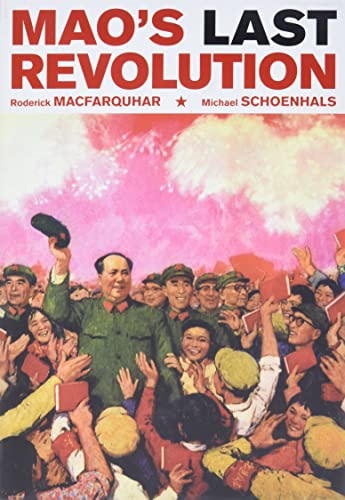
Chairman Mao's role in masterminding China's Cultural Revolution and why he did it is explained in a detailed portrait that offers the most authoritative account to date of the events, personalities, and repercussions of the period.
Die Inhaltsangabe kann sich auf eine andere Ausgabe dieses Titels beziehen.
Über die Autorinnen und Autoren
Roderick MacFarquhar was Leroy B. Williams Professor of History and Political Science, and Professor of Government, Harvard University.
Michael Schoenhals is Professor of Chinese at Chinese Lund University, Sweden.
„Über diesen Titel“ kann sich auf eine andere Ausgabe dieses Titels beziehen.
Suchergebnisse für Mao's Last Revolution

Beispielbild für diese ISBN
Mao's Last Revolution
Verlag:
Harvard University Press, 2008
ISBN 10: 0674027485
ISBN 13: 9780674027480
Gebraucht
Paperback
Anbieter: World of Books (was SecondSale), Montgomery, IL, USA
Verkäuferbewertung 5 von 5 Sternen

Paperback. Zustand: Fair. The authors explain why Mao launched the Cultural Revolution, and show his Machiavellian role in masterminding it (which Chinese publications conceal). In its critical analysis of Chairman Mao and its portrait of a culture in turmoil, this book offers the most authoritative and compelling account to date of this seminal event in Chinese history. Bestandsnummer des Verkäufers 00109928480
Gebraucht kaufen
EUR 18,28
Versand gratis
Versand innerhalb von USA
Versand innerhalb von USA
Anzahl: 1 verfügbar
Beispielbild für diese ISBN
Mao's Last Revolution
Verlag:
Belknap Press: An Imprint of Harvard University Press, 2008
ISBN 10: 0674027485
ISBN 13: 9780674027480
Gebraucht
Soft cover
Anbieter: Tim's Used Books Provincetown Mass., Provincetown, MA, USA
Verkäuferbewertung 5 von 5 Sternen
Soft cover. Zustand: Very Good. No marks in text. Not a library book. Ships today in a cardboard enclosure, with tracking. One copy only of this title at this price. The book you see listed here is the book you'll receive. Tim's Used Books, open shop in Provincetown, Mass., recognized for great books and great service since 1991. shelf LL/second from right. Bestandsnummer des Verkäufers 2691410
Gebraucht kaufen
EUR 13,79
EUR 5,80 Versand
Versand innerhalb von USA
Versand innerhalb von USA
Anzahl: 1 verfügbar
Beispielbild für diese ISBN
Mao's Last Revolution
Verlag:
Harvard University Press, 2008
ISBN 10: 0674027485
ISBN 13: 9780674027480
Gebraucht
Paperback
Anbieter: World of Books Inc, Montgomery, IL, USA
Verkäuferbewertung 4 von 5 Sternen

Paperback. Zustand: Fair. The authors explain why Mao launched the Cultural Revolution, and show his Machiavellian role in masterminding it (which Chinese publications conceal). In its critical analysis of Chairman Mao and its portrait of a culture in turmoil, this book offers the most authoritative and compelling account to date of this seminal event in Chinese history. Bestandsnummer des Verkäufers CIN0674027485A
Gebraucht kaufen
EUR 20,12
Versand gratis
Versand innerhalb von USA
Versand innerhalb von USA
Anzahl: 1 verfügbar
Beispielbild für diese ISBN
Mao's Last Revolution
Anbieter: ThriftBooks-Atlanta, AUSTELL, GA, USA
Verkäuferbewertung 5 von 5 Sternen
Paperback. Zustand: Very Good. No Jacket. Former library book; May have limited writing in cover pages. Pages are unmarked. ~ ThriftBooks: Read More, Spend Less. Bestandsnummer des Verkäufers G0674027485I4N10
Gebraucht kaufen
EUR 21,96
Versand gratis
Versand innerhalb von USA
Versand innerhalb von USA
Anzahl: 1 verfügbar
Beispielbild für diese ISBN
Maoâs Last Revolution
Verlag:
Belknap Press: An Imprint of Har, 2008
ISBN 10: 0674027485
ISBN 13: 9780674027480
Gebraucht
Paperback
Anbieter: HPB-Red, Dallas, TX, USA
Verkäuferbewertung 5 von 5 Sternen
Paperback. Zustand: Good. Connecting readers with great books since 1972! Used textbooks may not include companion materials such as access codes, etc. May have some wear or writing/highlighting. We ship orders daily and Customer Service is our top priority! Bestandsnummer des Verkäufers S_484019760
Gebraucht kaufen
EUR 20,21
EUR 3,35 Versand
Versand innerhalb von USA
Versand innerhalb von USA
Anzahl: 1 verfügbar
Beispielbild für diese ISBN
Mao's Last Revolution
Verlag:
Harvard University Press, 2008
ISBN 10: 0674027485
ISBN 13: 9780674027480
Gebraucht
Softcover
Anbieter: Better World Books, Mishawaka, IN, USA
Verkäuferbewertung 5 von 5 Sternen
Zustand: Very Good. Pages intact with possible writing/highlighting. Binding strong with minor wear. Dust jackets/supplements may not be included. Stock photo provided. Product includes identifying sticker. Better World Books: Buy Books. Do Good. Bestandsnummer des Verkäufers 18463059-6
Gebraucht kaufen
EUR 27,08
Versand gratis
Versand innerhalb von USA
Versand innerhalb von USA
Anzahl: 1 verfügbar
Foto des Verkäufers
Mao's Last Revolution
Verlag:
Belknap Press: An Imprint of Harvard University Press, 2008
ISBN 10: 0674027485
ISBN 13: 9780674027480
Gebraucht
Softcover
Anbieter: GreatBookPrices, Columbia, MD, USA
Verkäuferbewertung 5 von 5 Sternen
Zustand: As New. Unread book in perfect condition. Bestandsnummer des Verkäufers 5421672
Gebraucht kaufen
EUR 33,42
EUR 2,36 Versand
Versand innerhalb von USA
Versand innerhalb von USA
Anzahl: Mehr als 20 verfügbar
Foto des Verkäufers
Mao's Last Revolution
Verlag:
Belknap Press: An Imprint of Harvard University Press, 2008
ISBN 10: 0674027485
ISBN 13: 9780674027480
Neu
Softcover
Anbieter: GreatBookPrices, Columbia, MD, USA
Verkäuferbewertung 5 von 5 Sternen
Zustand: New. Bestandsnummer des Verkäufers 5421672-n
Neu kaufen
EUR 35,17
EUR 2,36 Versand
Versand innerhalb von USA
Versand innerhalb von USA
Anzahl: Mehr als 20 verfügbar
Beispielbild für diese ISBN
Maos Last Revolution (Paperback)
Verlag:
Harvard University Press, Cambridge, Mass., 2008
ISBN 10: 0674027485
ISBN 13: 9780674027480
Neu
Paperback
Anbieter: Grand Eagle Retail, Bensenville, IL, USA
Verkäuferbewertung 5 von 5 Sternen
Paperback. Zustand: new. Paperback. The Cultural Revolution was a watershed event in the history of the People's Republic of China, the defining decade of half a century of communist rule. Before 1966, China was a typical communist state, with a command economy and a powerful party able to keep the population under control. But during the Cultural Revolution, in a move unprecedented in any communist country, Mao unleashed the Red Guards against the party. Tens of thousands of officials were humiliated, tortured, and even killed. Order had to be restored by the military, whose methods were often equally brutal. In a masterly book, Roderick MacFarquhar and Michael Schoenhals explain why Mao launched the Cultural Revolution, and show his Machiavellian role in masterminding it (which Chinese publications conceal). In often horrifying detail, they document the Hobbesian state that ensued. The movement veered out of control and terror paralyzed the country. Power struggles raged among Lin Biao, Zhou Enlai, Deng Xiaoping, and Jiang Qing-Mao's wife and leader of the Gang of Four-while Mao often played one against the other.After Mao's death, in reaction to the killing and the chaos, Deng Xiaoping led China into a reform era in which capitalism flourishes and the party has lost its former authority. In its invaluable critical analysis of Chairman Mao and its brilliant portrait of a culture in turmoil, Mao's Last Revolution offers the most authoritative and compelling account to date of this seminal event in the history of China. The authors explain why Mao launched the Cultural Revolution, and show his Machiavellian role in masterminding it (which Chinese publications conceal). In its critical analysis of Chairman Mao and its portrait of a culture in turmoil, this book offers the most authoritative and compelling account to date of this seminal event in Chinese history. Shipping may be from multiple locations in the US or from the UK, depending on stock availability. Bestandsnummer des Verkäufers 9780674027480
Foto des Verkäufers
Mao's Last Revolution
Anbieter: Rarewaves.com USA, London, LONDO, Vereinigtes Königreich
Verkäuferbewertung 5 von 5 Sternen
Paperback. Zustand: New. The Cultural Revolution was a watershed event in the history of the People's Republic of China, the defining decade of half a century of communist rule. Before 1966, China was a typical communist state, with a command economy and a powerful party able to keep the population under control. But during the Cultural Revolution, in a move unprecedented in any communist country, Mao unleashed the Red Guards against the party. Tens of thousands of officials were humiliated, tortured, and even killed. Order had to be restored by the military, whose methods were often equally brutal. In a masterly book, Roderick MacFarquhar and Michael Schoenhals explain why Mao launched the Cultural Revolution, and show his Machiavellian role in masterminding it (which Chinese publications conceal). In often horrifying detail, they document the Hobbesian state that ensued. The movement veered out of control and terror paralyzed the country. Power struggles raged among Lin Biao, Zhou Enlai, Deng Xiaoping, and Jiang Qing-Mao's wife and leader of the Gang of Four-while Mao often played one against the other.After Mao's death, in reaction to the killing and the chaos, Deng Xiaoping led China into a reform era in which capitalism flourishes and the party has lost its former authority. In its invaluable critical analysis of Chairman Mao and its brilliant portrait of a culture in turmoil, Mao's Last Revolution offers the most authoritative and compelling account to date of this seminal event in the history of China. Bestandsnummer des Verkäufers LU-9780674027480
Neu kaufen
EUR 39,03
Versand gratis
Versand von Vereinigtes Königreich nach USA
Versand von Vereinigtes Königreich nach USA
Anzahl: Mehr als 20 verfügbar