
Verwandte Artikel zu Disaster Drawn: Visual Witness, Comics, and Documentary...
Inhaltsangabe
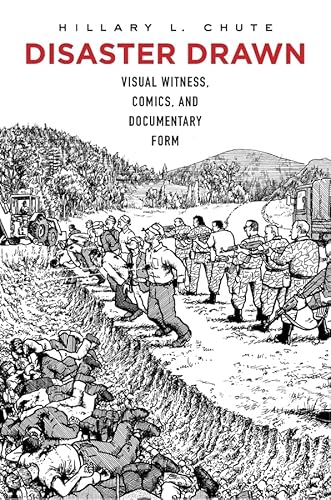
In hard-hitting accounts of Auschwitz, Bosnia, Palestine, and Hiroshima’s Ground Zero, comics display a stunning capacity to bear witness to trauma. Investigating how hand-drawn comics has come of age as a serious medium for engaging history, Disaster Drawn explores the ways graphic narratives by diverse artists, including Jacques Callot, Francisco Goya, Keiji Nakazawa, Art Spiegelman, and Joe Sacco, document the disasters of war.
Hillary L. Chute traces how comics inherited graphic print traditions and innovations from the seventeenth century and later, pointing out that at every turn new forms of visual-verbal representation have arisen in response to the turmoil of war. Modern nonfiction comics emerged from the shattering experience of World War II, developing in the 1970s with Art Spiegelman’s first “Maus” story about his immigrant family’s survival of Nazi death camps and with Hiroshima survivor Keiji Nakazawa’s inaugural work of “atomic bomb manga,” the comic book Ore Wa Mita (“I Saw It”)—a title that alludes to Goya’s famous Disasters of War etchings.
Chute explains how the form of comics—its collection of frames—lends itself to historical narrative. By interlacing multiple temporalities over the space of the page or panel, comics can place pressure on conventional notions of causality. Aggregating and accumulating frames of information, comics calls attention to itself as evidence. Disaster Drawn demonstrates why, even in the era of photography and film, people understand hand-drawn images to be among the most powerful forms of historical witness.
Die Inhaltsangabe kann sich auf eine andere Ausgabe dieses Titels beziehen.
Über die Autorin bzw. den Autor
Hillary L. Chute is Professor of English at Northeastern University.
Von der hinteren Coverseite
In hard-hitting accounts of Auschwitz, Bosnia, Palestine, and Hiroshima’s Ground Zero, comics have shown a stunning capacity to bear witness to trauma. Hillary Chute explores the ways graphic narratives by diverse artists, including Jacques Callot, Francisco Goya, Keiji Nakazawa, Art Spiegelman, and Joe Sacco, document the disasters of war.
„Über diesen Titel“ kann sich auf eine andere Ausgabe dieses Titels beziehen.
Suchergebnisse für Disaster Drawn: Visual Witness, Comics, and Documentary...

Foto des Verkäufers
Disaster Drawn: Visual Witness, Comics, and Documentary Form
ISBN 10: 0674504518
ISBN 13: 9780674504516
Gebraucht
Hardcover
Erstausgabe
Anbieter: Books & Bidders, Cleveland, OH, USA
Verkäuferbewertung 5 von 5 Sternen

Hardcover. Zustand: Fine. Zustand des Schutzumschlags: Fine. First Edition. Grey cloth, silver gilt title in unclipped, mylar protected dust-jacket, (9.5 x 6.5 inches). First Edition/First Printing (First Printing stated on copyright page). 359 pages with extensive Notes and Index; color illustrations. This book is a critical study of the nature of trauma in visual narrative; it is a major work in comic studies. A clean, tight copy. Bestandsnummer des Verkäufers 007250
Gebraucht kaufen
EUR 36,17
Versand gratis
Versand innerhalb von USA
Versand innerhalb von USA
Anzahl: 1 verfügbar
Beispielbild für diese ISBN
Disaster Drawn
Anbieter: PBShop.store UK, Fairford, GLOS, Vereinigtes Königreich
Verkäuferbewertung 5 von 5 Sternen
HRD. Zustand: New. New Book. Shipped from UK. Established seller since 2000. Bestandsnummer des Verkäufers WH-9780674504516
Neu kaufen
EUR 39,18
EUR 6,83 Versand
Versand von Vereinigtes Königreich nach USA
Versand von Vereinigtes Königreich nach USA
Anzahl: 2 verfügbar
Beispielbild für diese ISBN
Disaster Drawn
Anbieter: Kennys Bookshop and Art Galleries Ltd., Galway, GY, Irland
Verkäuferbewertung 5 von 5 Sternen
Zustand: New. In hard-hitting accounts of Auschwitz, Bosnia, Palestine, and Hiroshima s Ground Zero, comics have shown a stunning capacity to bear witness to trauma. Hillary Chute explores the ways graphic narratives by diverse artists, including Jacques Callot, Francisco Goya, Keiji Nakazawa, Art Spiegelman, and Joe Sacco, document the disasters of war." Num Pages: 336 pages. BIC Classification: AKLC; FZG; JW. Category: (G) General (US: Trade). . . 2016. Hardcover. . . . . Bestandsnummer des Verkäufers V9780674504516
Neu kaufen
EUR 38,21
EUR 9,50 Versand
Versand von Irland nach USA
Versand von Irland nach USA
Anzahl: 1 verfügbar
Beispielbild für diese ISBN
Disaster Drawn Visual Witness, Comics, and Documentary Form
Anbieter: Revaluation Books, Exeter, Vereinigtes Königreich
Verkäuferbewertung 5 von 5 Sternen
Hardcover. Zustand: Brand New. 336 pages. 9.50x6.50x1.25 inches. In Stock. Bestandsnummer des Verkäufers __0674504518
Neu kaufen
EUR 42,81
EUR 14,53 Versand
Versand von Vereinigtes Königreich nach USA
Versand von Vereinigtes Königreich nach USA
Anzahl: 1 verfügbar
Beispielbild für diese ISBN
Disaster Drawn
Anbieter: Kennys Bookstore, Olney, MD, USA
Verkäuferbewertung 5 von 5 Sternen
Zustand: New. In hard-hitting accounts of Auschwitz, Bosnia, Palestine, and Hiroshima s Ground Zero, comics have shown a stunning capacity to bear witness to trauma. Hillary Chute explores the ways graphic narratives by diverse artists, including Jacques Callot, Francisco Goya, Keiji Nakazawa, Art Spiegelman, and Joe Sacco, document the disasters of war." Num Pages: 336 pages. BIC Classification: AKLC; FZG; JW. Category: (G) General (US: Trade). . . 2016. Hardcover. . . . . Books ship from the US and Ireland. Bestandsnummer des Verkäufers V9780674504516
Neu kaufen
EUR 48,17
EUR 9,22 Versand
Versand innerhalb von USA
Versand innerhalb von USA
Anzahl: 1 verfügbar
Beispielbild für diese ISBN
Disaster Drawn: Visual Witness, Comics, and Documentary Form
Verlag:
Belknap Press: An Imprint of Harvard University Press, 2016
ISBN 10: 0674504518
ISBN 13: 9780674504516
Neu
Hardcover
Anbieter: Ria Christie Collections, Uxbridge, Vereinigtes Königreich
Verkäuferbewertung 5 von 5 Sternen
Zustand: New. In English. Bestandsnummer des Verkäufers ria9780674504516_new
Neu kaufen
EUR 46,63
EUR 13,13 Versand
Versand von Vereinigtes Königreich nach USA
Versand von Vereinigtes Königreich nach USA
Anzahl: Mehr als 20 verfügbar
Beispielbild für diese ISBN
Disaster Drawn: Visual Witness, Comics, and Documentary Form
Anbieter: THE SAINT BOOKSTORE, Southport, Vereinigtes Königreich
Verkäuferbewertung 5 von 5 Sternen
Hardback. Zustand: New. New copy - Usually dispatched within 4 working days. Bestandsnummer des Verkäufers B9780674504516
Neu kaufen
EUR 39,20
EUR 21,95 Versand
Versand von Vereinigtes Königreich nach USA
Versand von Vereinigtes Königreich nach USA
Anzahl: 4 verfügbar
Beispielbild für diese ISBN
Disaster Drawn; Visual Witness, Comics, and Documentary Form
Anbieter: BWS BKS, Ferndale, NY, USA
Verkäuferbewertung 2 von 5 Sternen

Hardcover. Zustand: New. Bestandsnummer des Verkäufers 115338
Neu kaufen
EUR 1.786,73
EUR 2,63 Versand
Versand innerhalb von USA
Versand innerhalb von USA
Anzahl: 1 verfügbar