
Verwandte Artikel zu Dio Chrysostom: Discourses Xxxvii-Lx/Lcl 376 (Loeb...
Dio Chrysostom: Discourses Xxxvii-Lx/Lcl 376 (Loeb Classical Library) - Hardcover
Buch 4 von 5: Loeb Classical Library: Dio Chrysostom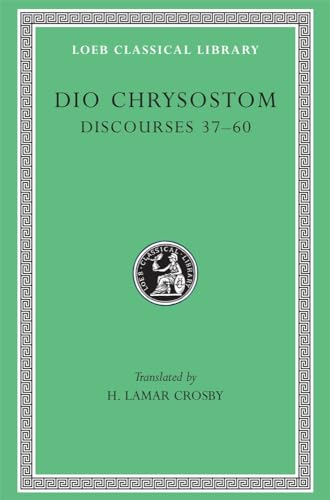
Inhaltsangabe
Dio Cocceianus Chrysostomus, ca. 40?ca. 120 CE, of Prusa in Bithynia, Asia Minor, inherited with his brothers large properties and debts from his generous father Pasicrates. He became a skilled rhetorician hostile to philosophers. But in the course of his travels he went to Rome in Vespasian's reign (69?79) and was converted to Stoicism. Strongly critical of the emperor Domitian (81?96) he was about 82 banned by him from Italy and Bithynia and wandered in poverty, especially in lands north of the Aegean, as far as the Danube and the primitive Getae. In 97 he spoke publicly to Greeks assembled at Olympia, was welcomed at Rome by emperor Nerva (96?98), and returned to Prusa. Arriving again at Rome on an embassy of thanks about 98?99 he became a firm friend of emperor Trajan. In 102 he travelled to Alexandria and elsewhere. Involved in a lawsuit about plans to beautify Prusa at his own expense, he stated his case before the governor of Bithynia, Pliny the Younger, 111?112. The rest of his life is unknown.
Nearly all of Dio's extant Discourses (or Orations) reflect political concerns (the most important of them dealing with affairs in Bithynia and affording valuable details about conditions in Asia Minor) or moral questions (mostly written in later life; they contain much of his best writing). Some philosophical and historical works, including one on the Getae, are lost. What survives of his achievement as a whole makes him prominent in the revival of Greek literature in the last part of the first century and the first part of the second.
The Loeb Classical Library edition of Dio Chrysostom is in five volumes.
Die Inhaltsangabe kann sich auf eine andere Ausgabe dieses Titels beziehen.
Über die Autorin bzw. den Autor
Henry Lamar Crosby (1880-1954) was Professor of Classics at the University of Pennsylvania.
„Über diesen Titel“ kann sich auf eine andere Ausgabe dieses Titels beziehen.
Suchergebnisse für Dio Chrysostom: Discourses Xxxvii-Lx/Lcl 376 (Loeb...

Beispielbild für diese ISBN
Dio Chrysostom: Discourses 37-60 (Loeb Classical Library No. 376)
Verlag:
Harvard University Press January 1946, 1946
ISBN 10: 0674994140
ISBN 13: 9780674994140
Gebraucht
Hardcover
Anbieter: Magus Books Seattle, Seattle, WA, USA
Verkäuferbewertung 5 von 5 Sternen

Hardcover. Zustand: VG-. Zustand des Schutzumschlags: Good. used hardcover in a dust jacket. the jacket is somewhat worn about the edges and slightly scuffed, has only small tears at extremeties. corners slightly bumped, but pages and binding are clean, straight and tight. there are no marks to the text or other serious flaws. Bestandsnummer des Verkäufers 1373988
Gebraucht kaufen
EUR 20,98
EUR 4,46 Versand
Versand innerhalb von USA
Versand innerhalb von USA
Anzahl: 1 verfügbar
Beispielbild für diese ISBN
Dio Chrysostom: Discourses 37-60 (Loeb Classical Library No. 376)
Verlag:
Harvard University Press January 1946, 1946
ISBN 10: 0674994140
ISBN 13: 9780674994140
Gebraucht
Hardcover
Anbieter: BookMarx Bookstore, Steubenville, OH, USA
Verkäuferbewertung 4 von 5 Sternen

Hardcover. Zustand: Good. Zustand des Schutzumschlags: Good. Support Small Business by buying this book! No marks or writing observed in text other than previous owner's name inside. Binding sound. Some wear to spine and light wear on cover. Light sun-tanning to pages and covers. Bestandsnummer des Verkäufers 127533
Gebraucht kaufen
EUR 20,55
EUR 5,35 Versand
Versand innerhalb von USA
Versand innerhalb von USA
Anzahl: 1 verfügbar
Beispielbild für diese ISBN
DIO CHRYSOSTOM VOL. IV; Discourses 37-60
Verlag:
William Heinemann & Harvard University Press, 1962
ISBN 10: 0674994140
ISBN 13: 9780674994140
Gebraucht
Hardcover
Anbieter: Ancient World Books, Toronto, ON, Kanada
Verkäuferbewertung 5 von 5 Sternen
Hardcover. Zustand: Very Good. Zustand des Schutzumschlags: Good. DJ is price-clipped. DJ spine is browned. Some tears to DJ.; Loeb Classical Library No. 376; 4; 480 pages. Bestandsnummer des Verkäufers 45712
Gebraucht kaufen
EUR 21,12
EUR 6,69 Versand
Versand von Kanada nach USA
Versand von Kanada nach USA
Anzahl: 1 verfügbar
Beispielbild für diese ISBN
Discourses 37-60
Verlag:
Harvard University Press, 2001
ISBN 10: 0674994140
ISBN 13: 9780674994140
Gebraucht
Hardcover
Anbieter: Ammareal, Morangis, Frankreich
Verkäuferbewertung 5 von 5 Sternen
No jacket. Zustand: Bon. Ancien livre de bibliothèque avec équipements. Sans jaquette. Edition 2001. Ammareal reverse jusqu'à 15% du prix net de cet article à des organisations caritatives. ENGLISH DESCRIPTION Book Condition: Used, Good. Former library book. No dust jacket. Edition 2001. Ammareal gives back up to 15% of this item's net price to charity organizations. Bestandsnummer des Verkäufers I-273-278
Gebraucht kaufen
EUR 20,27
EUR 16,50 Versand
Versand von Frankreich nach USA
Versand von Frankreich nach USA
Anzahl: 1 verfügbar
Foto des Verkäufers
Dio Chrysostom : Discourses Xxxvii-Lx/Lcl 376
Verlag:
Harvard University Press, 1946
ISBN 10: 0674994140
ISBN 13: 9780674994140
Gebraucht
Hardcover
Anbieter: GreatBookPrices, Columbia, MD, USA
Verkäuferbewertung 5 von 5 Sternen
Zustand: As New. Unread book in perfect condition. Bestandsnummer des Verkäufers 623718
Gebraucht kaufen
EUR 34,76
EUR 2,35 Versand
Versand innerhalb von USA
Versand innerhalb von USA
Anzahl: 12 verfügbar
Beispielbild für diese ISBN
Discourses 37?60 (eng)
Anbieter: Brook Bookstore On Demand, Napoli, NA, Italien
Verkäuferbewertung 5 von 5 Sternen
Zustand: new. Bestandsnummer des Verkäufers 280e414b6ac9f1bf6bc6df966ea11ead
Neu kaufen
EUR 32,18
EUR 5,50 Versand
Versand von Italien nach USA
Versand von Italien nach USA
Anzahl: 13 verfügbar
Beispielbild für diese ISBN
Discourses 3760
Anbieter: PBShop.store UK, Fairford, GLOS, Vereinigtes Königreich
Verkäuferbewertung 5 von 5 Sternen
HRD. Zustand: New. New Book. Shipped from UK. Established seller since 2000. Bestandsnummer des Verkäufers WL-9780674994140
Neu kaufen
EUR 32,91
EUR 4,90 Versand
Versand von Vereinigtes Königreich nach USA
Versand von Vereinigtes Königreich nach USA
Anzahl: 13 verfügbar
Foto des Verkäufers
Dio Chrysostom : Discourses Xxxvii-Lx/Lcl 376
Anbieter: GreatBookPrices, Columbia, MD, USA
Verkäuferbewertung 5 von 5 Sternen
Zustand: New. Bestandsnummer des Verkäufers 623718-n
Neu kaufen
EUR 36,44
EUR 2,35 Versand
Versand innerhalb von USA
Versand innerhalb von USA
Anzahl: 12 verfügbar
Beispielbild für diese ISBN
Discourses 3760 (Hardcover)
Verlag:
Harvard University Press, Cambridge, Mass, 1946
ISBN 10: 0674994140
ISBN 13: 9780674994140
Neu
Hardcover
Anbieter: Grand Eagle Retail, Bensenville, IL, USA
Verkäuferbewertung 5 von 5 Sternen
Hardcover. Zustand: new. Hardcover. Dio Cocceianus Chrysostomus, ca. 40ca. 120 CE, of Prusa in Bithynia, Asia Minor, inherited with his brothers large properties and debts from his generous father Pasicrates. He became a skilled rhetorician hostile to philosophers. But in the course of his travels he went to Rome in Vespasian's reign (6979) and was converted to Stoicism. Strongly critical of the emperor Domitian (8196) he was about 82 banned by him from Italy and Bithynia and wandered in poverty, especially in lands north of the Aegean, as far as the Danube and the primitive Getae. In 97 he spoke publicly to Greeks assembled at Olympia, was welcomed at Rome by emperor Nerva (9698), and returned to Prusa. Arriving again at Rome on an embassy of thanks about 9899 he became a firm friend of emperor Trajan. In 102 he travelled to Alexandria and elsewhere. Involved in a lawsuit about plans to beautify Prusa at his own expense, he stated his case before the governor of Bithynia, Pliny the Younger, 111112. The rest of his life is unknown.Nearly all of Dio's extant Discourses (or Orations) reflect political concerns (the most important of them dealing with affairs in Bithynia and affording valuable details about conditions in Asia Minor) or moral questions (mostly written in later life; they contain much of his best writing). Some philosophical and historical works, including one on the Getae, are lost. What survives of his achievement as a whole makes him prominent in the revival of Greek literature in the last part of the first century and the first part of the second.The Loeb Classical Library edition of Dio Chrysostom is in five volumes. Dio Chrysostomus (c. 40 c. 120 CE) was a rhetorician hostile to philosophers, whose Discourses (or Orations) reflect political or moral concerns. What survives of his works make him prominent in the revival of Greek literature in the late first and early second century CE. Shipping may be from multiple locations in the US or from the UK, depending on stock availability. Bestandsnummer des Verkäufers 9780674994140
Foto des Verkäufers
Discourses 37-60
Anbieter: Rarewaves.com USA, London, LONDO, Vereinigtes Königreich
Verkäuferbewertung 5 von 5 Sternen
Hardback. Zustand: New. The man with the golden mouth.Dio Cocceianus Chrysostomus (AD ca. 40-ca. 120), of Prusa in Bithynia, Asia Minor, inherited with his brothers large properties and debts from his generous father Pasicrates. He became a skilled rhetorician hostile to philosophers. But in the course of his travels he went to Rome in Vespasian's reign (69-79) and was converted to Stoicism. Strongly critical of the emperor Domitian (81-96) he was about 82 banned by him from Italy and Bithynia and wandered in poverty, especially in lands north of the Aegean, as far as the Danube and the primitive Getae. In 97 he spoke publicly to Greeks assembled at Olympia, was welcomed at Rome by emperor Nerva (96-98), and returned to Prusa. Arriving again at Rome on an embassy of thanks about 98-99 he became a firm friend of emperor Trajan. In 102 he traveled to Alexandria and elsewhere. Involved in a lawsuit about plans to beautify Prusa at his own expense, he stated his case before the governor of Bithynia, Pliny the Younger, 111-112. The rest of his life is unknown. Nearly all of Dio's extant Discourses (or Orations) reflect political concerns (the most important of them dealing with affairs in Bithynia and affording valuable details about conditions in Asia Minor) or moral questions (mostly written in later life; they contain much of his best writing). Some philosophical and historical works, including one on the Getae, are lost. What survives of his achievement as a whole makes him prominent in the revival of Greek literature in the last part of the first century and the first part of the second. The Loeb Classical Library edition of Dio Chrysostom is in five volumes. Bestandsnummer des Verkäufers LU-9780674994140
Neu kaufen
EUR 39,69
Versand gratis
Versand von Vereinigtes Königreich nach USA
Versand von Vereinigtes Königreich nach USA
Anzahl: 7 verfügbar