
Verwandte Artikel zu Geek Mom: Projects, Tips, and Adventures for Moms and...
Inhaltsangabe
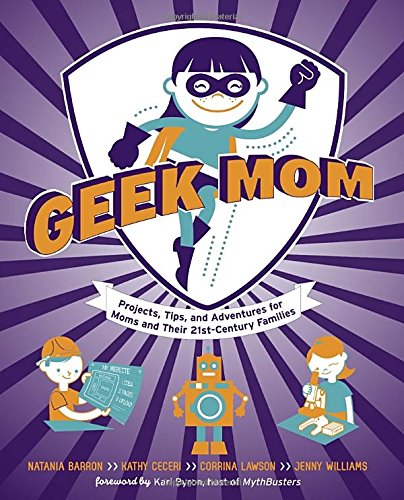
It’s fast becoming a geek world out there, and all moms need to show off their tech smarts and superhero-like skills in order to keep their savvy kids entertained and engaged.Geek Mom: Projects, Tips, and Adventures for Moms and Their 21st-Century Families explores the many fun and interesting ways that digital-age parents and kids can get their geek on together. Imaginative ideas for all ages and budgets include thrifty Halloween costumes, homemade lava lamps, hobbit feasts, and magical role-playing games. There are even projects for moms to try when they have a few precious moments alone. With six sections spanning everything from home-science experiments to superheroes, this comprehensive handbook from the editors of Wired.com’s popular GeekMom blog is packed with ideas guaranteed to inspire a love of learning and discovery. Along the way, parents will also find important tips on topics such as determining safe online communities for children, organizing a home learning center, and encouraging girls to love science.
Being geeky is all about exploring the world with endless curiosity. Geek Mom is your invitation to introducing the same sense of wonder and imagination to the next generation.
Die Inhaltsangabe kann sich auf eine andere Ausgabe dieses Titels beziehen.
Über die Autorin bzw. den Autor
Natania Barron, Kathy Ceceri, Corrina Lawson, and Jenny Williams are the cofounders and senior editors of Wired.com’sGeekMom blog. The only female contributors to the GeekDad blog, they joined together to create a website where women could share some of the special aspects of being geeky and being moms. Today the GeekMom blog’s loyal followers—men and women, parents and others—flock to hear them talk at conventions around the country. In addition to its editors, theGeekMom blog has more than twenty regular contributors and many more occasional writers from across the United States, Canada, and Europe. This is the first joint book project for the four coauthors.
Auszug. © Genehmigter Nachdruck. Alle Rechte vorbehalten.
Chapter 1
Secret
Identities
Introduction to Imagination
My first memory of pretending to be a superhero is as a toddler when I grabbed one of my old baby blankets and fashioned it into a cape. I still remember how powerful I felt and how much fun it was. Geeky moms are in a unique position to introduce the next generation to wonder. Although superheroes are often thought of as a male bastion, it’s usually mothers who first introduce their children to the concept. Mothers are generally the ones who stress out over Halloween costumes or the right books to read or the right shows to watch, and geeky mothers are the ones who pass down their love of stuff such as Star Wars, steampunk, fantasy, and science fiction. We’re often the first to introduce children to impossible stories that fire the imagination.
The first time we show our children all the various versions of Star Trek and realize they love it as much as we do, it’s a shared bond. The first time they come running to us about a book they just read that they love that we also loved as a child, such as The Chronicles of Narnia, we feel their joy. This chapter is about recapturing that feeling of exhilaration for ourselves and our children. Some of the projects are complicated, many are less so, but they are all designed with laughter and fun in mind and with an eye to providing that special thrill that pretending brings to everyone.
Why Superheroes Matter
especially to children
It’s a striking and compelling image: the ordinary-looking person sees someone around him or her in trouble and springs into action, revealing a hidden hero.
That image goes directly to our collective desire to matter, to make a difference, to be a hero. Adults are still drawn to the idea, but those who truly take it to heart are children.
Children are mostly powerless in the world. Everything around them is adult sized. They generally have no say in where they live or even where they’re going on any given day. Their life is regimented. No wonder they’re drawn to the fantasy of possessing incredible power under the surface.
But if superheroes were simply about power, they wouldn’t speak to kids so strongly.
I asked my youngest son, age eleven, what superheroes do. He said, “They stand for justice, they fight evil guys, and sometimes they help with things like natural disasters and do stuff ordinary people can’t do.”
He didn’t say “they have cool powers” or “they beat up bad guys” or even “they have great adventures.” Instead, what he has absorbed most about superheroes is that they stand for what’s right, for justice, for the best parts of humanity.
And that’s why superheroes are wonderful role models for children. Not only do kids learn that they can be powerful and they can make a difference, but they also learn the proper use of that power.
Justice is a concept that is so very hard to teach. It’s not quite fairness, as kids learn early that life is not always fair. Rather, justice is about balancing the scales and trying to do the right thing, perhaps even in a bad situation. It’s about being a good moral person.
This is why it’s so important for superheroes to be men and women and why it’s also essential for these heroes to come from as many racial and ethnic groups as possible. It’s hard to adopt a superhero as a role model if he or she doesn’t speak to your experience, if the hero doesn’t look or act or come from the same place as you.
I was five years old when I first watched the Adam West Batman show in reruns. Batman was an ironic show that focused mainly on jokes, but it was also about the good guys trying to do the right thing. I laughed and had fun watching it, but I didn’t fall in love with it until the debut of Batgirl, which hit me like a lightning bolt.
Meek librarian Barbara Gordon’s wall swiveled to reveal a costume and a motorcycle. In a split second, she was transformed into a hero who could fight the villains just as well—sometimes better—than the male crime fighters.
I never, ever wanted so badly to be a superhero as on that day.
Over the years, I’ve absorbed other heroes beyond Batman and his supporting cast. Superman, of course, Black Canary, Green Arrow, the Justice League, the Legion of Super-Heroes, Captain America, Iron Man, the Avengers, the X-Men, and the Fantastic Four.
I learned values from all their superhero stories. Values about self-sacrifice, about morality, about the way people should treat each other.
The very first issue of the Legion of Super-Heroes that I ever purchased featured a reanimated soldier from the previous war intent on continuing to fight until his side achieved victory. The Legion failed to stop him in a fight and all appeared lost until the heroes looked into the soldier’s background. He had originally died saving his platoon from a grenade. Once they knew this, the Legionnaires stopped the soldier by dressing as his superior officers and telling him he’d done his job well. The strange energy that had animated the soldier faded and he died knowing he’d done his job well and saved his comrades.
The Legionnaires had powers, and they were fierce fighters. But they solved the problem with intelligence and compassion instead of battle. That’s what made them heroes, and that’s the lesson I learned as a child.
In a story featuring Batman, the Dark Knight returned to the alley where his parents had been murdered. He had to prevent criminals from menacing an elderly woman who had once comforted the young, orphaned Bruce Wayne on the night his parents were killed. Young Bruce had suffered, but the grown-up Bruce was now a hero who could protect others. As someone who lost her father at a young age, I took to heart the lesson that even someone who suffered a terrible loss could go on to accomplish great things.
I also took away a lasting role model for who I wanted to be like: Lois Lane. I couldn’t grow up to be a superhero, but I could do what Lois Lane did. I could be a reporter. I could fight for truth as much as Superman ever did. I’m not alone. I’ve spoken to many female journalists over the years and a large number point to Lois Lane as their initial inspiration.
One of the very best parts of being a mother has been introducing my own children to the superheroes I loved as a child. They have had the same reaction. They love superheroes. As you can see from my son’s quote earlier, they know exactly what superheroes represent: standing up for yourself, might in the service of right, and being good to each other.
An episode of Batman: The Brave and the Bold on Cartoon Network portrayed the sacrifice of the Doom Patrol—a band of ostracized loners—for a small number of people they didn’t know. In one of the most poignant moments of Grant Morrison’s All-Star Superman, Superman prevents a teenage girl from committing suicide. Superman knows he himself is dying from being poisoned by Lex Luthor, but he talks the girl out of jumping off a building, saying there’s always a chance that life will get better.
Adults sometimes see superheroes and concentrate on the “super” part. And the costumes and the powers are a lot of fun.
But kids know better.
They know the “hero” part is far more important. They know that they can’t really be superheroes when they grow up, as much as they wish they could, but they will know how to be a hero.
Create Your Own Secret Lair
When I was growing up, my favorite places were the hidden ones where I could let my imagination run wild. It...
„Über diesen Titel“ kann sich auf eine andere Ausgabe dieses Titels beziehen.
Suchergebnisse für Geek Mom: Projects, Tips, and Adventures for Moms and...

Beispielbild für diese ISBN
Geek Mom: Projects, Tips, and Adventures for Moms and Their 21st-Century Families
Anbieter: Once Upon A Time Books, Siloam Springs, AR, USA
Verkäuferbewertung 4 von 5 Sternen

paperback. Zustand: Good. This is a used book in good condition and may show some signs of use or wear . This is a used book in good condition and may show some signs of use or wear . Bestandsnummer des Verkäufers mon0001051066
Gebraucht kaufen
EUR 2,07
EUR 3,52 Versand
Versand innerhalb von USA
Versand innerhalb von USA
Anzahl: 1 verfügbar
Beispielbild für diese ISBN
Geek Mom: Projects, Tips, and Adventures for Moms and Their 21st-Century Families
Anbieter: World of Books (was SecondSale), Montgomery, IL, USA
Verkäuferbewertung 5 von 5 Sternen

Paperback. Zustand: Good. Bestandsnummer des Verkäufers 00097962541
Gebraucht kaufen
EUR 5,69
Versand gratis
Versand innerhalb von USA
Versand innerhalb von USA
Anzahl: 2 verfügbar
Beispielbild für diese ISBN
Geek Mom : Projects, Tips, and Adventures for Moms and Their 21st Century Families
Verlag:
Potter/Ten Speed/Harmony/Rodale, 2012
ISBN 10: 0823085929
ISBN 13: 9780823085927
Gebraucht
Softcover
Anbieter: Better World Books, Mishawaka, IN, USA
Verkäuferbewertung 5 von 5 Sternen
Zustand: Very Good. Pages intact with possible writing/highlighting. Binding strong with minor wear. Dust jackets/supplements may not be included. Stock photo provided. Product includes identifying sticker. Better World Books: Buy Books. Do Good. Bestandsnummer des Verkäufers 9902466-6
Gebraucht kaufen
EUR 6,18
Versand gratis
Versand innerhalb von USA
Versand innerhalb von USA
Anzahl: 1 verfügbar
Beispielbild für diese ISBN
Geek Mom : Projects, Tips, and Adventures for Moms and Their 21st Century Families
Verlag:
Potter/Ten Speed/Harmony/Rodale, 2012
ISBN 10: 0823085929
ISBN 13: 9780823085927
Gebraucht
Softcover
Anbieter: Better World Books, Mishawaka, IN, USA
Verkäuferbewertung 5 von 5 Sternen
Zustand: Very Good. Former library copy. Pages intact with possible writing/highlighting. Binding strong with minor wear. Dust jackets/supplements may not be included. Includes library markings. Stock photo provided. Product includes identifying sticker. Better World Books: Buy Books. Do Good. Bestandsnummer des Verkäufers 9941390-6
Gebraucht kaufen
EUR 6,18
Versand gratis
Versand innerhalb von USA
Versand innerhalb von USA
Anzahl: 1 verfügbar
Beispielbild für diese ISBN
Geek Mom: Projects, Tips, and Adventures for Moms and Their 21st-Century Families
Anbieter: The Maryland Book Bank, Baltimore, MD, USA
Verkäuferbewertung 5 von 5 Sternen
paperback. Zustand: Very Good. Used - Very Good. Bestandsnummer des Verkäufers 6-T-6-0238
Gebraucht kaufen
EUR 2,04
EUR 4,18 Versand
Versand innerhalb von USA
Versand innerhalb von USA
Anzahl: 1 verfügbar
Beispielbild für diese ISBN
Geek Mom: Projects, Tips, and Adventures for Moms and Their 21st-Century Families
Anbieter: Wonder Book, Frederick, MD, USA
Verkäuferbewertung 5 von 5 Sternen
Zustand: As New. Like New condition. A near perfect copy that may have very minor cosmetic defects. Bestandsnummer des Verkäufers O12F-01273
Gebraucht kaufen
EUR 6,43
Versand gratis
Versand innerhalb von USA
Versand innerhalb von USA
Anzahl: 2 verfügbar
Beispielbild für diese ISBN
Geek Mom: Projects, Tips, and Adventures for Moms and Their 21st-Century Families
Anbieter: World of Books Inc, Montgomery, IL, USA
Verkäuferbewertung 4 von 5 Sternen
Paperback. Zustand: Good. Bestandsnummer des Verkäufers CIN0823085929G
Gebraucht kaufen
EUR 7,52
Versand gratis
Versand innerhalb von USA
Versand innerhalb von USA
Anzahl: 2 verfügbar
Beispielbild für diese ISBN
Geek Mom: Projects, Tips, and Adventures for Moms and Their 21st-Century Families
Anbieter: WorldofBooks, Goring-By-Sea, WS, Vereinigtes Königreich
Verkäuferbewertung 5 von 5 Sternen
Paperback. Zustand: Very Good. The book has been read, but is in excellent condition. Pages are intact and not marred by notes or highlighting. The spine remains undamaged. Bestandsnummer des Verkäufers GOR005419468
Gebraucht kaufen
EUR 2,58
EUR 6,68 Versand
Versand von Vereinigtes Königreich nach USA
Versand von Vereinigtes Königreich nach USA
Anzahl: 1 verfügbar
Beispielbild für diese ISBN
Geek Mom: Projects, Tips, and Adventures for Moms and Their 21st-Century Families
Anbieter: Cheryl's Books, Vinemont, AL, USA
Verkäuferbewertung 5 von 5 Sternen
paperback. Zustand: Good. Paperback book in good condition. Bestandsnummer des Verkäufers APR2226N0382286
Gebraucht kaufen
EUR 9,14
EUR 5,75 Versand
Versand innerhalb von USA
Versand innerhalb von USA
Anzahl: 1 verfügbar
Beispielbild für diese ISBN
Geek Mom: Projects, Tips, and Adventures for Moms and Their 21st-Century Families
Anbieter: Cycle Books LA, South el monte, CA, USA
Verkäuferbewertung 5 von 5 Sternen
Zustand: new. Bestandsnummer des Verkäufers AMTV.0823085929.N
Neu kaufen
EUR 15,37
EUR 2,67 Versand
Versand innerhalb von USA
Versand innerhalb von USA
Anzahl: 1 verfügbar