
Verwandte Artikel zu Helping: How to Offer, Give, and Receive Help (The...
Inhaltsangabe
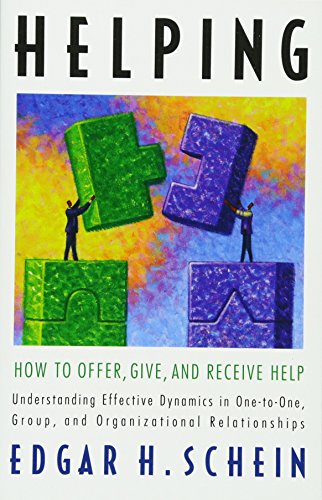
A Strategy+Business Best Leadership Book of the Year: An “uncommonly wise” analysis of the psychological and social dynamics of helping relationships (Warren Bennis, author of On Becoming a Leader).
Helping is a fundamental human activity, but it can also be a frustrating one. All too often, to our bewilderment, our sincere offers of help are resented, resisted, or refused—and we often react the same way when people try to help us. Why is it so difficult to provide or accept help? How can we make the whole process easier?
Many words are used for helping: assisting, aiding, advising, caregiving, coaching, consulting, counseling, guiding, mentoring, supporting, teaching, and more. In this seminal book on the topic, corporate culture and organizational development guru Ed Schein analyzes the social and psychological dynamics common to all types of helping relationships, explains why help is often not helpful, and shows what any would-be helpers must do to ensure that their assistance is both welcomed and genuinely useful. He shows how to navigate the delicate acts of asking for or offering help; avoid pitfalls; mitigate power imbalances; and establish a solid foundation of trust—and how these techniques can be applied to teamwork and organizational leadership.
From the bestselling author of Organizational Culture and Leadership, and illustrated with examples from many types of relationships—husbands and wives, doctors and patients, consultants and clients—Helping is a concise, definitive analysis of what it takes to establish successful, mutually satisfying helping relationships.
Die Inhaltsangabe kann sich auf eine andere Ausgabe dieses Titels beziehen.
Über die Autorin bzw. den Autor
Ed Schein was educated at the University of Chicago, Stanford University (where he received a master’s degree in psychology in 1949), and Harvard University (where he received his Ph.D. in social psychology in 1952). He has taught at the MIT Sloan School of Management since 1956 and was named the Sloan Fellows Professor of Management in 1978. He is currently professor emeritus. He is the author of many articles and books, most recently Process Consultation Revisited (1999), The Corporate Culture Survival Guide (1999), and DEC Is Dead: Long Live DEC (2003). His book Organizational Culture and Leadership, 3rd ed. (2004) has defined the field of organizational culture. He has consulted with many organizations in the United States and overseas on organizational culture, organization development, process consultation, and career dynamics. What has distinguished Schein’s work is his combination of sociology, anthropology, and social psychology, as illustrated in this book.
Auszug. © Genehmigter Nachdruck. Alle Rechte vorbehalten.
Helpful and Unhelpful Help
Helping is a complex phenomenon. There’s helpful help and unhelpful help. This book is written to shed light on the difference between the two. In my career as a professor and sometimes consultant I often reflect on what is helpful and what is not, why some classes go well and others do not, why coaching and experiential learning are often more successful than formal lectures. When I am with organizational clients, why does it work better to focus on process rather than content, or how things are done rather than what is done? My goal in this book is to provide the reader with enough insight to be able to actually help when help is asked for or needed, and to be able to receive help when help is needed and offered. Neither is as easy as we often wish.
The other day, for example, a friend asked me for some advice on how to deal with a problem he was having with his wife. I offered a suggestion to which he replied huffily that not only had he already tried that and it didn’t work, but he also implied that I was insensitive to have even made that suggestion. It reminded me of many other situations I have witnessed where help was asked for or offered but the result felt unsuccessful and uncomfortable.
Then I was reminded of a case of helpful help. Outside my house a woman in her car drove up and asked me, “How do I get to Massachusetts Ave.?” I asked her where she was headed and learned that she wanted to go to downtown Boston. I then pointed out that the road she was on led directly to downtown and she did not need Mass. Ave. She thanked me profusely for not sending her to the street she had asked for.
The most common version of unhelpful help that I have experienced as both helper and client concerns the computer. When I call the help line I often don’t even understand the diagnostic questions that the helper asks me in order to determine what help I need. When my computer coach tells me the several steps I need to take to solve the problem, I don’t know how to interrupt to say, “Wait, I don’t understand the first step.” On the other hand, another computer coach I hired asked me what my personal goals were in learning to use the computer, elicited my desire to use it primarily for writing, and then showed me all the programs and tools that would make writing easier. That felt great. Yet when my wife asks me for help with the computer, I routinely fall into the same trap of telling her what I would do, which turns out to be more than she can handle, and we both end up frustrated.
Friends, editors, consultants, teachers, and coaches have often made suggestions and proposals that were quite irrelevant to my problem at the time. Even when I ignored them as gently as I could, my sometimes self-appointed helpers reminded me in an irritated tone that they were only trying to be helpful, implying that I was wrong in some way not to have been able to accept the help.
I remember one of my children asking me for help with her math homework. I interrupted my work, did the problem for her, only to find her sulking off without a thank you. What had I done wrong? On another occasion a child asked for homework help and I said, “Let’s talk. . . .” I discovered that she wanted to talk about some serious social problems at school that had nothing to do with homework. We had a good talk and both felt better.
Doctors, therapists, social workers, and coaches of all sorts have had the experience of the best-intended help going wrong somehow. As a consultant and career coach to managers in various kinds of organizations, I have often figured out solutions to problems that they posed, and only later discovered that either my advice did not work or the client could not or would not implement what I had suggested. I also remember in my own consulting how often it happened that when I intervened to point out some dysfunctional behavior in a group meeting, I was thanked for being very helpful, only to find that the behavior did not change one iota.
Help is, of course, not limited to the one-on-one situation. Group effort and teamwork often hinge on the degree to which members perform their roles properly in accomplishing the group’s task. We do not typically think of an effective team as being a group of people who really know how to help each other in the performance of a task, yet that is precisely what good teamwork is—successful reciprocal help. It is interesting to note, however, that the word “help” is only used in relation to teamwork when it does not occur, as when one group member says to another, “What you did was not helpful” or “Why didn’t you help more?”
Helping in a team context is most obvious in team sports, where the ability of one player to score is entirely dependent on the skill of others to pass or block. There are many football stories of successful runners taking their linemen out to dinner after a successful game in acknowledgment of their support. Failure to help in this regard becomes obvious when the quarterback is sacked or the runner is tackled behind the line.
Clearly, there is more to helping or being helped than meets the eye. This seemingly common and very necessary human process is, in fact, fraught with difficulty and often does not succeed. This book starts with the premise that help is an important but complicated human process. I examine what it really means to help or be helped; what psychological, social, and cultural traps are inherent in this process; and how one can avoid them. As the examples above show, help refers to many things other than the professional help we expect from doctors, lawyers, ministers and social workers. So what is it all about and how do we ensure that it works?
The Multiple Meanings of Help
Helping is a very broad concept ranging all the way from the knight in shining armor rescuing the maiden before she is eaten by the dragon to the consultant working with an organization to change its culture to meet new strategic objectives or to improve its performance. From a client perspective, help includes not only what we ask for, but also the spontaneous and generous behavior of others who recognize when we need help even if we have not asked for it.
Consider the many life situations in which helping of some sort is involved (see Table 1.1). It occurs all the time in both formal and informal situations, and many of the roles described in Table 1.1 are ones we are called on to play ourselves at various times in our lives. To go one step further, helping is intrinsic to all forms of organization and work, because, by definition, we organize because we cannot do the whole job ourselves. Hired help truly refers not only to servants and caretakers, but applies equally to all organizational employees hired to do a specific job that we cannot do ourselves. Fulfilling one’s duties in a job is, therefore, also a routine way in which we help. Consider the tensions that arise between supervisors and subordinates when either the subordinate did not put forth the effort to complete the task or the boss did not provide the time or other resources to get the job done. Workers and their bosses have a sort of psychological contract based on what kind of help they can expect from each other.
TABLE 1.1 The Many Forms of Help
The stranger giving the tourist directions
The parent doing the child’s homework
The spouse advising on what to wear for the party
The nurse assisting a patient with the bedpan
The friend supplying a word that is on the tip of your tongue
The guest offering to clear and do the dishes
The teacher explaining a concept to a student
The computer expert walking you through steps to fix...
„Über diesen Titel“ kann sich auf eine andere Ausgabe dieses Titels beziehen.
Suchergebnisse für Helping: How to Offer, Give, and Receive Help (The...

Foto des Verkäufers
Helping: How to Offer, Give, and Receive Help (The Humble Leadership Series)
Verlag:
Berrett-Koehler Publishers, 2011
ISBN 10: 1605098566
ISBN 13: 9781605098562
Gebraucht
Softcover
Anbieter: Dream Books Co., Denver, CO, USA
Verkäuferbewertung 5 von 5 Sternen

Zustand: good. Gently used with minimal wear on the corners and cover. A few pages may contain light highlighting or writing, but the text remains fully legible. Dust jacket may be missing, and supplemental materials like CDs or codes may not be included. May be ex-library with library markings. Ships promptly! Bestandsnummer des Verkäufers DBV.1605098566.G
Gebraucht kaufen
EUR 3,95
Versand gratis
Versand innerhalb von USA
Versand innerhalb von USA
Anzahl: 1 verfügbar
Beispielbild für diese ISBN
Helping: How to Offer, Give, a
Verlag:
Berrett-Koehler Publishers, 2011
ISBN 10: 1605098566
ISBN 13: 9781605098562
Gebraucht
Softcover
Anbieter: World of Books (was SecondSale), Montgomery, IL, USA
Verkäuferbewertung 5 von 5 Sternen
Zustand: Good. Item in good condition. Textbooks may not include supplemental items i.e. CDs, access codes etc. Bestandsnummer des Verkäufers 00097986951
Gebraucht kaufen
EUR 4,02
Versand gratis
Versand innerhalb von USA
Versand innerhalb von USA
Anzahl: 10 verfügbar
Beispielbild für diese ISBN
Helping: How to Offer, Give, and Receive Help
Anbieter: World of Books (was SecondSale), Montgomery, IL, USA
Verkäuferbewertung 5 von 5 Sternen
Paperback. Zustand: Very Good. AStrategy+BusinessBest Leadership Book of the Year: An "uncommonly wise" analysis of the psychological and social dynamics of helping relationships (Warren Bennis, author of On Becoming a Leader). Helping is a fundamental human activity, but it can also be a frustrating one. All too often, to our bewilderment, our sincere offers of help are resented, resisted, or refused-and we often react the same way when people try to help us. Why is it so difficult to provide or accept help? How can we make the whole process easier? Many words are used for helping: assisting, aiding, advising, caregiving, coaching, consulting, counseling, guiding, mentoring, supporting, teaching, and more. In this seminal book on the topic, corporate culture and organizational development guru Ed Schein analyzes the social and psychological dynamics common to all types of helping relationships, explains why help is often not helpful, and shows what any would-be helpers must do to ensure that their assistance is both welcomed and genuinely useful. He shows how to navigate the delicate acts of asking for or offering help; avoid pitfalls; mitigate power imbalances; and establish a solid foundation of trust-and how these techniques can be applied to teamwork and organizational leadership. From the bestselling author of Organizational Culture and Leadership, and illustrated with examples from many types of relationships-husbands and wives, doctors and patients, consultants and clients-Helping is a concise, definitive analysis of what it takes to establish successful, mutually satisfying helping relationships. Bestandsnummer des Verkäufers 00108682006
Gebraucht kaufen
EUR 4,02
Versand gratis
Versand innerhalb von USA
Versand innerhalb von USA
Anzahl: 3 verfügbar
Foto des Verkäufers
Helping: How to Offer, Give, and Receive Help (The Humble Leadership Series)
Verlag:
Berrett-Koehler Publishers, 2011
ISBN 10: 1605098566
ISBN 13: 9781605098562
Gebraucht
Softcover
Anbieter: Zoom Books East, Glendale Heights, IL, USA
Verkäuferbewertung 5 von 5 Sternen
Zustand: very_good. Book is in very good condition and may include minimal underlining highlighting. The book can also include "From the library of" labels. May not contain miscellaneous items toys, dvds, etc. . We offer 100% money back guarantee and 24 7 customer service. Bestandsnummer des Verkäufers ZEV.1605098566.VG
Gebraucht kaufen
EUR 4,26
Versand gratis
Versand innerhalb von USA
Versand innerhalb von USA
Anzahl: 1 verfügbar
Foto des Verkäufers
Helping: How to Offer, Give, and Receive Help (The Humble Leadership Series)
Verlag:
Berrett-Koehler Publishers, 2011
ISBN 10: 1605098566
ISBN 13: 9781605098562
Gebraucht
Softcover
Anbieter: Aspen Book Co., Denver, CO, USA
Verkäuferbewertung 5 von 5 Sternen
Zustand: good. A well-loved companion. Corners and cover might show a little wear, and you could find some notes or highlights. The dust jacket might be MIA, it might have been a library book and extras aren't guaranteedâ"but the story's all there! Bestandsnummer des Verkäufers PKV.1605098566.G
Gebraucht kaufen
EUR 4,50
Versand gratis
Versand innerhalb von USA
Versand innerhalb von USA
Anzahl: 1 verfügbar
Foto des Verkäufers
Helping: How to Offer, Give, and Receive Help (The Humble Leadership Series)
Verlag:
Berrett-Koehler Publishers, 2011
ISBN 10: 1605098566
ISBN 13: 9781605098562
Gebraucht
Softcover
Anbieter: Greenworld Books, Arlington, TX, USA
Verkäuferbewertung 5 von 5 Sternen
Zustand: good. Fast Free Shipping â" Good condition. It may show normal signs of use, such as light writing, highlighting, or library markings, but all pages are intact and the book is fully readable. A solid, complete copy that's ready to enjoy. Bestandsnummer des Verkäufers GWV.1605098566.G
Gebraucht kaufen
EUR 5,32
Versand gratis
Versand innerhalb von USA
Versand innerhalb von USA
Anzahl: 1 verfügbar
Beispielbild für diese ISBN
Helping: How to Offer, Give, and Receive Help
Anbieter: World of Books Inc, Montgomery, IL, USA
Verkäuferbewertung 4 von 5 Sternen

Paperback. Zustand: Good. AStrategy+BusinessBest Leadership Book of the Year: An "uncommonly wise" analysis of the psychological and social dynamics of helping relationships (Warren Bennis, author of On Becoming a Leader). Helping is a fundamental human activity, but it can also be a frustrating one. All too often, to our bewilderment, our sincere offers of help are resented, resisted, or refused-and we often react the same way when people try to help us. Why is it so difficult to provide or accept help? How can we make the whole process easier? Many words are used for helping: assisting, aiding, advising, caregiving, coaching, consulting, counseling, guiding, mentoring, supporting, teaching, and more. In this seminal book on the topic, corporate culture and organizational development guru Ed Schein analyzes the social and psychological dynamics common to all types of helping relationships, explains why help is often not helpful, and shows what any would-be helpers must do to ensure that their assistance is both welcomed and genuinely useful. He shows how to navigate the delicate acts of asking for or offering help; avoid pitfalls; mitigate power imbalances; and establish a solid foundation of trust-and how these techniques can be applied to teamwork and organizational leadership. From the bestselling author of Organizational Culture and Leadership, and illustrated with examples from many types of relationships-husbands and wives, doctors and patients, consultants and clients-Helping is a concise, definitive analysis of what it takes to establish successful, mutually satisfying helping relationships. Bestandsnummer des Verkäufers CIN1605098566G
Gebraucht kaufen
EUR 5,85
Versand gratis
Versand innerhalb von USA
Versand innerhalb von USA
Anzahl: 13 verfügbar
Beispielbild für diese ISBN
Helping: How to Offer, Give, and Receive Help
Anbieter: World of Books Inc, Montgomery, IL, USA
Verkäuferbewertung 4 von 5 Sternen
Paperback. Zustand: Very Good. AStrategy+BusinessBest Leadership Book of the Year: An "uncommonly wise" analysis of the psychological and social dynamics of helping relationships (Warren Bennis, author of On Becoming a Leader). Helping is a fundamental human activity, but it can also be a frustrating one. All too often, to our bewilderment, our sincere offers of help are resented, resisted, or refused-and we often react the same way when people try to help us. Why is it so difficult to provide or accept help? How can we make the whole process easier? Many words are used for helping: assisting, aiding, advising, caregiving, coaching, consulting, counseling, guiding, mentoring, supporting, teaching, and more. In this seminal book on the topic, corporate culture and organizational development guru Ed Schein analyzes the social and psychological dynamics common to all types of helping relationships, explains why help is often not helpful, and shows what any would-be helpers must do to ensure that their assistance is both welcomed and genuinely useful. He shows how to navigate the delicate acts of asking for or offering help; avoid pitfalls; mitigate power imbalances; and establish a solid foundation of trust-and how these techniques can be applied to teamwork and organizational leadership. From the bestselling author of Organizational Culture and Leadership, and illustrated with examples from many types of relationships-husbands and wives, doctors and patients, consultants and clients-Helping is a concise, definitive analysis of what it takes to establish successful, mutually satisfying helping relationships. Bestandsnummer des Verkäufers CIN1605098566VG
Gebraucht kaufen
EUR 5,85
Versand gratis
Versand innerhalb von USA
Versand innerhalb von USA
Anzahl: 3 verfügbar
Beispielbild für diese ISBN
Helping: How to Offer, Give, and Receive Help
Verlag:
Berrett-Koehler Publishers, 2011
ISBN 10: 1605098566
ISBN 13: 9781605098562
Gebraucht
Paperback
Anbieter: ThriftBooks-Dallas, Dallas, TX, USA
Verkäuferbewertung 5 von 5 Sternen
Paperback. Zustand: Good. No Jacket. Pages can have notes/highlighting. Spine may show signs of wear. ~ ThriftBooks: Read More, Spend Less. Bestandsnummer des Verkäufers G1605098566I3N00
Gebraucht kaufen
EUR 6,02
Versand gratis
Versand innerhalb von USA
Versand innerhalb von USA
Anzahl: 1 verfügbar
Beispielbild für diese ISBN
Helping: How to Offer, Give, and Receive Help
Verlag:
Berrett-Koehler Publishers, 2011
ISBN 10: 1605098566
ISBN 13: 9781605098562
Gebraucht
Paperback
Anbieter: ThriftBooks-Atlanta, AUSTELL, GA, USA
Verkäuferbewertung 5 von 5 Sternen
Paperback. Zustand: Good. No Jacket. Pages can have notes/highlighting. Spine may show signs of wear. ~ ThriftBooks: Read More, Spend Less. Bestandsnummer des Verkäufers G1605098566I3N00
Gebraucht kaufen
EUR 6,02
Versand gratis
Versand innerhalb von USA
Versand innerhalb von USA
Anzahl: 1 verfügbar