
Verwandte Artikel zu Don't Eat This If You're Taking That: The Hidden...
Inhaltsangabe
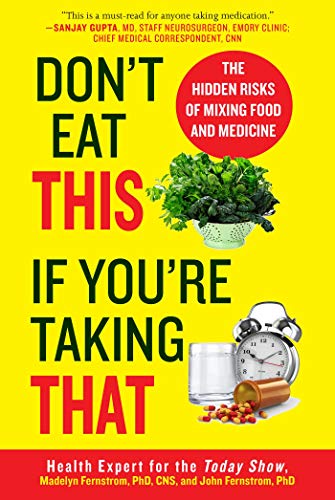
NBC Today Show nutrition and health guru Madelyn Fernstrom presents the ultimate guide to food and medicine interaction.
While no one wants to take medication to treat diabetes, high blood pressure, heart disease, or other ailments, for millions of people, this is a daily reality. Seven out of ten Americans take prescription drugs. But when it comes to food and medicine interactions, what you don’t know can harm your health.
Don’t Eat This If You’re Taking That takes the mystery out of food and medications, providing an easy-to-use guide for anyone taking a medication—short term or long term—that indicates foods to avoid that can interfere with the action of the medication. Readers can easily find a medication, see what foods to avoid, and make some smart swaps. Small diet changes learned from this book can have big health payoffs!
An added bonus in each chapter is a Dietary Supplements Alert box, providing the most up-to-date information on interactions with vitamins, minerals, and other dietary supplements. We all believe a diet rich in colorful fruits and vegetables, lean proteins, whole grains, and low-fat dairy products is the path to healthy eating, right? Not always. Consumers can easily personalize their healthiest eating plan to work with not against their medications.
Die Inhaltsangabe kann sich auf eine andere Ausgabe dieses Titels beziehen.
Über die Autorin bzw. den Autor
Dr. Madelyn Fernstrom is an award-winning clinician, scientist, health journalist, and author. She is a national media expert in the field of health and wellness with a particular focus on mindful living.
Auszug. © Genehmigter Nachdruck. Alle Rechte vorbehalten.
Don't Eat this If You're Taking That
The Hidden Risks of Mixing Food and Medicine
By Madelyn Fernstrom, John FernstromSkyhorse Publishing
Copyright © 2015 Madelyn Fernstrom and John Fernstrom
All rights reserved.
ISBN: 978-1-63220-452-3All rights reserved.
Contents
Introduction, ix,
Chapter 1: Antidepressants, 1,
Chapter 2: Pain Relief (Analgesic) Medicines, 31,
Chapter 3: Blood Thinners (Anticoagulants), 59,
Chapter 4: Diabetes Medicines, 81,
Chapter 5: Heartburn (Acid Reflux) Medicines, 101,
Chapter 6: Blood Pressure (Antihypertensive) Medicines, 123,
Chapter 7: Cholesterol-Lowering Medicines, 163,
Chapter 8: Heart (Cardiovascular) Medicines, 189,
Resources, 215,
Acknowledgments, 217,
Index, 219,
CHAPTER 1
ANTIDEPRESSANTS
While antidepressant medicines are well-known options for millions of people, it wasn't too long ago that the symptoms of depression were thought to be "all in your head" — and just a matter of willing yourself to feel better. Whether called "the blues" or melancholia, in the old days, the response to people reaching out for help was "life is tough, learn to cope." But science has shown that nothing could be further from the truth. The treatment of depression and anxiety has been documented for decades to be a combination of biology and behavior that can be helped by medicine.
The role of the brain in controlling mood is connected to actual abnormalities in brain chemistry. Small changes in brain chemistry in one or more neurotransmitters (brain chemicals) can produce large changes in mood. For many people, depression is a medical illness that benefits from medical treatment and the use of medicines, along with psychological treatment to help make necessary behavioral changes. It's that one-two punch of treatment that studies show is very effective in treating depression.
Beginning in the 1950s, the first generation of antidepressants — tricyclic antidepressants (TCAs) and monoamine oxidase inhibitors (MAOIs) — was discovered and quickly entered the marketplace. More than 50 years later, these medications are still used to treat certain types of depression. As interest in the connection between brain chemistry and depression continued to develop, a new class of antidepressants was introduced, the result of years of scientific research.
New to the market nearly 30 years after the first medications were introduced, these drugs were named serotonin-selective reuptake inhibitors (SSRIs), to resemble the action they had on brain chemistry. They became widely used because they worked well and had fewer side effects when compared with the earlier medicines. SSRIs are used primarily to treat major depression, but many are very useful for the long-term treatment of anxiety disorders and panic disorders. All are presently in clinical use.
Even more medications have been developed for the treatment of depression. A variation of the SSRIs (which only act on serotonin nerve cells), serotonin-norepinephrine reuptake inhibitors (SNRIs) is a group of drugs that act on two brain chemicals: serotonin and norepinephrine. This next generation of medicines has been shown to be a useful addition to antidepressant treatment options.
Still other antidepressants have been identified that don't fit neatly into one of the broad drug categories above. This is because their action on the brain is somewhat mixed, or not well understood, but they have proven to be good treatment options for some patients.
Everyone's brain is different, so it is a modern medical miracle to have so many drug options to help treat depression. The long-term treatment can be challenging, but the right combination of medication and talk therapy has provided relief for millions of people.
We'll take a look at each of these drug classes separately because of the important differences in how foods and supplements affect their actions.
Tricyclic Antidepressants
Eight different tricyclic antidepressants are available in the United States: amitriptyline (Elavil), clomipramine (Anafranil), desipramine (Norpramin), doxepin (Sinequan), imipramine (Tofranil), nortriptyline (Pamelor), protriptyline (Vivactil), and trimipramine (Surmontil). While in the same medication class, very small differences in their chemical makeup have different effects. That's a great thing when it comes to antidepressants, because individual responses to medication can vary widely. What is a miracle drug for one depressed person might not work for another.
If you begin taking one of these drugs, the daily dose will usually be divided into smaller doses taken throughout the day. After several weeks, once you and your physician have determined whether the medication is working, your doctor may suggest that you take the entire daily dose at one time. The general recommendation is usually shortly before bedtime, because these drugs can make you sleepy soon after you take them.
Foods to Avoid
Alcohol use can interfere with the delicate balance of choosing a dose of an antidepressant to optimize beneficial effects while minimizing side effects. For example, one of the most common side effects of these medications — drowsiness and dizziness — can be enhanced by alcohol. If you are a heavy drinker, alcohol can affect how the body breaks down these drugs, sometimes causing drug levels to be too high in the body and sometimes too low. Heavy alcohol use can make it quite difficult to determine the proper dose for maximizing beneficial effects, while also minimizing side effects. If you take a tricyclic antidepressant, it is wise to avoid alcohol altogether. Check with your doctor for guidance if you are a heavy alcohol user.
Limit the use of grapefruit and grapefruit juice. Grapefruit blocks the body's ability to break down tricyclic antidepressants, resulting in your body "seeing" too much of the medication — essentially, a higher dose. So, limit your intake of grapefruit products to a single serving each clay, such as one-half grapefruit or a small glass of grapefruit juice (6–8 ounces), if you are a grapefruit lover. You can also choose to avoid it altogether. If you don't already consume grapefruit products and take a tricyclic antidepressant, check with your doctor before adding any grapefruit products to your diet.
Dietary Supplements to Avoid
When it comes to dietary supplements, the list of compounds to avoid is long. That's because many of these supplements act on the brain, and antidepressants have multiple actions at different brain sites.
Kava and valerian can increase the drowsiness and sleepiness that occurs when taking these medicines. Kava can also interfere with your liver's ability to break down many of these antidepressants, increasing their concentration in the body, and thus potentially increasing side effects. Kava use should be avoided while you are taking a tricyclic antidepressant. If you already use kava or valerian, and a tricyclic antidepressant is recommended for you by your doctor, be sure to discuss your current use of these supplements with him.
St. John's wort increases the breakdown of several tricyclic antidepressants, reducing their levels in the body and potentially reducing their ability to treat your depression. It's as if your body is seeing a lower dose than intended. If you currently use or are thinking about using St.John's wort and are already taking a tricyclic antidepressant, you should discuss this plan with your...
„Über diesen Titel“ kann sich auf eine andere Ausgabe dieses Titels beziehen.
Suchergebnisse für Don't Eat This If You're Taking That: The Hidden...

Beispielbild für diese ISBN
Don't Eat This If You're Taking That: The Hidden Risks of Mixing Food and Medicine
Anbieter: World of Books (was SecondSale), Montgomery, IL, USA
Verkäuferbewertung 5 von 5 Sternen

Zustand: Good. Item in good condition. Textbooks may not include supplemental items i.e. CDs, access codes etc. Bestandsnummer des Verkäufers 00095532729
Gebraucht kaufen
EUR 4,59
Versand gratis
Versand innerhalb von USA
Versand innerhalb von USA
Anzahl: 1 verfügbar
Beispielbild für diese ISBN
Don't Eat This If You're Taking That: The Hidden Risks of Mixing Food and Medicine
Anbieter: World of Books (was SecondSale), Montgomery, IL, USA
Verkäuferbewertung 5 von 5 Sternen
Zustand: Very Good. Item in very good condition! Textbooks may not include supplemental items i.e. CDs, access codes etc. Bestandsnummer des Verkäufers 00107966966
Gebraucht kaufen
EUR 4,59
Versand gratis
Versand innerhalb von USA
Versand innerhalb von USA
Anzahl: 1 verfügbar
Foto des Verkäufers
Don't Eat This If You're Taking That: The Hidden Risks of Mixing Food and Medicine
Anbieter: Greenworld Books, Arlington, TX, USA
Verkäuferbewertung 5 von 5 Sternen
Zustand: very_good. Fast Free Shipping â" Very Good condition book with a firm cover and clean pages. Shows normal use and some light wear or limited notes markings. A solid, nice copy to enjoy. Bestandsnummer des Verkäufers GWV.1632204525.VG
Gebraucht kaufen
EUR 4,59
Versand gratis
Versand innerhalb von USA
Versand innerhalb von USA
Anzahl: 1 verfügbar
Beispielbild für diese ISBN
Don't Eat This If You're Taking That: The Hidden Risks of Mixing Food and Medicine
Anbieter: BooksRun, Philadelphia, PA, USA
Verkäuferbewertung 5 von 5 Sternen
Hardcover. Zustand: Very Good. With dust jacket. It's a well-cared-for item that has seen limited use. The item may show minor signs of wear. All the text is legible, with all pages included. It may have slight markings and/or highlighting. Bestandsnummer des Verkäufers 1632204525-11-18-29
Gebraucht kaufen
EUR 4,98
Versand gratis
Versand innerhalb von USA
Versand innerhalb von USA
Anzahl: 1 verfügbar
Beispielbild für diese ISBN
Don't Eat This If You're Taking That: The Hidden Risks of Mixing Food and Medicine
Anbieter: BooksRun, Philadelphia, PA, USA
Verkäuferbewertung 5 von 5 Sternen
Hardcover. Zustand: Very Good. It's a well-cared-for item that has seen limited use. The item may show minor signs of wear. All the text is legible, with all pages included. It may have slight markings and/or highlighting. Bestandsnummer des Verkäufers 1632204525-11-1
Gebraucht kaufen
EUR 5,31
Versand gratis
Versand innerhalb von USA
Versand innerhalb von USA
Anzahl: 1 verfügbar
Beispielbild für diese ISBN
Don't Eat This If You're Taking That: The Hidden Risks of Mixing Food and Medicine
Anbieter: Once Upon A Time Books, Siloam Springs, AR, USA
Verkäuferbewertung 4 von 5 Sternen

hardcover. Zustand: Acceptable. This is a used book. It may contain highlighting/underlining and/or the book may show heavier signs of wear . It may also be ex-library or without dustjacket. This is a used book. It may contain highlighting/underlining and/or the book may show heavier signs of wear . It may also be ex-library or without dustjacket. Bestandsnummer des Verkäufers mon0001304056
Gebraucht kaufen
EUR 2,03
EUR 3,45 Versand
Versand innerhalb von USA
Versand innerhalb von USA
Anzahl: 1 verfügbar
Beispielbild für diese ISBN
Don't Eat This If You're Taking That: The Hidden Risks of Mixing Food and Medicine
Anbieter: Half Price Books Inc., Dallas, TX, USA
Verkäuferbewertung 5 von 5 Sternen
Hardcover. Zustand: Very Good. Connecting readers with great books since 1972! Used books may not include companion materials, and may have some shelf wear or limited writing. We ship orders daily and Customer Service is our top priority! Bestandsnummer des Verkäufers S_475680856
Gebraucht kaufen
EUR 2,33
EUR 3,28 Versand
Versand innerhalb von USA
Versand innerhalb von USA
Anzahl: 1 verfügbar
Beispielbild für diese ISBN
Don't Eat This If You're Taking That : The Hidden Risks of Mixing Food and Medicine
Verlag:
Skyhorse Publishing Company, Incorporated, 2015
ISBN 10: 1632204525
ISBN 13: 9781632204523
Gebraucht
Hardcover
Anbieter: Better World Books, Mishawaka, IN, USA
Verkäuferbewertung 5 von 5 Sternen
Zustand: Good. Former library copy. Pages intact with minimal writing/highlighting. The binding may be loose and creased. Dust jackets/supplements are not included. Includes library markings. Stock photo provided. Product includes identifying sticker. Better World Books: Buy Books. Do Good. Bestandsnummer des Verkäufers 11373923-6
Gebraucht kaufen
EUR 6,05
Versand gratis
Versand innerhalb von USA
Versand innerhalb von USA
Anzahl: 2 verfügbar
Beispielbild für diese ISBN
Don't Eat This If You're Taking That: The Hidden Risks of Mixing Food and Medicine
Anbieter: HPB-Ruby, Dallas, TX, USA
Verkäuferbewertung 5 von 5 Sternen
Hardcover. Zustand: Very Good. Connecting readers with great books since 1972! Used books may not include companion materials, and may have some shelf wear or limited writing. We ship orders daily and Customer Service is our top priority! Bestandsnummer des Verkäufers S_478051556
Gebraucht kaufen
EUR 2,87
EUR 3,28 Versand
Versand innerhalb von USA
Versand innerhalb von USA
Anzahl: 1 verfügbar
Beispielbild für diese ISBN
Don't Eat This If You're Taking That: The Hidden Risks of Mixing Food and Medicine
Anbieter: Wonder Book, Frederick, MD, USA
Verkäuferbewertung 5 von 5 Sternen
Zustand: Very Good. Very Good condition. Very Good dust jacket. A copy that may have a few cosmetic defects. May also contain light spine creasing or a few markings such as an owner's name, short gifter's inscription or light stamp. Bundled media such as CDs, DVDs, floppy disks or access codes may not be included. Bestandsnummer des Verkäufers M06P-01486
Gebraucht kaufen
EUR 6,29
Versand gratis
Versand innerhalb von USA
Versand innerhalb von USA
Anzahl: 1 verfügbar