

Gesamtpreis (1 Artikel Artikel):
Versandziel:

harald keilhack (15 Ergebnisse)
Direkt zu den wichtigsten Suchergebnissen
Suchfilter
Produktart
- Alle Product Types
- Bücher (15)
- Magazine & Zeitschriften (Keine weiteren Ergebnisse entsprechen dieser Verfeinerung)
- Comics (Keine weiteren Ergebnisse entsprechen dieser Verfeinerung)
- Noten (Keine weiteren Ergebnisse entsprechen dieser Verfeinerung)
- Kunst, Grafik & Poster (Keine weiteren Ergebnisse entsprechen dieser Verfeinerung)
- Fotografien (Keine weiteren Ergebnisse entsprechen dieser Verfeinerung)
- Karten (Keine weiteren Ergebnisse entsprechen dieser Verfeinerung)
- Manuskripte & Papierantiquitäten (Keine weiteren Ergebnisse entsprechen dieser Verfeinerung)
Zustand Mehr dazu
- Neu (5)
- Wie Neu, Sehr Gut oder Gut Bis Sehr Gut (Keine weiteren Ergebnisse entsprechen dieser Verfeinerung)
- Gut oder Befriedigend (5)
- Ausreichend oder Schlecht (Keine weiteren Ergebnisse entsprechen dieser Verfeinerung)
- Wie beschrieben (5)
Einband
- alle Einbände
- Hardcover (15)
- Softcover (Keine weiteren Ergebnisse entsprechen dieser Verfeinerung)
Weitere Eigenschaften
- Erstausgabe (2)
- Signiert (Keine weiteren Ergebnisse entsprechen dieser Verfeinerung)
- Schutzumschlag (1)
- Angebotsfoto (9)
- Keine Print-on-Demand Angebote (15)
Sprache (3)
Preis
- Beliebiger Preis
- Weniger als EUR 20
- EUR 20 bis EUR 45
- Mehr als EUR 45 (Keine weiteren Ergebnisse entsprechen dieser Verfeinerung)
Gratisversand
- Kostenloser Versand nach USA (Keine weiteren Ergebnisse entsprechen dieser Verfeinerung)
Land des Verkäufers
Verkäuferbewertung
-

Schach-Höhepunkte. Auà ergewöhnliche Begebenheiten, kuriose Partien von 1997 bis 2003. Zusammengestellt auf Grundage der Schachspalten in der Stuttgarter Zeitung.
Sprache: Deutsch
Verlag: Schachverlag Kania, Schwieberdingen, 2004
ISBN 10: 3931192245 ISBN 13: 9783931192242
Anbieter: The Book Collector, Inc. ABAA, ILAB, Fort Worth, TX, USA
Verbandsmitglied: ABAA ILAB IOBA TXBA
Verkäuferbewertung 4 von 5 Sternen

Erstausgabe
Hardcover. Zustand: Very Good. 1st Edition. 319 pages with diagrams, tables, illustrations and drawings. Octavo (8 1/4" x 6") bound in original publisher's pictorial boards. First edition. Covers chess history from 1997 to 2003 with tournaments, matches and the development of chess ideas. Condition: Page ends lightly soiled else better than very good.
-

Knight on the Left: 1.Nc3
Sprache: Englisch
Verlag: Beyer Schachbuch Mär 2025, 2025
ISBN 10: 3959209401 ISBN 13: 9783959209403
Anbieter: BuchWeltWeit Ludwig Meier e.K., Bergisch Gladbach, Deutschland
Verkäuferbewertung 5 von 5 Sternen

Buch. Zustand: Neu. Neuware -This is the first full-length book about this interesting opening, unfolding a complete theory of 1.Nc3; including several offbeat lines against semi-open defences like the Alekhine or the Caro-Kann. The author thoroughly explains the basic structures which supply huge scope for creativity. There is broad discussion of move order subtleties andtransposition issues, so that the book deepens your understanding of opening play in general!'If you have a liking for the unusual and daring, you will probably not find many books this year that are better than this one!'(Garsten Hansen on Chesscafe, Checkpoint September 2003)Preface:This book covers the opening 1.Nc3. Opening - Oh, yes! Many consider 1. Nc3 to be just a move, which might be playable, but 'hardly has any independent value', rather transposing to 1.e4 systems.In this context, Khalifman's five volume opus 1.Nf3 - Opening for White according to Kramnik springs to mind. In an odyssey of more than 1300 pages, the former FIDE world Champion proves that the 'knight on the right' 1 Nf3 is a good move, but not an opening in itself! He doesn't at all cover the Reti (with which 1.Nf3 is usually connected), but a multitude of openings including the King's Indian, the Queen's Gambit (Slav, Orthodox, Accepted etc), the Dutch Defence, the English Opening and even some lines of the Sicilian (namely the Maroczy setup against the Accelerated Dragon); besides, some peculiarities like the Grünfeld without d2-d4. Quintessentially, 1.Nf3 is presented as a very subtle transposition tool, by which - to simplify a bit - undesirable lines of the aforementioned openings can be excluded.So, how are matters after 1.Nc3 There's a bunch of established independent concepts, e.g. after 1.Nc3 e5 2.Nf3 Nc6 3.d4 or 1.Nc3 d5 2.e4 d4 3.Nce2. It's mostly possible, but not always advisable to stay clear of all transpositions. Typical questions that a 1.Nc3 practitioner will face are:After 1.Nc3 d5 2.e4 e6, should he go for a French by 3.d4 or try some independent setup After 1.Nc3 c5, should he play 2.e4 immediately, possibly going for a Closed Sicilian (3.g3) or for the Grand Prix Attack (3.f4) Or transpose to a StanSicilian by 2.Nf3 Nc6 (2.d6, 2.e6) 3.d4 cxd4 4.Nxd4 and 5.e4 Or strive for the very tricky indepenlines, keeping the option of e2-e4, transposing to some Standard lines, as an 'emergency exit' in reserve After 1.Nc3 g6, should he return to 2.e4, should he go for the fierce 2.h4 or should he stay flexible by 2.Nf3 and 2.g3, not yet revealing his intentions In fact, every leading 1.Nc3 player has his own answers to those questions. Transat a later stage are full of subtleties, which will be revealed in this work. If one wants to switch from 1.e4 to 1.Nc3, this is even an advantage: you may start by playing 1.e4 e6/c6/Nf6 2.Nc3 (reaching some lines from Chapter IV), later on you play 1.Nc3, firstly transposing quite often to 1.e4 systems, then less and less.This book covers every possibility after 1.Nc3 which at least has some indepenvalue. Additionally, some 'secret' lines which belong to 1.e4 openings but in practice occur more often via 1.Nc3, or which have some features of this opening. For example, such Anti-Caro-Kann lines as 1.e4 c6 2.Nc3 d5 3.f4 or 3.Qf3! . Typically such lines are neglected in opening manuals.A special focus is on late transpositions (e.g., on move 6) to 1.e4 positions under favourable circumstances! I have excluded only 1.Nc3 d5 2.d4, which leads to the Veresov Opening after 2. Nf6 3.Bg5, to the French after 2.e6 3.e4 or the Caro-Kann after 2.c6 3.e4.Besides transpositions from 1.Nc3 to 1.e4 openings, there are also some in the other direction, e.g. 1.e4 e5 2.Nf3 d5 3.Nc3! , 1.e4 d5 2.Nc3! , 1.d4 Nf6 2.Nc3 c5 3.Nf3 (a basic position from Chapter V); one can argue that 1.e4 c5 2.f4 d5 3.Nc3 is also truly a 1.Nc3 position.An unrecognised openingUnlike unorthodox openings such as 1.b4 or 1.g4, 1.Nc3 by no means compromises White's position, an 384 pp. Englisch.
-

Zustand: good. Befriedigend/Good: Durchschnittlich erhaltenes Buch bzw. Schutzumschlag mit Gebrauchsspuren, aber vollständigen Seiten. / Describes the average WORN book or dust jacket that has all the pages present.
-

Knight on the Left: 1.Nc3
Sprache: Englisch
Verlag: Beyer Schachbuch Mär 2025, 2025
ISBN 10: 3959209401 ISBN 13: 9783959209403
Anbieter: Rheinberg-Buch Andreas Meier eK, Bergisch Gladbach, Deutschland
Verkäuferbewertung 5 von 5 Sternen
Buch. Zustand: Neu. Neuware -This is the first full-length book about this interesting opening, unfolding a complete theory of 1.Nc3; including several offbeat lines against semi-open defences like the Alekhine or the Caro-Kann. The author thoroughly explains the basic structures which supply huge scope for creativity. There is broad discussion of move order subtleties andtransposition issues, so that the book deepens your understanding of opening play in general!'If you have a liking for the unusual and daring, you will probably not find many books this year that are better than this one!'(Garsten Hansen on Chesscafe, Checkpoint September 2003)Preface:This book covers the opening 1.Nc3. Opening - Oh, yes! Many consider 1. Nc3 to be just a move, which might be playable, but 'hardly has any independent value', rather transposing to 1.e4 systems.In this context, Khalifman's five volume opus 1.Nf3 - Opening for White according to Kramnik springs to mind. In an odyssey of more than 1300 pages, the former FIDE world Champion proves that the 'knight on the right' 1 Nf3 is a good move, but not an opening in itself! He doesn't at all cover the Reti (with which 1.Nf3 is usually connected), but a multitude of openings including the King's Indian, the Queen's Gambit (Slav, Orthodox, Accepted etc), the Dutch Defence, the English Opening and even some lines of the Sicilian (namely the Maroczy setup against the Accelerated Dragon); besides, some peculiarities like the Grünfeld without d2-d4. Quintessentially, 1.Nf3 is presented as a very subtle transposition tool, by which - to simplify a bit - undesirable lines of the aforementioned openings can be excluded.So, how are matters after 1.Nc3 There's a bunch of established independent concepts, e.g. after 1.Nc3 e5 2.Nf3 Nc6 3.d4 or 1.Nc3 d5 2.e4 d4 3.Nce2. It's mostly possible, but not always advisable to stay clear of all transpositions. Typical questions that a 1.Nc3 practitioner will face are:After 1.Nc3 d5 2.e4 e6, should he go for a French by 3.d4 or try some independent setup After 1.Nc3 c5, should he play 2.e4 immediately, possibly going for a Closed Sicilian (3.g3) or for the Grand Prix Attack (3.f4) Or transpose to a StanSicilian by 2.Nf3 Nc6 (2.d6, 2.e6) 3.d4 cxd4 4.Nxd4 and 5.e4 Or strive for the very tricky indepenlines, keeping the option of e2-e4, transposing to some Standard lines, as an 'emergency exit' in reserve After 1.Nc3 g6, should he return to 2.e4, should he go for the fierce 2.h4 or should he stay flexible by 2.Nf3 and 2.g3, not yet revealing his intentions In fact, every leading 1.Nc3 player has his own answers to those questions. Transat a later stage are full of subtleties, which will be revealed in this work. If one wants to switch from 1.e4 to 1.Nc3, this is even an advantage: you may start by playing 1.e4 e6/c6/Nf6 2.Nc3 (reaching some lines from Chapter IV), later on you play 1.Nc3, firstly transposing quite often to 1.e4 systems, then less and less.This book covers every possibility after 1.Nc3 which at least has some indepenvalue. Additionally, some 'secret' lines which belong to 1.e4 openings but in practice occur more often via 1.Nc3, or which have some features of this opening. For example, such Anti-Caro-Kann lines as 1.e4 c6 2.Nc3 d5 3.f4 or 3.Qf3! . Typically such lines are neglected in opening manuals.A special focus is on late transpositions (e.g., on move 6) to 1.e4 positions under favourable circumstances! I have excluded only 1.Nc3 d5 2.d4, which leads to the Veresov Opening after 2. Nf6 3.Bg5, to the French after 2.e6 3.e4 or the Caro-Kann after 2.c6 3.e4.Besides transpositions from 1.Nc3 to 1.e4 openings, there are also some in the other direction, e.g. 1.e4 e5 2.Nf3 d5 3.Nc3! , 1.e4 d5 2.Nc3! , 1.d4 Nf6 2.Nc3 c5 3.Nf3 (a basic position from Chapter V); one can argue that 1.e4 c5 2.f4 d5 3.Nc3 is also truly a 1.Nc3 position.An unrecognised openingUnlike unorthodox openings such as 1.b4 or 1.g4, 1.Nc3 by no means compromises White's position, an 384 pp. Englisch.
-

Gebunden. Zustand: New.
-
Schachhöhepunkte. Außergewöhnliche Begebenheiten, kuriose Partien von 1997 bis 2003
Anbieter: Antiquariat ARS LIBRI, Andreas Lutz, Windeck, Deutschland
Verkäuferbewertung 5 von 5 Sternen
Stiefel, Frank (illustrator). Schwieberdingen, Kania 2004. 319 Seiten. Orig. Hardcover, 8°. Name verso Vorsatz, sonst gut erhalten.
-

Knight on the Left: 1.Nc3: Studies of an Unorthodox Chess Opening
Anbieter: buchversandmimpf2000, Emtmannsberg, BAYE, Deutschland
Verkäuferbewertung 5 von 5 Sternen
Gebundene Ausgabe. Zustand: Gut. Gebraucht - Gut - ungelesen,als Mängelexemplar gekennzeichnet, mit leichten Mängeln an Schnitt oder Einband durch Lager- oder Transportschaden Schachverlag Kania, Im Kaiserfeld 11, 71735 Eberdingen 383 pp. Englisch.
-

Knight on the Left: 1.Nc3 : Studies of an Unorthodox Chess Opening
Sprache: Englisch
Verlag: Beyer Schachbuch Mär 2025, 2025
ISBN 10: 3959209401 ISBN 13: 9783959209403
Anbieter: AHA-BUCH GmbH, Einbeck, Deutschland
Verkäuferbewertung 5 von 5 Sternen
Buch. Zustand: Neu. Neuware - This is the first full-length book about this interesting opening, unfolding a complete theory of 1.Nc3; including several offbeat lines against semi-open defences like the Alekhine or the Caro-Kann. The author thoroughly explains the basic structures which supply huge scope for creativity. There is broad discussion of move order subtleties andtransposition issues, so that the book deepens your understanding of opening play in general!'If you have a liking for the unusual and daring, you will probably not find many books this year that are better than this one!'(Garsten Hansen on Chesscafe, Checkpoint September 2003)Preface:This book covers the opening 1.Nc3. Opening - Oh, yes! Many consider 1. Nc3 to be just a move, which might be playable, but 'hardly has any independent value', rather transposing to 1.e4 systems.In this context, Khalifman's five volume opus 1.Nf3 - Opening for White according to Kramnik springs to mind. In an odyssey of more than 1300 pages, the former FIDE world Champion proves that the 'knight on the right' 1 Nf3 is a good move, but not an opening in itself! He doesn't at all cover the Reti (with which 1.Nf3 is usually connected), but a multitude of openings including the King's Indian, the Queen's Gambit (Slav, Orthodox, Accepted etc), the Dutch Defence, the English Opening and even some lines of the Sicilian (namely the Maroczy setup against the Accelerated Dragon); besides, some peculiarities like the Grünfeld without d2-d4. Quintessentially, 1.Nf3 is presented as a very subtle transposition tool, by which - to simplify a bit - undesirable lines of the aforementioned openings can be excluded.So, how are matters after 1.Nc3 There's a bunch of established independent concepts, e.g. after 1.Nc3 e5 2.Nf3 Nc6 3.d4 or 1.Nc3 d5 2.e4 d4 3.Nce2. It's mostly possible, but not always advisable to stay clear of all transpositions. Typical questions that a 1.Nc3 practitioner will face are:After 1.Nc3 d5 2.e4 e6, should he go for a French by 3.d4 or try some independent setup After 1.Nc3 c5, should he play 2.e4 immediately, possibly going for a Closed Sicilian (3.g3) or for the Grand Prix Attack (3.f4) Or transpose to a StanSicilian by 2.Nf3 Nc6 (2.d6, 2.e6) 3.d4 cxd4 4.Nxd4 and 5.e4 Or strive for the very tricky indepenlines, keeping the option of e2-e4, transposing to some Standard lines, as an 'emergency exit' in reserve After 1.Nc3 g6, should he return to 2.e4, should he go for the fierce 2.h4 or should he stay flexible by 2.Nf3 and 2.g3, not yet revealing his intentions In fact, every leading 1.Nc3 player has his own answers to those questions. Transat a later stage are full of subtleties, which will be revealed in this work. If one wants to switch from 1.e4 to 1.Nc3, this is even an advantage: you may start by playing 1.e4 e6/c6/Nf6 2.Nc3 (reaching some lines from Chapter IV), later on you play 1.Nc3, firstly transposing quite often to 1.e4 systems, then less and less.This book covers every possibility after 1.Nc3 which at least has some indepenvalue. Additionally, some 'secret' lines which belong to 1.e4 openings but in practice occur more often via 1.Nc3, or which have some features of this opening. For example, such Anti-Caro-Kann lines as 1.e4 c6 2.Nc3 d5 3.f4 or 3.Qf3! . Typically such lines are neglected in opening manuals.A special focus is on late transpositions (e.g., on move 6) to 1.e4 positions under favourable circumstances! I have excluded only 1.Nc3 d5 2.d4, which leads to the Veresov Opening after 2. Nf6 3.Bg5, to the French after 2.e6 3.e4 or the Caro-Kann after 2.c6 3.e4.Besides transpositions from 1.Nc3 to 1.e4 openings, there are also some in the other direction, e.g. 1.e4 e5 2.Nf3 d5 3.Nc3! , 1.e4 d5 2.Nc3! , 1.d4 Nf6 2.Nc3 c5 3.Nf3 (a basic position from Chapter V); one can argue that 1.e4 c5 2.f4 d5 3.Nc3 is also truly a 1.Nc3 position.An unrecognised openingUnlike unorthodox openings such as 1.b4 or 1.g4, 1.Nc3 by no means compromises White's position, an; Ungekürzte Ausgabe.
-

Buch. Zustand: Neu. Knight on the Left: 1.Nc3 | Studies of an Unorthodox Chess Opening | Harald Keilhack | Buch | 384 S. | Englisch | 2025 | Beyer Schachbuch | EAN 9783959209403 | Verantwortliche Person für die EU: Joachim Beyer Verlag, Zur Wallfahrtskirche 5, 97483 Eltmann, info[at]beyerverlag[dot]de | Anbieter: preigu.
-

Knight on the Left: 1.Nc3. Studies of an Unorthodox Chess Opening.
Anbieter: Antikvariat Faust, Göteborg, Schweden
Verkäuferbewertung 4 von 5 Sternen
Schachverlag Kania, Schwieberdingen 2005. 383, (1) pp. Hardcover. Front end paper is missing. Good condition.
-
Grundlagen des modernen Eröffnungsspiels
Anbieter: Gerald Wollermann, Bad Vilbel, Deutschland
Verkäuferbewertung 5 von 5 Sternen
Gebundene Ausgabe. Zustand: Gut. 2., erw. u. aktualis. 303 S. Innerhalb Deutschlands Versand je nach Größe/Gewicht als Großbrief bzw. Bücher- und Warensendung mit der Post oder per DHL. Rechnung mit MwSt.-Ausweis liegt jeder Lieferung bei. Sprache: Deutsch Gewicht in Gramm: 581.
-
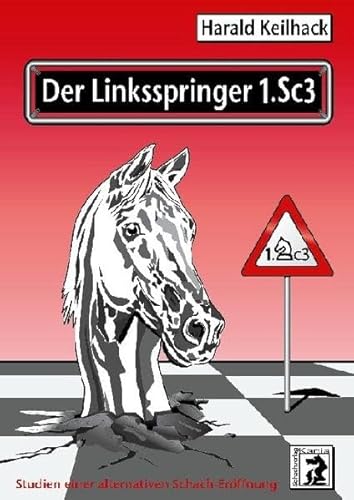
Der Linksspringer 1.Sc3
Anbieter: Mooney's bookstore, Den Helder, Niederlande
Verkäuferbewertung 4 von 5 Sternen
Zustand: Very good.
-
Der Linksspringer 1.Sc3.
Anbieter: Vangsgaards Antikvariat Aps, Copenhagen, Dänemark
Verkäuferbewertung 5 von 5 Sternen
Schachverlag Kania, Schwieberdingen 2003. 399 pages. Orig. boards. Near fine.
-

Der Linksspringer 1. Pc3 - Studien einer alternativen Schach-Eröffnung
Sprache: Deutsch
Verlag: Schwieberdingen, Schachverlag Kania, 2003
ISBN 10: 3931192202 ISBN 13: 9783931192204
Anbieter: Antiquariaat Looijestijn, Rotterdam, Niederlande
Verkäuferbewertung 5 von 5 Sternen
2003, original boards, 400 pp., in very good condition.
-
Knight on the Left: 1.Nc3 (Studies of an Unorthodox Chess Opening)
Anbieter: Frans Melk Antiquariaat, HILVERSUM, Niederlande
Verkäuferbewertung 5 von 5 Sternen
Erstausgabe
Schachverlag Kania, 2005. First printing. 21,5 x 15 cm. Hardcover. 383 pages. Text in English. AS NEW [Schaken / Chess ].


