Gesamtpreis (1 Artikel Artikel):
Versandziel:

moshe leon (5 Ergebnisse)
Direkt zu den wichtigsten Suchergebnissen
Suchfilter
Produktart
- Alle Product Types
- Bücher (5)
- Magazine & Zeitschriften (Keine weiteren Ergebnisse entsprechen dieser Verfeinerung)
- Comics (Keine weiteren Ergebnisse entsprechen dieser Verfeinerung)
- Noten (Keine weiteren Ergebnisse entsprechen dieser Verfeinerung)
- Kunst, Grafik & Poster (Keine weiteren Ergebnisse entsprechen dieser Verfeinerung)
- Fotografien (Keine weiteren Ergebnisse entsprechen dieser Verfeinerung)
- Karten (Keine weiteren Ergebnisse entsprechen dieser Verfeinerung)
- Manuskripte & Papierantiquitäten (Keine weiteren Ergebnisse entsprechen dieser Verfeinerung)
Zustand Mehr dazu
- Neu (1)
- Wie Neu, Sehr Gut oder Gut Bis Sehr Gut (Keine weiteren Ergebnisse entsprechen dieser Verfeinerung)
- Gut oder Befriedigend (3)
- Ausreichend oder Schlecht (Keine weiteren Ergebnisse entsprechen dieser Verfeinerung)
- Wie beschrieben (1)
Einband
Weitere Eigenschaften
- Erstausgabe (Keine weiteren Ergebnisse entsprechen dieser Verfeinerung)
- Signiert (Keine weiteren Ergebnisse entsprechen dieser Verfeinerung)
- Schutzumschlag (Keine weiteren Ergebnisse entsprechen dieser Verfeinerung)
- Angebotsfoto (3)
- Keine Print-on-Demand Angebote (5)
Sprache (3)
Gratisversand
- Kostenloser Versand nach USA (Keine weiteren Ergebnisse entsprechen dieser Verfeinerung)
Land des Verkäufers
Verkäuferbewertung
-
Liberties Journal of Culture and Politics: Volume I, Issue 1
Sprache: Englisch
Verlag: Liberties Journal Foundation, 2020
ISBN 10: 173571870X ISBN 13: 9781735718705
Paperback. Zustand: Very Good. Connecting readers with great books since 1972! Used books may not include companion materials, and may have some shelf wear or limited writing. We ship orders daily and Customer Service is our top priority!
-

Verlag: Caractères, n° 30-31, c. 1983. Un volume in-8°, broché., 1983
Anbieter: Librairie Dhouailly, Paris, Frankreich
Verbandsmitglied: ILAB
Verkäuferbewertung 4 von 5 Sternen

[16773].
-
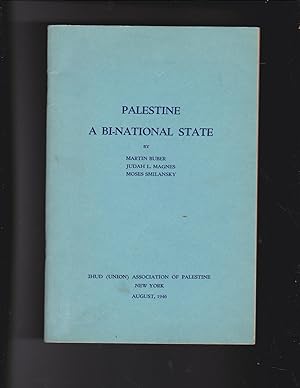
Palestine, a bi-national state
Verlag: Ihud (Union) Association of Palestine, 1776 Broadway, Room 2306 New York 19, New York, 1946
Soft cover. Zustand: Very Good. 79, [1] pages ; 23 x 15 cm. Contents: Preface, by J.L. Magnes. Written statement to the Anglo-American committee of inquiry, Jerusalem, March 5, 1946, by the Ihud (Union) association of Palestine. Oral testimony before Anglo-American committee of inquiry, by Martin Buber, J.L. Magnes, Moses Smilansky -Jerusalem, March 14, 1946. Letter to New York times, June 3, 1946, by J.L. Magnes. Palestine and the Middle East, NBC broadcast, New York, June 22, 1946, by J.L. Magnes. Laid in: a new looking card asking for contributions towards the work of the Ihud, with checks payable to J. L. Magnes, Chairman. Martin (Mordechai) Buber (Vienna, February 8, 1878 - Jerusalem, Israel, June 13, 1965) was an Austrian and Israeli Jewish philosopher best known for his philosophy of dialogue, a form of existentialism centered on the distinction between the I-Thou relationship and the I-It relationship. Buber came from a family of observant Jews, but broke with Jewish custom to pursue secular studies in philosophy. He wrote about Zionism and worked with various bodies within the Zionist movement for almost 50 years. In 1923, Buber wrote his famous essay on existence, Ich und Du (translated into English as I and Thou), and in 1925, he began translating the Hebrew Bible into German reflecting the patterns of the Hebrew language. He was nominated for the Nobel Prize in Literature ten times, and the Nobel Peace Prize seven times. Buber was born to an Orthodox Jewish family and was a direct descendant of the 16th century rabbi Meir Katzenellenbogen, the Maharam, the Hebrew acronym for "Mordechai, HaRav (the Rabbi), Meir", of Padua. Karl Marx is another notable relative. After the divorce of his parents when he was three years old, he was raised by his grandfather in Lemberg (now Lviv in Ukraine). His grandfather, Solomon Buber, was a scholar of Midrash and Rabbinic Literature. At home, Buber spoke Yiddish and German. In 1892, Buber returned to his father's house in Lemberg. Despite Buber's putative connection to the Davidic line as a descendant of Katzenellenbogen, a personal religious crisis led him to break with Jewish religious customs. He began reading Immanuel Kant, Soren Kierkegaard, and Friedrich Nietzsche. The latter two, in particular, inspired him to pursue studies in philosophy. In 1896, Buber began studies in philosophy, art history, German studies, and philology in Vienna. In 1898, he joined the Zionist movement, participating in congresses and organizational work. In 1899, while studying in Zürich, Buber met his future wife, Paula Winkler, a brilliant Catholic writer from a Bavarian peasant family who in 1901 left the Catholic Church and in 1907 converted to Judaism. In 1930, Buber became an honorary professor at the University of Frankfurt am Main, but resigned from his professorship in protest immediately after Adolf Hitler came to power in 1933. He then founded the Central Office for Jewish Adult Education, which became an increasingly important body as the German government forbade Jews from public education. In 1938, Buber left Germany and settled in Jerusalem, Mandatory Palestine, receiving a professorship at Hebrew University and lecturing in anthropology and introductory sociology. Buber became the best known Israeli philosopher. Buber's evocative, sometimes poetic, writing style marked the major themes in his work: the retelling of Hasidic and Chinese tales, Biblical commentary, and metaphysical dialogue. A cultural Zionist, Buber was active in the Jewish and educational communities of Germany and Israel. He was also a supporter of a binational solution in Eretz Israel, and, after the establishment of the Jewish state of Israel, of a regional federation of Israel and Arab states. His influence extends across the humanities, particularly in the fields of social psychology, social philosophy, and religious existentialism. Buber's attitude toward Zionism was tied to his desire to promote a vision of "Hebrew humanism", a term coined.
-
PALESTINE A Bi-NATIONAL STATE
Verlag: IHUD (UNION) Association of Palestine, 1776 Broadway, Room 2306, New York 19, New York, 1946
Soft cover. Zustand: Very Good. 80 pages. 227 x 151 mm. Contents: Preface, by J.L. Magnes.--Written statement to the Anglo-American committee of inquiry, Jerusalem, March 5, 1946, by the Ihud (Union) association of Palestine.--Oral testimony before Anglo-American committee of inquiry, by Martin Buber, J.L. Magnes, Moses Smilansky--Jerusalem, March 14, 1946.--Letter to New York times, June 3, 1946, by J.L. Magnes.--Palestine and the Middle East, NBC broadcast, New York, June 22, 1946, by J.L. Magne. Moshe Smilansky (February 24, 1874 the village of Telepino in Kiev Governorate, then part of the Russian Empire - October 6, 1953 Tel Aviv, Israel) was a pioneer of the First Aliyah, a Zionist leader who advocated a bi-national state with the Arabs. He was a farmer and a prolific author of fiction and non-fiction literary works. He was born to a family of farmers in Telepino, immigrated to Eretz Israel in 1890 when it was part of the Ottoman Palestine. He planned to study at Mikve Israel, but refused to study there in French and with his family's help purchased land in Hadera in 1891. He prevailed on his parents to settle in Eretz Israel and after his family's return to Russia Smilansky became an agricultural worker in Rishon LeZion before settling in Rehovot in 1893. In addition to being an agricultural pioneer (vineyards, almonds and citrus groves owner), he was one of the founders of the Hitahadut ha-Moshavot bi-Yehudah ve-Shomron, whose chairman he became during World War I. In 1922 Smilansky was one of the founders of Hitahdut HaIkarim, which he headed during its early years and the editor of its periodical, Bustenai, from 1929 to 1937. Smilansky volunteered to the Jewish Legion in 1918, and was the commander of the Haganah Organization in Rehovot during the 1921 Jaffa Riots. Smilansky was also active during the 1920s and 1930s in organizations for the reclamation and acquisition of land, especially in the Negev. Smilansky, considered himself a disciple of Ahad Ha'am, was an active Zionist, wrote many essays and articles, which he has contributed to Hebrew periodicals published in Russia and in Germany (Ha-Tsefirah, Ha-Meliz, Ha-Tzofeh, Lu'ah Ahiasaf, Ha-Shilo'ah, and Ha-Olam), sometimes under the pen name "Ben Hava". Smilansky also published in Hebrew periodicals in Eretz Israel, where he was one of the first contributors (writing under the pen name "Heruti") to the journal of Ha-Po'el ha-Tsa'ir and a co-founder of Ha-Omer literary journal together with David Yellin and S. Ben Zion (Simha Alter Guttman). Smilansky was a delegate to the Seventh Zionist Congress in Basel in 1905. In the 1930s Smilanskysky was a member of "The Five" (together with Gad Frumkin, Pinhas Rutenberg, Moshe Novomeysky, and Judah Leon Magnes), who met with Arab leaders in an attempt to explore the idea of a bi-national state. In the 1940s, with the Arabs in mind, he opposed the struggle against the British in Palestine. In 1946, Smilansky, together with members of Ihud, advocated the establishment of an Arab-Jewish state to the Anglo-American Committee of Inquiry. Smilansky's literary works include autobiographical novels as well as memoirs and non-fiction depictions of the Zionist pioneers of the First Aliyah and Second Aliyah that were collected in the four-volume Mishpahat ha-Adamah and the six-volume Perakim be-Toledot ha-Yishuv. His groundbreaking fiction stories and sketches depicting Arab life in Ottoman Palestine were first published in 1906 under the pseudonym Hawaja Mussa (Hebrew:khudja Musa), and collected in the volume Bene Arav, first published in Odessa in 1911. Martin (Mordechai) Buber (Vienna, February 8, 1878 - Jerusalem, Israel, June 13, 1965) was an Austrian and Israeli Jewish philosopher best known for his philosophy of dialogue, a form of existentialism centered on the distinction between the I-Thou relationship and the I-It relationship. Buber came from a family of observant Jews, but broke with Jewish custom to pursue secular studies in philosophy. . . .
-

Kitvei Rabbi Moshe di Leon 2 vols
Sprache: Hebräisch
Erscheinungsdatum: 2019
Anbieter: Sifrey Sajet, STRASBOURG, Frankreich
Verkäuferbewertung 4 von 5 Sternen
Hardback. Zustand: New. Hebrew only. Modern print. Contains 12 different titles of this author. Multiple copies of our books may sometimes be available. Please enquire if interested. // En hébreu. Moshe ben Shem Tov de Leon est un rabbin espagnol du XIIIe siècle, parfois considéré comme le compilateur du Zohar. De multiples exemplaires de nos livres peuvent parfois etre disponibles. Renseignez-vous.