
Repin i e (3 Ergebnisse)

- Softcover
Anbieter: medimops, Berlin, Deutschlandmedimops
Verkäufer/-in kontaktierenVerkäufer/-in mit 5 SternenZustand: Gebraucht - Gut
EUR 10,97
EUR 10,00 VersandVersand von Deutschland nach USAAnzahl: 1 verfügbar
Zustand: very good. Gut/Very good: Buch bzw. Schutzumschlag mit wenigen Gebrauchsspuren an Einband, Schutzumschlag oder Seiten. / Describes a book or dust jacket that does show some signs of wear on either the binding, dust jacket or pages.

Sprache: Russisch
- Hardcover
Anbieter: Oriental Research Partners, Newtonville, MA, USAOriental Research Partners
Verkäufer/-in kontaktierenVerkäufer/-in mit 5 SternenZustand: Gebraucht - Sehr gut
EUR 21,89
EUR 2,43 VersandVersand innerhalb von USAAnzahl: 1 verfügbar
In den WarenkorbHardcover. Zustand: Fine. Len. 1986/, pp. 488, ill. Repin as famous artist.
- Softcover
Anbieter: Ground Zero Books, Ltd., Silver Spring, MD, USAGround Zero Books, Ltd.
Verkäufer/-in kontaktierenVerkäufer/-in mit 5 SternenZustand: Gebraucht - Befriedigend
EUR 58,65
EUR 4,38 VersandVersand innerhalb von USAAnzahl: 1 verfügbar
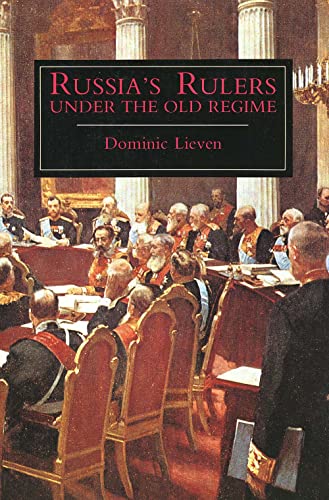
Trade paperback. Zustand: Good. Second printing. xxii, 407 [3] pages. Chronology. Glossary. Illus. Notes. Select Bibliography. Appendices. Index. Index of Authors Cited. The author draws on previously untouched Soviet archival sources. The front and back covers show some wear around the edges. The author probes deeply into the l…ives of the 215 men appointed by Tsar Nicholas II to the State Council, which contained important members of the Russian governmental system. Basing his research on previously untouched Soviet archival sources, Dominic Lieven describes the social, ethnic, educational, and career backgrounds of these men, and he explores how their mentalities were shaped, what their political views were. Lieven looks forward to the causes of the collapse of the old regime and backward as well, tracing the history of the Russian ruling elite from its origins and making comparisons with the ruling elite of other societies. Dominic Lieven (born 19 January 1952) is an English research professor at Cambridge University (Senior Research Fellow, Trinity College) and a Fellow of the British Academy and of Trinity College, Cambridge. Lieven is a writer on Russian history, on empires and emperors, on the Napoleonic era and the First World War, and on European aristocracy. Lieven is on the Editorial Board of Journal of Intelligence and Terrorism Studies[4]. He was elected in 2001 Fellow of the British Academy, and was head of the History Department at the London School of Economics from 2009 to 2011; he was appointed lecturer there in 1978, and professor in 1993. He was appointed to his current position at the University of Cambridge in 2011. Who were the members of the Russian ruling elite during the reign of the last Tsar before the Revolution? How did high-level politics operate in Imperial Russia's last years? In this highly original book, Dominic Lieven probes deeply into the lives of the 215 men appointed by Nicholas II to the State Council, which contained all important members of the Russian governmental system of that era. Basing his research on previously untouched Soviet archival sources, Dominic Lieven describes the social, ethnic, educational, and career backgrounds of these men, and he explores how their mentalities were shaped, what their political views were, and how their attitudes and opinions were influenced by their differing backgrounds and careers. Lieven looks not only forward to the causes of the collapse of the old regime but, in his introductory chapter, backward as well, tracing the history of the Russian ruling elite from its earliest origins and making comparisons with the ruling elite of other societies. His conclusions about the resilience of the old aristocratic Russian families and the operation of their self-protective, career-advancing network are striking and original. Lieven's book serves many purposes. It tells us a great deal about the balance of power between the bureaucrats and their monarchs, it brings to life the members of the last ruling elite, and it reveals interesting information about the role and personality of the Emperor Nicholas II. By making regular comparisons with aristocratic elites elsewhere, it sets the Russian experience in a broader European context. And by looking at Russia's problems through the eyes of its ruling aristocracy, it enables us to understand a good deal that is otherwise incomprehensible about the coming of the Russian Revolution. His conclusions about the resilience of the old aristocratic Russian families and the operation of their self-protective, career-advancing network are striking and original. Lieven's book serves many purposes. It tells us a great deal about the balance of power between the bureaucrats and their monarchs, it brings to life the members of the last ruling elite, and it reveals interesting information about the role and personality of the Emperor Nicholas II. By making regular comparisons with aristocratic elites elsewhere, it sets the Russian experience in a broader European context. And by looking at Russia's problems through the eyes of its ruling aristocracy, it enables us to understand a good deal that is otherwise incomprehensible about the coming of the Russian Revolution. I. E. Repin (Cover Illustration) (illustrator).

