Gesamtpreis (1 Artikel Artikel):
Versandziel:

ringlemann (2 Ergebnisse)
Direkt zu den wichtigsten Suchergebnissen
Suchfilter
Produktart
- Alle Product Types
- Bücher (2)
- Magazine & Zeitschriften (Keine weiteren Ergebnisse entsprechen dieser Verfeinerung)
- Comics (Keine weiteren Ergebnisse entsprechen dieser Verfeinerung)
- Noten (Keine weiteren Ergebnisse entsprechen dieser Verfeinerung)
- Kunst, Grafik & Poster (Keine weiteren Ergebnisse entsprechen dieser Verfeinerung)
- Fotografien (Keine weiteren Ergebnisse entsprechen dieser Verfeinerung)
- Karten (Keine weiteren Ergebnisse entsprechen dieser Verfeinerung)
- Manuskripte & Papierantiquitäten (Keine weiteren Ergebnisse entsprechen dieser Verfeinerung)
Zustand Mehr dazu
- Neu (Keine weiteren Ergebnisse entsprechen dieser Verfeinerung)
- Wie Neu, Sehr Gut oder Gut Bis Sehr Gut (Keine weiteren Ergebnisse entsprechen dieser Verfeinerung)
- Gut oder Befriedigend (2)
- Ausreichend oder Schlecht (Keine weiteren Ergebnisse entsprechen dieser Verfeinerung)
- Wie beschrieben (Keine weiteren Ergebnisse entsprechen dieser Verfeinerung)
Einband
- alle Einbände
- Hardcover (2)
- Softcover (Keine weiteren Ergebnisse entsprechen dieser Verfeinerung)
Weitere Eigenschaften
- Erstausgabe (Keine weiteren Ergebnisse entsprechen dieser Verfeinerung)
- Signiert (Keine weiteren Ergebnisse entsprechen dieser Verfeinerung)
- Schutzumschlag (Keine weiteren Ergebnisse entsprechen dieser Verfeinerung)
- Angebotsfoto (2)
- Keine Print-on-Demand Angebote (2)
Sprache (1)
Preis
- Beliebiger Preis
- Weniger als EUR 20 (Keine weiteren Ergebnisse entsprechen dieser Verfeinerung)
- EUR 20 bis EUR 45 (Keine weiteren Ergebnisse entsprechen dieser Verfeinerung)
- Mehr als EUR 45
Gratisversand
- Kostenloser Versand nach USA (Keine weiteren Ergebnisse entsprechen dieser Verfeinerung)
Land des Verkäufers
Verkäuferbewertung
-
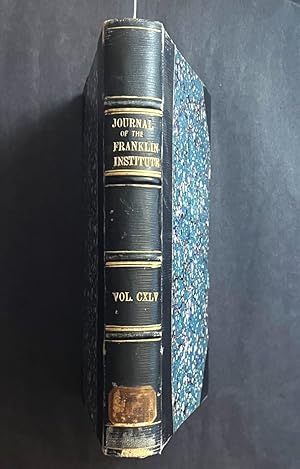
(Ringlemann) "The Smoke Nuisance and its Regulation, with Especial Reference to the Condition Prevailing in Philadelphia Improved Furnaces and Mechanical Stokers" in "Journal of the Franklin Institute."
Verlag: Philadelphia, Franklin Institute, 1898
Anbieter: JF Ptak Science Books, Hendersonville, NC, USA
Verkäuferbewertung 5 von 5 Sternen

Hardcover. Zustand: Good. (Ringlemann) "The Smoke Nuisance and its Regulation, with Especial Reference to the Condition Prevailing in Philadelphia Improved Furnaces and Mechanical Stokers" in "Journal of the Franklin Institute" vol 145, January and February 1898, 476pp, with the Smoke Nuisance paper in two parts, pp -124 and 107-133. With illustrations. Nice copy of this volume, bound in half calf with raised bands and marbled boards. Ex-library copy with an old paper label on spine bottom and the library bookplate. GOOD+ condition. [++] This is one of those things that you'd probably not properly think about until you had to do so--a quantitative measuring device to classify smoke (or visible emissions). In a way it reminds me of Mr. Howard who was the first to classify clouds in a scientific way in 1803--surely you'd think that the great classifiers like Aristotle & Co. would have done this over the centuries, but evidently the moving floating mountains escaped scientific classification until relatively recently. Is the same true of the cloud's distant cousin, smoke? And what about classifying fog? I don't have the answers to this tonight as its too late to figure it out right now, but I'll return with the answers and correctly update this post. In the meantime, please find below the last part of a two-part article that appeared in the Journal of the Franklin Institute1 in which the organization and classification of smoke by Max Ringlemann is discussed and explained. It seems as though there is a slightly earlier publication of the scale in Engineering News in 1897, though I haven't yet (again!) found the original article by Ringlemann himself. ("In 1897 architectural engineer Maximilien Ringelmann developed smoke charts to allow observers to contextualize observable smoke into a scale of known gray. Lighter smoke indicated fewer particulates and more water, while the darkest of smoke was of grave concern. The charts were posted outside of factories, providing a very public method of environmental monitoring and awareness."--Science History Institute.
-
GÉNIE RURAL APPLIQUÉ AUX COLONIES.
Anbieter: Livraria Castro e Silva, Lisboa, Portugal
Verkäuferbewertung 5 von 5 Sternen
Hard Cover. Zustand: Good. Cours professé a l'Institut National d'Agronomie Coloniale par. Membre de l'Académie d'Agriculture, Professeur a l'Institut National Agronomique, Directeur de la Station d'Essais de Machines. Deuxième édition, revue et augmentée. Société d'Éditions Géographiques, Maritimes et Coloniales. Paris. 1930. De 25x17 cm. Com [viii], 727 págs. Encadernação em tecido, com o corte das folhas mosqueado a azul. Profusamente ilustrado com 976 figuras (fotografias e gravuras), das quais 538 foram gravadas a partir de desenhos do autor. Language: Francês / French Location/localizacao: I-196-C-16.