Gesamtpreis (1 Artikel Artikel):
Versandziel:

rontgen wilhelm konrad (5 Ergebnisse)
Direkt zu den wichtigsten Suchergebnissen
Suchfilter
Produktart
- Alle Product Types
- Bücher (5)
- Magazine & Zeitschriften (Keine weiteren Ergebnisse entsprechen dieser Verfeinerung)
- Comics (Keine weiteren Ergebnisse entsprechen dieser Verfeinerung)
- Noten (Keine weiteren Ergebnisse entsprechen dieser Verfeinerung)
- Kunst, Grafik & Poster (Keine weiteren Ergebnisse entsprechen dieser Verfeinerung)
- Fotografien (Keine weiteren Ergebnisse entsprechen dieser Verfeinerung)
- Karten (Keine weiteren Ergebnisse entsprechen dieser Verfeinerung)
- Manuskripte & Papierantiquitäten (Keine weiteren Ergebnisse entsprechen dieser Verfeinerung)
Zustand Mehr dazu
- Neu (1)
- Wie Neu, Sehr Gut oder Gut Bis Sehr Gut (2)
- Gut oder Befriedigend (1)
- Ausreichend oder Schlecht (Keine weiteren Ergebnisse entsprechen dieser Verfeinerung)
- Wie beschrieben (1)
Einband
- alle Einbände
- Hardcover (Keine weiteren Ergebnisse entsprechen dieser Verfeinerung)
- Softcover (4)
Weitere Eigenschaften
- Erstausgabe (1)
- Signiert (Keine weiteren Ergebnisse entsprechen dieser Verfeinerung)
- Schutzumschlag (Keine weiteren Ergebnisse entsprechen dieser Verfeinerung)
- Angebotsfoto (3)
- Keine Print-on-Demand Angebote (5)
Sprache (3)
Preis
- Beliebiger Preis
- Weniger als EUR 20 (Keine weiteren Ergebnisse entsprechen dieser Verfeinerung)
- EUR 20 bis EUR 45
- Mehr als EUR 45
Gratisversand
- Kostenloser Versand nach USA (Keine weiteren Ergebnisse entsprechen dieser Verfeinerung)
Land des Verkäufers
Verkäuferbewertung
-

EUR 21,65
EUR 48,99 Versand
Versand von Deutschland nach USAAnzahl: Mehr als 20 verfügbar
In den WarenkorbZustand: New. KlappentextrnrnExcerpt from Eine Neue Art von StrahlenB0bftlllk Regetitorium der Botanik fur Mediciner, Pharmazeuten un lehramts-canditaten von Prof. Dr. A. Hansen.About the PublisherForgotten Books publishes hundreds of .
-

Eine neue Art von Strahlen, pts. 1 & 2, . Facsimile, English Translation, and Bibliography, ed. by H.S. Klickstein (The Mallincrodt Classics of Radiology Volume I)
Verlag: Mallinckrodt Classics, 1966
Anbieter: Wm Burgett Bks and Collectibles, San diego, CA, USA
Verkäuferbewertung 4 von 5 Sternen

Wraps In Slip Case. Zustand: Fine. All items present. Size: 4to - over 9¾" - 12" tall.
-
Eine neue Art von Strahlen, pts. 1 & 2, . Facsimile, English Translation, and Bibliography, ed. by H.S. Klickstein (The Mallincrodt Classics of Radiology Volume I)
Verlag: Mallinckrodt Classics, 1966
Anbieter: Wm Burgett Bks and Collectibles, San diego, CA, USA
Verkäuferbewertung 4 von 5 Sternen
Wraps In Slip Case. Zustand: Fine. All items present. Size: 4to - over 9¾" - 12" tall.
-
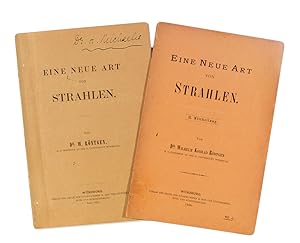
Eine neue Art von Strahlen. (Vorläufige Mittheilung) / Eine neue Art von Strahlen. II. Mittheilung.
Sprache: Deutsch
Verlag: Verlag und Druck der Stahel'schen K.B. Hof- und Universitätsbuch- und Kunsthandlung, Würzburg, 1895
Anbieter: Milestones of Science Books, Ritterhude, Deutschland
Verkäuferbewertung 5 von 5 Sternen

Erstausgabe
EUR 9.500,00
EUR 45,00 Versand
Versand von Deutschland nach USAAnzahl: 1 verfügbar
In den WarenkorbSoft cover. Zustand: Very Good. 1st Edition. Two offprints from: Sitzungsberichte der Würzburger Physikalisch-medicinischen Gesellschaft Würzburg, 1895-1896. 8vo (230 x 150 mm). 10; 9 [3] pp. Including 3 unnumbered pages of publisher's adverts in 2nd part. Publisher's original printed wrappers (minor repair to wrappers with reinforcement of spine edges and the inner wrappers silked, light soiling and wrinkling, weak vertical fold crease through 1st part). Housed in custom-made quarter morocco and cloth clamshell box. Internally clean and crisp throughout, with just a little age-toning and a trifle of dust-soiling to outer margins, but free of foxing or staining. Provenance: Arthur Edward Lyons (his bookplate to inner cover of clamshell box). Very good copies in the original wrappers which, due to paper quality, are often found embrittled and heavily chipped (here stabilized with thin, transparent fiber fabric not obscuring readability of the adverts). ---- FIRST EDITIONS, OFFPRINT ISSUES, OF RÖNTGEN'S FIRST COMMUNICATION OF THE DISCOVERY OF THE X-RAY. The most important contribution to medical diagnosis in a century, and the key to modern physics, Röntgen's paper was in immediate demand; there were five separate printings in six issues in the space of two months. The follow-up announcement, published a year later, introduces a scale for measuring X-ray intensity and an improved tube. "While performing experiments with a Crookes vacuum tube, a type of cathode-ray tube, Röntgen observed that some agent produced in the tube was causing barium platinocyanide crystals to fluoresce. Upon investigation he found that the fluorescence was caused by unknown rays (which he named 'X-rays') originating from the spot where cathode rays hit the glass wall of the vacuum tube. He announced his discovery in the present paper, which described the rays' photographic properties and their amazing ability to penetrate all substances, even living flesh. Although he was unable to determine the true physical nature of the rays, Röntgen was certain that he had discovered something entirely new, a belief soon confirmed by the work of other scientists such as Becquerel, Laue and the Curies. For his discovery, Röntgen was awarded the Nobel Prize in physics for 1901 . . . Röntgen submitted his paper for publication in the obscure Sitzungs-Berichte of the Würzburg Physical-Medical Society, a strategy deliberately employed to assure fast publication" (Norman 1841). "Their importance in surgery, medicine and metallurgy is well known. Incomparably the most important aspect of Röntgen's experiments, however, is his discovery of matter in a new form, which has completely revolutionized the study of chemistry and physics. Laue and the Braggs have used the X-rays to show us the atomic structure of crystals. Moseley has reconstructed the periodic table of the elements. Becquerel was directly inspired by Röntgen's results to the investigation that discovered radioactivity. Finally, J.J. Thomson enunciated the electron theory as a result of investigating the nature of the X-rays" (PMM 380). Bibliography & References: PMM 380; Dibner 162; Horblit 90; Norman 1841; Sparrow 171; Cushing R 193-94; [Le Fanu] Notable Medical Books 239; Garrison-Morton-Norman 2683; Gernsheim 517-18; Klickstein, Roentgen pp 24-30 & entries III.2 & .10; Osler 1700; Waller 8078 & 8083. - Visit our website to see more images!
-
Eine Neue Art von Strahlen; Eine neue Art von Strahlen. II. Mittheilung (Fortsetzung und Schluss)
Verlag: K. Hof, Wurzburg, 1895
Anbieter: B & L Rootenberg Rare Books, ABAA, Sherman Oaks, CA, USA
Verkäuferbewertung 4 von 5 Sternen
FIRST EDITIONS. Original printed wrappers, with the ownership signature of Dr. H. Michaelis (?) on front wrapper. Preserved in a folding clamshell box. PMM, 380. First edition of the first published reports on the sensational discovery of X-rays -- a form of light invisible to the eye which had never before been observed. With remarkable insight, Röntgen first suspected a new phenomenon while investigating the florescence produced near a Crookes tube in late 1895. He immediately began a thorough set of experiments that revealed the uses of the new ray for science and medicine. Hundreds of articles and books on the new Röntgen-rays were published in the year following their discoverer's announcement. Röntgen (1845-1923), a German physicist, was awarded the first Nobel Prize in physics in 1901. His research spanned nearly all the branches of physics, from work with gases and solutions to investigations of the electromagnetic theory of Maxwell.