

Gesamtpreis (1 Artikel Artikel):
Versandziel:

lexical semantics knowledge representation von pustejovsky james (13 Ergebnisse)
Direkt zu den wichtigsten Suchergebnissen
Suchfilter
Produktart
- Alle Product Types
- Bücher (13)
- Magazine & Zeitschriften (Keine weiteren Ergebnisse entsprechen dieser Verfeinerung)
- Comics (Keine weiteren Ergebnisse entsprechen dieser Verfeinerung)
- Noten (Keine weiteren Ergebnisse entsprechen dieser Verfeinerung)
- Kunst, Grafik & Poster (Keine weiteren Ergebnisse entsprechen dieser Verfeinerung)
- Fotografien (Keine weiteren Ergebnisse entsprechen dieser Verfeinerung)
- Karten (Keine weiteren Ergebnisse entsprechen dieser Verfeinerung)
- Manuskripte & Papierantiquitäten (Keine weiteren Ergebnisse entsprechen dieser Verfeinerung)
Zustand Mehr dazu
- Neu (7)
- Wie Neu, Sehr Gut oder Gut Bis Sehr Gut (1)
- Gut oder Befriedigend (5)
- Ausreichend oder Schlecht (Keine weiteren Ergebnisse entsprechen dieser Verfeinerung)
- Wie beschrieben (Keine weiteren Ergebnisse entsprechen dieser Verfeinerung)
Einband
- alle Einbände
- Hardcover (Keine weiteren Ergebnisse entsprechen dieser Verfeinerung)
- Softcover (13)
Weitere Eigenschaften
- Erstausgabe (Keine weiteren Ergebnisse entsprechen dieser Verfeinerung)
- Signiert (Keine weiteren Ergebnisse entsprechen dieser Verfeinerung)
- Schutzumschlag (1)
- Angebotsfoto (5)
- Keine Print-on-Demand Angebote (10)
Sprache (1)
Preis
- Beliebiger Preis
- Weniger als EUR 20 (Keine weiteren Ergebnisse entsprechen dieser Verfeinerung)
- EUR 20 bis EUR 45
- Mehr als EUR 45
Gratisversand
- Kostenloser Versand nach USA (Keine weiteren Ergebnisse entsprechen dieser Verfeinerung)
Land des Verkäufers
Verkäuferbewertung
-
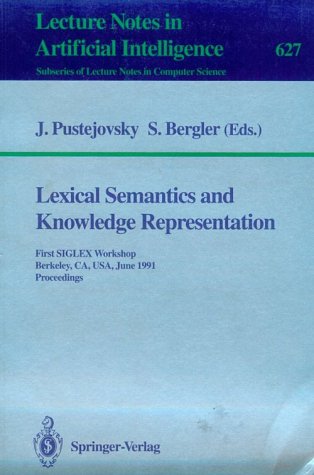
Lexical Semantics and Knowledge Representation: First Siglex Workshop Berkeley, Ca, Usa, June 17, 1991 Proceedings (Lecture Notes in Artificial Intelligence 627)
Sprache: Englisch
Verlag: Springer-Verlag, Berlin / London / New York, 1992
ISBN 10: 0387558012 ISBN 13: 9780387558011
Anbieter: PsychoBabel & Skoob Books, Didcot, Vereinigtes Königreich
Verkäuferbewertung 5 von 5 Sternen

EUR 20,92
EUR 14,49 Versand
Versand von Vereinigtes Königreich nach USAAnzahl: 1 verfügbar
In den WarenkorbPaperback. Zustand: Good. Zustand des Schutzumschlags: No Dust Jacket. Sticker to front cover. (Lecture Notes in Artificial Intelligence 627). Used.
-

Lexical Semantics and Knowledge Representation : First SIGLEX Workshop, Berkeley, CA, USA, June 17, 1991. Proceedings
Sprache: Englisch
Verlag: Springer Berlin / Heidelberg, 1992
ISBN 10: 3540558012 ISBN 13: 9783540558019
Anbieter: Better World Books Ltd, Dunfermline, Vereinigtes Königreich
Verkäuferbewertung 5 von 5 Sternen
EUR 49,38
EUR 5,80 Versand
Versand von Vereinigtes Königreich nach USAAnzahl: 1 verfügbar
In den WarenkorbZustand: Good. Pages intact with minimal writing/highlighting. The binding may be loose and creased. Dust jackets/supplements are not included. Stock photo provided. Product includes identifying sticker. Better World Books: Buy Books. Do Good.
-
Lexical Semantics and Knowledge Representation: First SIGLEX Workshop, Berkeley, CA, USA, June 17, 1991. Proceedings (Lecture Notes in Computer Science / Lecture Notes in Artificial Intelligence 627)
Anbieter: Ria Christie Collections, Uxbridge, Vereinigtes Königreich
Verkäuferbewertung 5 von 5 Sternen
EUR 60,66
EUR 13,89 Versand
Versand von Vereinigtes Königreich nach USAAnzahl: Mehr als 20 verfügbar
In den WarenkorbZustand: New. In.
-
Lexical Semantics and Knowledge Representation : First SIGLEX Workshop, Berkeley, CA, USA, June 17, 1991. Proceedings
Anbieter: Chiron Media, Wallingford, Vereinigtes Königreich
Verkäuferbewertung 5 von 5 Sternen
EUR 57,23
EUR 17,96 Versand
Versand von Vereinigtes Königreich nach USAAnzahl: 10 verfügbar
In den WarenkorbPF. Zustand: New.
-

Lexical Semantics and Knowledge Representation : First SIGLEX Workshop, Berkeley, CA, USA, June 17, 1991. Proceedings
Anbieter: AHA-BUCH GmbH, Einbeck, Deutschland
Verkäuferbewertung 5 von 5 Sternen
Taschenbuch. Zustand: Neu. Druck auf Anfrage Neuware - Printed after ordering - Recent work on formal methods in computational lexicalsemantics has had theeffect of bringing many linguisticformalisms much closer to the knowledge representationlanguages used in artificial intelligence. Formalisms arenow emerging which may be more expressive and formallybetter understood than many knowledge representationlanguages. The interests of computational linguists nowextend to include such domains as commonsense knowledge,inheritance, default reasoning, collocational relations, andeven domain knowledge. With such an extension of the normalpurview of 'linguistic' knowledge, one may question whetherthere is any logical justification for distinguishingbetween lexical semantics and commonsense reasoning.This volume explores the question from severalmethodologicaland theoretical perspectives. What emerges isa clear consensus that the notion of the lexicon and lexicalknowledge assumed in earlier linguistic research is grosslyinadequate and fails to address the deeper semantic issuesrequired for natural language analysis.
-
Taschenbuch. Zustand: Neu. Lexical Semantics and Knowledge Representation | First SIGLEX Workshop, Berkeley, CA, USA, June 17, 1991. Proceedings | James Pustejovsky (u. a.) | Taschenbuch | xii | Englisch | 1992 | Springer | EAN 9783540558019 | Verantwortliche Person für die EU: Springer Verlag GmbH, Tiergartenstr. 17, 69121 Heidelberg, juergen[dot]hartmann[at]springer[dot]com | Anbieter: preigu.
-
Zustand: Gut. Zustand: Gut | Seiten: 400 | Sprache: Englisch | Produktart: Bücher | Recent work on formal methods in computational lexicalsemantics has had theeffect of bringing many linguisticformalisms much closer to the knowledge representationlanguages used in artificial intelligence. Formalisms arenow emerging which may be more expressive and formallybetter understood than many knowledge representationlanguages. The interests of computational linguists nowextend to include such domains as commonsense knowledge,inheritance, default reasoning, collocational relations, andeven domain knowledge. With such an extension of the normalpurview of "linguistic" knowledge, one may question whetherthere is any logical justification for distinguishingbetween lexical semantics and commonsense reasoning.This volume explores the question from severalmethodologicaland theoretical perspectives. What emerges isa clear consensus that the notion of the lexicon and lexicalknowledge assumed in earlier linguistic research is grosslyinadequate and fails to address the deeper semantic issuesrequired for natural language analysis.
-
Zustand: Sehr gut. Zustand: Sehr gut | Seiten: 400 | Sprache: Englisch | Produktart: Bücher | Recent work on formal methods in computational lexicalsemantics has had theeffect of bringing many linguisticformalisms much closer to the knowledge representationlanguages used in artificial intelligence. Formalisms arenow emerging which may be more expressive and formallybetter understood than many knowledge representationlanguages. The interests of computational linguists nowextend to include such domains as commonsense knowledge,inheritance, default reasoning, collocational relations, andeven domain knowledge. With such an extension of the normalpurview of "linguistic" knowledge, one may question whetherthere is any logical justification for distinguishingbetween lexical semantics and commonsense reasoning.This volume explores the question from severalmethodologicaland theoretical perspectives. What emerges isa clear consensus that the notion of the lexicon and lexicalknowledge assumed in earlier linguistic research is grosslyinadequate and fails to address the deeper semantic issuesrequired for natural language analysis.
-
Lexical Semantics and Knowledge Representation: First Siglex Workshop Berkeley, Ca, Usa, June 17, 1991 Proceedings (Lecture Notes in Computer Science)
Anbieter: Mispah books, Redhill, SURRE, Vereinigtes Königreich
Verkäuferbewertung 4 von 5 Sternen

EUR 152,86
EUR 28,99 Versand
Versand von Vereinigtes Königreich nach USAAnzahl: 1 verfügbar
In den Warenkorbpaperback. Zustand: Good. Good. Dust Jacket NOT present. CD WILL BE MISSING. . SHIPS FROM MULTIPLE LOCATIONS. book.
-
Lexical Semantics and Knowledge Representation
Anbieter: BUCHSERVICE / ANTIQUARIAT Lars Lutzer, Wahlstedt, Deutschland
Verkäuferbewertung 5 von 5 Sternen
Softcover. Zustand: gut. 1992. Lexical Semantics and Knowledge Representation In deutscher Sprache. pages.
-

Lexical Semantics and Knowledge Representation
Sprache: Englisch
Verlag: Springer Berlin Heidelberg Sep 1992, 1992
ISBN 10: 3540558012 ISBN 13: 9783540558019
Anbieter: BuchWeltWeit Ludwig Meier e.K., Bergisch Gladbach, Deutschland
Verkäuferbewertung 5 von 5 Sternen
Taschenbuch. Zustand: Neu. This item is printed on demand - it takes 3-4 days longer - Neuware -Recent work on formal methods in computational lexicalsemantics has had theeffect of bringing many linguisticformalisms much closer to the knowledge representationlanguages used in artificial intelligence. Formalisms arenow emerging which may be more expressive and formallybetter understood than many knowledge representationlanguages. The interests of computational linguists nowextend to include such domains as commonsense knowledge,inheritance, default reasoning, collocational relations, andeven domain knowledge. With such an extension of the normalpurview of 'linguistic' knowledge, one may question whetherthere is any logical justification for distinguishingbetween lexical semantics and commonsense reasoning.This volume explores the question from severalmethodologicaland theoretical perspectives. What emerges isa clear consensus that the notion of the lexicon and lexicalknowledge assumed in earlier linguistic research is grosslyinadequate and fails to address the deeper semantic issuesrequired for natural language analysis. 400 pp. Englisch.
-

Lexical Semantics and Knowledge Representation
Sprache: Englisch
Verlag: Springer Berlin Heidelberg, 1992
ISBN 10: 3540558012 ISBN 13: 9783540558019
EUR 48,37
EUR 48,99 Versand
Versand von Deutschland nach USAAnzahl: Mehr als 20 verfügbar
In den WarenkorbZustand: New. Dieser Artikel ist ein Print on Demand Artikel und wird nach Ihrer Bestellung fuer Sie gedruckt. Recent work on formal methods in computational lexicalsemantics has had theeffect of bringing many linguisticformalisms much closer to the knowledge representationlanguages used in artificial intelligence. Formalisms arenow emerging which may be mor.
-

Lexical Semantics and Knowledge Representation
Sprache: Englisch
Verlag: Springer, Springer Sep 1992, 1992
ISBN 10: 3540558012 ISBN 13: 9783540558019
Anbieter: buchversandmimpf2000, Emtmannsberg, BAYE, Deutschland
Verkäuferbewertung 5 von 5 Sternen
Taschenbuch. Zustand: Neu. This item is printed on demand - Print on Demand Titel. Neuware -Recent work on formal methods in computational lexicalsemantics has had theeffect of bringing many linguisticformalisms much closer to the knowledge representationlanguages used in artificial intelligence. Formalisms arenow emerging which may be more expressive and formallybetter understood than many knowledge representationlanguages. The interests of computational linguists nowextend to include such domains as commonsense knowledgeinheritance, default reasoning, collocational relations, andeven domain knowledge. With such an extension of the normalpurview of 'linguistic' knowledge, one may question whetherthere is any logical justification for distinguishingbetween lexical semantics and commonsense reasoning.This volume explores the question from severalmethodologicaland theoretical perspectives. What emerges isa clear consensus that the notion of the lexicon and lexicalknowledge assumed in earlier linguistic research is grosslyinadequate and fails to address the deeper semantic issuesrequired for natural language analysis.Springer-Verlag KG, Sachsenplatz 4-6, 1201 Wien 400 pp. Englisch.


