Gesamtpreis (1 Artikel Artikel):
Versandziel:

feure (45 Ergebnisse)
Direkt zu den wichtigsten Suchergebnissen
Suchfilter
Produktart
- Alle Product Types
- Bücher (33)
- Magazine & Zeitschriften (Keine weiteren Ergebnisse entsprechen dieser Verfeinerung)
- Comics (Keine weiteren Ergebnisse entsprechen dieser Verfeinerung)
- Noten (Keine weiteren Ergebnisse entsprechen dieser Verfeinerung)
- Kunst, Grafik & Poster (12)
- Fotografien (Keine weiteren Ergebnisse entsprechen dieser Verfeinerung)
- Karten (Keine weiteren Ergebnisse entsprechen dieser Verfeinerung)
- Manuskripte & Papierantiquitäten (Keine weiteren Ergebnisse entsprechen dieser Verfeinerung)
Zustand Mehr dazu
- Neu (3)
- Wie Neu, Sehr Gut oder Gut Bis Sehr Gut (15)
- Gut oder Befriedigend (6)
- Ausreichend oder Schlecht (Keine weiteren Ergebnisse entsprechen dieser Verfeinerung)
- Wie beschrieben (21)
Weitere Eigenschaften
Sprache (4)
Gratisversand
Land des Verkäufers
Verkäuferbewertung
-

Teodora, Emperatriz de Bizancio, Francis Fèvre, Ed. Edaf
Anbieter: Librería La Palabrería, Almunecar, GR, Spanien
Verkäuferbewertung 5 von 5 Sternen

-

Georges de Feure 1868 -1943.
Anbieter: Antiquariaat A. Kok & Zn. B.V., Amsterdam, Niederlande
Verkäuferbewertung 5 von 5 Sternen
Amsterdam, Van Gogh Museum & Zwolle, Waanders Uitgevers, [ 1993]. 104 pp. Col. & b./w. ills. Orig. softcover (pictorial wrappers). 4to. (19th-century masters).Georges de Feure was a French painter, theatrical designer, and industrial art designer in the symbolism and Art Nouveau styles.
-

Essays in Process Theology
Anbieter: Mispah books, Redhill, SURRE, Vereinigtes Königreich
Verkäuferbewertung 4 von 5 Sternen

EUR 191,97
EUR 28,94 Versand
Versand von Vereinigtes Königreich nach USAAnzahl: 1 verfügbar
In den Warenkorbhardcover. Zustand: Good. Good. Dust Jacket NOT present. CD WILL BE MISSING. . SHIPS FROM MULTIPLE LOCATIONS. book.
-

Georges de Feure.
Verlag: Musée Maurice Denis, 1995
Anbieter: Antiquariat Dorner, Reinheim, Deutschland
Verkäuferbewertung 5 von 5 Sternen
Du symbolisme à l'art nouveau (1890-1905). Ausstellungskatalog. Saint-Germain-en-Laye, Musée Maurice Denis 1995. 112 S., OKart. 4to. Umschlag etwas berieben.
-

"Thes Palais Indiens" - Thea Thee The poster Plakat Art Nouveau Jugendstil - from: "Les Affiches Illustrées" de Ernest Maindron.
Sprache: Französisch
Verlag: Paris, G. Boudet, 1896
Anbieter: Antiquariat Steffen Völkel GmbH, Seubersdorf, Deutschland
Verkäuferbewertung 5 von 5 Sternen
Kunst / Grafik / Poster
Original Farblithographie von 1896. Blatt-Maße: ca. 31 x 22 cm. gut erhalten. // Original color lithograph from 1896. // Wir, das Antiquariat Steffen Völkel, kaufen und verkaufen alte Bücher, Handschriften, Zeichnungen, Autographen, Grafiken und Fotografien. Wir sind stets am Ankauf von kompletten Bibliotheken, Sammlungen und Nachlässen interessiert. Sprache: Französisch Gewicht in Gramm: 20.
-

"Helyett / Marjolaine" - poster Plakat Art Nouveau Jugendstil - from: "Les Affiches Illustrées" de Ernest Maindron.
Sprache: Französisch
Verlag: Paris, G. Boudet, 1896
Anbieter: Antiquariat Steffen Völkel GmbH, Seubersdorf, Deutschland
Verkäuferbewertung 5 von 5 Sternen
Kunst / Grafik / Poster
Original Farblithographie von 1896. Blatt-Maße: ca. 31 x 22 cm. gut erhalten. // Original color lithograph from 1896. // Wir, das Antiquariat Steffen Völkel, kaufen und verkaufen alte Bücher, Handschriften, Zeichnungen, Autographen, Grafiken und Fotografien. Wir sind stets am Ankauf von kompletten Bibliotheken, Sammlungen und Nachlässen interessiert. Sprache: Französisch Gewicht in Gramm: 20.
-
JOURNAL DE LA DECORATION AÑO XIX LÁM. 38. DÉCORATIONS POUR ASSIETTES (George De Feure). CROMOLITOGRA
Verlag: Armand Guérinet, 1905
Anbieter: Libros Fugitivos, Valencia, V, Spanien
Verkäuferbewertung 4 von 5 Sternen
Kunst / Grafik / Poster
Art print. Zustand: Good. JOURNAL DE LA DECORATION AÑO XIX LÁM. 38. DÉCORATIONS POUR ASSIETTES (George De Feure) Armand Guérinet, Paris, Circa 1905. CROMOLITOGRAFÍA 63x46. Hoja suelta. 25x35 cm. (Base x Altura x Grosor). Ilustrado. Color. NOTA: La fecha es aproximada, no se indica fecha de edición en el ejemplar consultado. - - - NOTAS SOBRE EL ESTADO: Artículo de segunda mano. En normal estado de conservacion, con señales de uso normal. Ver fotos y leer descripcion, las fotos se consideran parte de la descripcion.
-
MARJOLAINE ORIGINAL LITHOGRAPH OF POSTER
Verlag: Les Affiches Illustrees, Imprimerie Chaix, Paris, 1896
Anbieter: Sage Rare & Collectible Books, IOBA, Livonia, MI, USA
Verbandsmitglied: IOBA
Verkäuferbewertung 5 von 5 Sternen
Hardcover. Zustand: Very Good. Lithographer: G. Bataille. Size: 12.5" x 9". This original antique art nouveau lithograph of the poster is toned with a small faint soil spot near lower right corner but the lithograph itself is bright and in beautiful condition. .
-
Le Théâtre. revue bimensuelle illustrée Année 1910 1er semestre janvier-juin
Verlag: Manzi, Joyant & Cie, 1910
Anbieter: Librairie de l'Avenue - Henri Veyrier, Saint-Ouen, FR, Frankreich
Verkäuferbewertung 4 von 5 Sternen
Signiert
Couverture rigide. Zustand: Bon état. Grand in-4. Cartonnage de l'éditeur pleine percaline bleu ciel, couvertures d'origine conservées, premier plat de couverture orné d'une composition polychrome signée Georges de Feure, 288 pp., 24 pp. par numéro, illustrations en noir et en couleurs. Coiffes et coins émoussés légèrement usés, garde manquante, intérieur en bon état. Actualités théâtrales de l'époque, avec importants passages consacrés à "Chantecler", pièce créée en 1910. in-4°.
-
The Manners and Customs of the Romans
Verlag: John And Paul Knapton, London, 1740
Anbieter: John R. Sanderson, Bookseller, Stockbridge, MA, USA
Verbandsmitglied: SNEAB
Verkäuferbewertung 5 von 5 Sternen
Erstausgabe
Contemporary Calf. Zustand: Good Plus. First Edition. Wide ranging study of 359 pages. Contemporary panelled calf slightly worn along extremities.
-
Souvenirs d'art et de littérature - Exemplaire de Jules Chéret
Verlag: Editions du cygne, 1930
Anbieter: Librairie Le Feu Follet, Paris, Frankreich
Verbandsmitglied: ILAB
Verkäuferbewertung 5 von 5 Sternen
Erstausgabe Signiert
couverture souple. Editions du cygne | Paris 1930 | 18.50 x 24 cm | broché | Edition originale illustrée de dessins et de bois gravés d'Achille Rouquet, Georges de Feure, Félix Vallotton et Achille Laugé. Un manque en angle inférieur droit du premier plat, rousseurs. Précieux envoi autographe signé d'Achille Astre : "à Jules Chéret à l'artiste le plus délicieux de notre époque son bien dévoué Achille Astre." | [ENGLISH DESCRIPTION FOLLOWS] First edition illustrated with drawings and wood engravings by Achille Rouquet, Georges de Feure, Félix Vallotton and Achille Laugé. A lack to the lower right corner of the front cover, foxing. Precious autograph inscription signed by Achille Astre: "à Jules Chéret à l'artiste le plus délicieux de notre époque son bien dévoué Achille Astre." (to Jules Chéret to the most delightful artist of our time his very devoted Achille Astre.) *.
-
L'Image. Revue litteraire et artistique ornee de figures sur bois, nº 12
Verlag: Floury, Paris, 1897
Anbieter: Cole & Contreras / Sylvan Cole Gallery, Sitges, B, Spanien
Verkäuferbewertung 5 von 5 Sternen
Signiert
A set of 38 relief prints executed for the December issue--the last of twelve published--of L'Image, a groundbreaking artistic and literary journal. THIS IS A SET OF PROOFS ON CHINESE PAPER, WITHOUT THE TEXT, with dozens wood-engravings and woodcuts. Folio. Printed wraps adorned with a wood-engraving after Marcel Lenoir. Stitching loose and a few plates spotted, else FINE AND BRIGHT. Ray 321 and 321A.
-

Original Art for Les Maitres de l'Affiche
Verlag: Paris, 1896
Anbieter: Trillium Antique Prints & Rare Books, Franklin, TN, USA
Verkäuferbewertung 2 von 5 Sternen

Kunst / Grafik / Poster
Hardcover. Zustand: Fine. De Feure (illustrator). This first edition, folio lithograph after a poster is from "Les Maitres de l'Affiche". The work was published by Imprimerie Chaix under the direction of Jules Cheret in Paris between 1896 and 1900. The prints were published as a monthly subscription, with 4 sent each month to subscribers. On 16 occasions "bonus" plates of original designs by noted artists were also included. Each lithograph features the blind embossed stamp of Maitres de l'Affiche designed by Cheret. Celebrated artists of the time contributed to the work including Steinlen, Mucha, Toulouse-Lautrec, Bonnard, Forain, Grasset, Meunier, Louis Rhead, Dudley Hardy, Beggarstaff, Edward Penfield et al. --- Jules Cheret was considered the father of poster art. "He dominated the series, with one in every four Maitres by him, the first in each monthly instalment, and 7 of the Special plates, a total of 67. With over 1000 poster designs to his credit, his large representation in the series is justified, although some critics have pointed out that, as the artistic director, he may have been biased towards selecting his own work." (Appelbaum p.iii) Cheret demonstrated a unique combination of artistic, technical, and entrepreneurial talent that spearheaded the poster industry. He opened his own print shop in 1866 in Paris and from 1881 on his shop operated as part of the Chaix firm which gave us "Les Maitres de l'Affiche". --- Among the most sought after plates in the work are the "Job" and "Moulin Rouge" by Toulouse Lautrec. Rennert noted of the "Job" by Mucha that "more than any other work of Mucha's, this beauty established him as the master of convoluted hair and the creator of unforgettable popular images; the poster was used for years in many variants all over the world, sometimes with marginal text in various languages. A classic by any standard." (Rennert, PAI-XLIX 389) "Jane Abdy called it "a secular icon," and indeed it is a magnificent production, considering that it advertises cigarette paper. "The background, in a dull imperial purple is a perfect foil for the golden curls of the smoking girl, whose locks are spread over the poster like the delicate filigree work of an Indian bracelet"(Abdy, p.136) --- This art subscription was created during the Belle Epoque period in France. "There was nothing exclusive about the 'joie de vivre' that swept Paris, at a delirious pace, out of the 19th century into the 20th. As Victor Hugo had observed, the city lived by, and for, the whole human race. Haussman's great boulevards had opened up a spacious stage where Paris made a spectacle of herself by day and night. Outdoors and indoors the walls of buildings flowered with posters that took their themes from the passing show of 'La Vie Parisenne.' Advertising never knew happier days. The most ephemeral of the arts has left us with a vision of the 'good old days' that vanished forever in the gunsmoke of 1914. Those gay nineties and naughty noughts that will always be remembered as 'La Belle Epoque.'(The beautiful era)" (Horizon p. 97) --- "By the 1890s the streets of every great metropolis were enlivened by large colourful posters (see The Great Poster Movement). The poster had not only caught the fancy of the broad public, but its best examples were already being regarded as works of art (specifically, as fine prints) to be exhibited, reviewed in journals, collected and reprinted in a manageable form. In the last five years of the century, the Imprimerie Chaix was to play great part in codifying, hallowing and perpetuating the ebullient period of 'La Belle Epoque.' It was in those years that the firm published "Les Maitres de l'Affiche" (Masters of the Poster) reduced lithographic versions, in authentic colours, of the best posters of Europe and America, by more than 90 great artists, posters that bring the period to life." (Appelbaum p.iii) --- The work is in very good to excellent condition. There may be a few minor imperfections to be expected with age. Please review the ima.
-
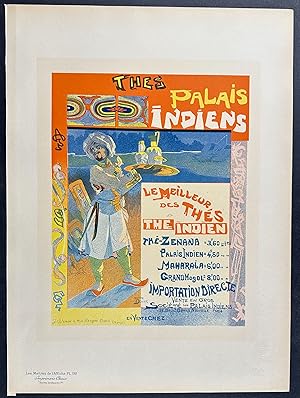
Thes du Palais Indien
Verlag: Paris, 1896
Anbieter: Trillium Antique Prints & Rare Books, Franklin, TN, USA
Verkäuferbewertung 2 von 5 Sternen
Kunst / Grafik / Poster
Hardcover. Zustand: Fine. De Feure (illustrator). This first edition, folio lithograph after a poster is from "Les Maitres de l'Affiche". The work was published by Imprimerie Chaix under the direction of Jules Cheret in Paris between 1896 and 1900. The prints were published as a monthly subscription, with 4 sent each month to subscribers. On 16 occasions "bonus" plates of original designs by noted artists were also included. Each lithograph features the blind embossed stamp of Maitres de l'Affiche designed by Cheret. Celebrated artists of the time contributed to the work including Steinlen, Mucha, Toulouse-Lautrec, Bonnard, Forain, Grasset, Meunier, Louis Rhead, Dudley Hardy, Beggarstaff, Edward Penfield et al. --- Jules Cheret was considered the father of poster art. "He dominated the series, with one in every four Maitres by him, the first in each monthly instalment, and 7 of the Special plates, a total of 67. With over 1000 poster designs to his credit, his large representation in the series is justified, although some critics have pointed out that, as the artistic director, he may have been biased towards selecting his own work." (Appelbaum p.iii) Cheret demonstrated a unique combination of artistic, technical, and entrepreneurial talent that spearheaded the poster industry. He opened his own print shop in 1866 in Paris and from 1881 on his shop operated as part of the Chaix firm which gave us "Les Maitres de l'Affiche". --- Among the most sought after plates in the work are the "Job" and "Moulin Rouge" by Toulouse Lautrec. Rennert noted of the "Job" by Mucha that "more than any other work of Mucha's, this beauty established him as the master of convoluted hair and the creator of unforgettable popular images; the poster was used for years in many variants all over the world, sometimes with marginal text in various languages. A classic by any standard." (Rennert, PAI-XLIX 389) "Jane Abdy called it "a secular icon," and indeed it is a magnificent production, considering that it advertises cigarette paper. "The background, in a dull imperial purple is a perfect foil for the golden curls of the smoking girl, whose locks are spread over the poster like the delicate filigree work of an Indian bracelet"(Abdy, p.136) --- This art subscription was created during the Belle Epoque period in France. "There was nothing exclusive about the 'joie de vivre' that swept Paris, at a delirious pace, out of the 19th century into the 20th. As Victor Hugo had observed, the city lived by, and for, the whole human race. Haussman's great boulevards had opened up a spacious stage where Paris made a spectacle of herself by day and night. Outdoors and indoors the walls of buildings flowered with posters that took their themes from the passing show of 'La Vie Parisenne.' Advertising never knew happier days. The most ephemeral of the arts has left us with a vision of the 'good old days' that vanished forever in the gunsmoke of 1914. Those gay nineties and naughty noughts that will always be remembered as 'La Belle Epoque.'(The beautiful era)" (Horizon p. 97) --- "By the 1890s the streets of every great metropolis were enlivened by large colourful posters (see The Great Poster Movement). The poster had not only caught the fancy of the broad public, but its best examples were already being regarded as works of art (specifically, as fine prints) to be exhibited, reviewed in journals, collected and reprinted in a manageable form. In the last five years of the century, the Imprimerie Chaix was to play great part in codifying, hallowing and perpetuating the ebullient period of 'La Belle Epoque.' It was in those years that the firm published "Les Maitres de l'Affiche" (Masters of the Poster) reduced lithographic versions, in authentic colours, of the best posters of Europe and America, by more than 90 great artists, posters that bring the period to life." (Appelbaum p.iii) --- The work is in very good to excellent condition. There may be a few minor imperfections to be expected with age. Please review the ima.
-
Le pêcheur d'anguilles. Légende d'après un lied en prose et avec un frontispice de Georges Feure
Verlag: (189
Anbieter: Librairie Alain Brieux, Paris, Frankreich
Verbandsmitglied: ILAB
Verkäuferbewertung 4 von 5 Sternen
Couverture rigide. Zustand: Bon. 45 pp., frontispice illustré Paris, Bibliothèque de la Plume, (1894), in-8, 45 pp, frontispice illustré, Broché, couverture imprimée de l'éditeur, Très rare édition originale de ce poème inspiré d'une légende hollandaise, tirée à 154 exemplaires numérotés ; un des 150 exemplaires sur simili-hollande (n° 60). L'ouvrage est orné d'un joli frontispice de l'artiste symboliste Georges de Feure (1868-1943), imprimé sur papier vélin. Exemplaire non rogné. Couverture un peu salie, pliure angulaire.
-

A Jeanne d'Arc
Verlag: Paris, 1896
Anbieter: Trillium Antique Prints & Rare Books, Franklin, TN, USA
Verkäuferbewertung 2 von 5 Sternen
Kunst / Grafik / Poster
Hardcover. Zustand: Fine. De Feure (illustrator). This first edition, folio lithograph after a poster is from "Les Maitres de l'Affiche". The work was published by Imprimerie Chaix under the direction of Jules Cheret in Paris between 1896 and 1900. The prints were published as a monthly subscription, with 4 sent each month to subscribers. On 16 occasions "bonus" plates of original designs by noted artists were also included. Each lithograph features the blind embossed stamp of Maitres de l'Affiche designed by Cheret. Celebrated artists of the time contributed to the work including Steinlen, Mucha, Toulouse-Lautrec, Bonnard, Forain, Grasset, Meunier, Louis Rhead, Dudley Hardy, Beggarstaff, Edward Penfield et al. --- Jules Cheret was considered the father of poster art. "He dominated the series, with one in every four Maitres by him, the first in each monthly instalment, and 7 of the Special plates, a total of 67. With over 1000 poster designs to his credit, his large representation in the series is justified, although some critics have pointed out that, as the artistic director, he may have been biased towards selecting his own work." (Appelbaum p.iii) Cheret demonstrated a unique combination of artistic, technical, and entrepreneurial talent that spearheaded the poster industry. He opened his own print shop in 1866 in Paris and from 1881 on his shop operated as part of the Chaix firm which gave us "Les Maitres de l'Affiche". --- Among the most sought after plates in the work are the "Job" and "Moulin Rouge" by Toulouse Lautrec. Rennert noted of the "Job" by Mucha that "more than any other work of Mucha's, this beauty established him as the master of convoluted hair and the creator of unforgettable popular images; the poster was used for years in many variants all over the world, sometimes with marginal text in various languages. A classic by any standard." (Rennert, PAI-XLIX 389) "Jane Abdy called it "a secular icon," and indeed it is a magnificent production, considering that it advertises cigarette paper. "The background, in a dull imperial purple is a perfect foil for the golden curls of the smoking girl, whose locks are spread over the poster like the delicate filigree work of an Indian bracelet"(Abdy, p.136) --- This art subscription was created during the Belle Epoque period in France. "There was nothing exclusive about the 'joie de vivre' that swept Paris, at a delirious pace, out of the 19th century into the 20th. As Victor Hugo had observed, the city lived by, and for, the whole human race. Haussman's great boulevards had opened up a spacious stage where Paris made a spectacle of herself by day and night. Outdoors and indoors the walls of buildings flowered with posters that took their themes from the passing show of 'La Vie Parisenne.' Advertising never knew happier days. The most ephemeral of the arts has left us with a vision of the 'good old days' that vanished forever in the gunsmoke of 1914. Those gay nineties and naughty noughts that will always be remembered as 'La Belle Epoque.'(The beautiful era)" (Horizon p. 97) --- "By the 1890s the streets of every great metropolis were enlivened by large colourful posters (see The Great Poster Movement). The poster had not only caught the fancy of the broad public, but its best examples were already being regarded as works of art (specifically, as fine prints) to be exhibited, reviewed in journals, collected and reprinted in a manageable form. In the last five years of the century, the Imprimerie Chaix was to play great part in codifying, hallowing and perpetuating the ebullient period of 'La Belle Epoque.' It was in those years that the firm published "Les Maitres de l'Affiche" (Masters of the Poster) reduced lithographic versions, in authentic colours, of the best posters of Europe and America, by more than 90 great artists, posters that bring the period to life." (Appelbaum p.iii) --- The work is in very good to excellent condition. There may be a few minor imperfections to be expected with age. Please review the ima.
-
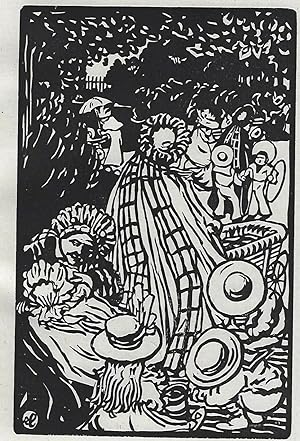
L'Image. Revue litteraire et artistique ornee de figures sur bois, nº 8. (with "Au Luxembourg", by Jean-Emile Laboureur)
Verlag: Floury, Paris, 1897
Anbieter: Cole & Contreras / Sylvan Cole Gallery, Sitges, B, Spanien
Verkäuferbewertung 5 von 5 Sternen
Signiert
A COMPLETE PROOF SET ON CHINESE PAPER, before all letters, of all of the relief prints executed for the July issue--the ninth of twelve published--of L'Image, a groundbreaking artistic and literary journal. Numerous wood-engravings and woodcuts including A FINE PROOF ON CHINE OF LABOUREUR'S "AU LUXEMBOURG" (Laboureur I, 572), his first important print. Laboureur was 19 when this issue came out, and its publication marked his being recognized as a consequential artist. This copy, exceptionally, includes A "FUME" (early proof) OF THE WOOD-ENGRAVING AFTER THOMAS LAWRENCE, SIGNED IN PENCIL BY BELTRAND AND JUSTIFIED "Fumé nº 1". Folio. Printed wraps illustrated iwth art nouveau wood engravings after Berthon and De Feure. Stitching loose, else FINE AND BRIGHT. Ray 321 and 321A.
-
FÉMINIES, huit chapitres inédits dévoués à la femme, à l'amour, à la beauté par Gyp, Abel Hermant, Henri Lavedan, Marcel Schwob et Octave Uzanne. Frontispices en couleurs d'après Félicien Rops, encadrements et vignettes de Léon Rudnicki.
Verlag: Paris, imprimé pour les Bibliophiles contemporains en 1896 (achevé d'imprimer le 15 février 1896)., 1896
Anbieter: Librairie L'amour qui bouquine, ALISE SAINTE REINE, Frankreich
Verkäuferbewertung 5 von 5 Sternen
Erstausgabe
Couverture souple. Zustand: Très bon. Edition originale. Octave UZANNE, GYP, Abel HERMANT, Henri LAVEDAN, Marcel SCHWOB - Félicien ROPS, Georges de FEURE, Léon RUDNICKI, illustrateurs FÉMINIES, huit chapitres inédits dévoués à la femme, à l'amour, à la beauté par Gyp, Abel Hermant, Henri Lavedan, Marcel Schwob et Octave Uzanne. Frontispices en couleurs d'après Félicien Rops, encadrements et vignettes de Léon Rudnicki. Paris, imprimé pour les Bibliophiles contemporains en 1896 (achevé d'imprimer le 15 février 1896). 1 volume in-8 (26,3 x 16,7 cm) de IV-205-(3) pages. Toutes les pages sont illustrées d'encadrements imprimés dans divers tons d'après les dessins de Léon Rudnicki, couverture illustrée en couleurs par Georges de Feure, 1 titre en couleurs, 8 eaux-fortes hors-texte d'après les dessins de Félicien Rops en deux états (noir et couleurs). Exemplaire en feuilles (débroché, prêt à être relié). La couverture et le dos sont conservés (légères usures et salissures). Feuilles du corpus de l'ouvrage en excellent état. Planches très fraîches. Quelques petites usures dans certains fonds de cahiers et traces de colle sans gravité. Premier tirage des 8 superbes frontispices d'après les dessins inédits de Félicien Rops. Tirage unique à 183 exemplaires, tous sur papier du Japon. Exemplaire nominatif imprimé au nom du Baron du Charmel (voir provenance). On joint un état supplémentaire du premier plat de couverture par Georges de Feure (bon état). Bien complet du feuillet imprimé qui annonce le Dictionnaire Bibliophilosophique et la fin des Bibliophiles Contemporains. C'est un des plus beaux livres jamais édités par les soins et sous la direction d'Octave Uzanne. Il avait été commencé dès mai 1895 et sort des presses de l'Ancienne maison Quantin. Ce livre a été composé pour MM. les Sociétaires de l'Académie des Beaux Livres, Bibliophiles contemporains (alors que cette société n'existe plus en réalité depuis plusieurs mois lorsque ce livre est fini d'imprimer). Le tirage en couleur à "la poupée" des planches gravées d'après Félicien Rops, par Hellé, Fornet et Massé, a été exécuté par F. Maire. Les encadrements de pages ont été gravés d'après les dessins de L. Rudnicki. La couverture de Georges de Feure a été coloriée au patron par Charpentier. Cet ouvrage inédit et qui - dans son ensemble - ne saurait être désormais réimprimé, a été publié pour les Bibliophiles contemporains. Par les soins et sous la direction de son fondateur Octave Uzanne. Le tirage a été fait au nombre des Sociétaires de l'Académie des Beaux Livres, plus quelques exemplaires de don, prévus par les statuts, les exemplaires de réserve et enfin les exemplaires de réserve et enfin les exemplaires destinés aux divers auteurs des chapitres de ce livre, au total 183 exemplaires. Celui-ci porte le n° 29 et port le nom du Baron F. du Charmel.Provenance : de la bibliothèque de Fernand du Charmel (imprimé à son nom, avec son ex libris joint sur feuillet de garde blanche conservée). Il apparaît ainsi dans la liste des membres fondateurs des Bibliophiles Contemporains fondés par Octave Uzanne : Charmel (baron Fernand de), château de Vaussieux, par Saint-Léger-Carcagny (Calvados). Fernand de Bonnefoy, baron du Charmel était né en 1845 à Paris. Il fut sous-lieutenant de la Garde Nationale Mobile de Seine-et-Marne puis Ministre de Monaco à Paris (1889-1900). Il fut également Commissaire Général de la Principauté de Monaco à l'Exposition Universelle de Paris en 1900. Il avait conservé cet exemplaire broché dans sa riche bibliothèque. Livre très recherché pour les dessins de Félicien Rops gravés par les meilleurs artistes de l'époque. Exemplaire à relier.
-
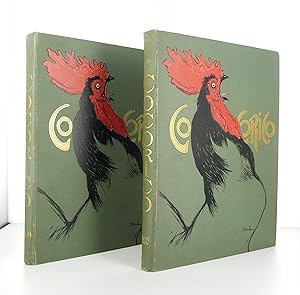
COCORICO - 2 Tomes
Verlag: Au bureau de la Revue 1898-1900, Paris, 1898
Anbieter: Librairie KOEGUI, BAYONNE, Frankreich
Verbandsmitglied: ILAB
Verkäuferbewertung 5 von 5 Sternen
Cartonnés. 2 tomes. In-4. Cartonnage d'éditeur pleine percaline verte. Titre à la chinoise doré sur le dos. Plat supérieur illustré d'un dessin signé de Steinlen représentant un coq chantant en noir et rouge devant le titre"Cocorico" écrit en doré. Le présent exemplaire est ici en deux volumes : numéros 1 à 24 pour 1898-1899 ; numéros 25 à 44 pour 1900. (Les couvertures en couleurs et les annonces sont reliées in-fine pour le premier volume). Rare Réunion des 44 premiers numéros de cette revue Art-Nouveau Revue bi-mensuelle, créée et dirigée par Paul Boutigny, pour soutenir l'Art Nouveau.
-
LE RETOUR, FACE OF A WOMAN
Verlag: Lestampe Moderne, Impremerie Champenois, Paris, 1897
Anbieter: L'Estampe Originale ABAA/ILAB-LILA, Saratoga, CA, USA
Verkäuferbewertung 5 von 5 Sternen
Erstausgabe Signiert
None. Zustand: Near Fine. Zustand des Schutzumschlags: None. de Feure,Georges (illustrator). Grand Deluxe of 50 on Japon. Lithograph. 1897. Published by L'estampe Moderne, Impremerie Champenois. Image: 25,5 x 33cm. Margins:40,8x55cm. One of 50 proofs in the Grand Luxe printed on Japan with wide margins, Velin paper. Signature of the artist in the plate. Blindstamp of the editor lower right hand margin. On the Verso is the serpent stamp and number of the edition "78" / of 100 signed in pen. 2000 of the regular edition with smaller margins were published. Included is a proof in one color. photo upon request.
-
LE RETOUR, FACE OF A WOMAN
Verlag: Le Estampe Moderne, Paris, 1899
Anbieter: L'Estampe Originale ABAA/ILAB-LILA, Saratoga, CA, USA
Verkäuferbewertung 5 von 5 Sternen
Erstausgabe Signiert
none. Zustand: Fine. Zustand des Schutzumschlags: none. George De Feure (illustrator). Lithograph. As Published in L'estampe Moderne. With a proof page in purple ink. Printed on Vellum. With wide margins. Paris, Imprimerie Champenois, 1897 Published lithograph printed in purple, red and rust with a proof in purple with a remarque lower right Image 13 x 10 with approximately 16 x 14 full margins Both LITHOGRAPHS as published in the deluxe edition on Japan paper of L'ESTAMPE MODERNE Number 3, signed # 78 on the verso top left for specail edition of 100, juillet 1897 Millman, p.124 L'Estampe Moderne (1897-1898), a more commercial and later version of L'Estampe Originale, was a monthly publication of print portfolios, producing twenty-four issues containing four color lithographs each Only a few prints exhibiting Japanese influence were issued, mostly by minor artists, yet they were equally as beautiful in image as their predecessors Sold framed L'estampe moderne was edited by Charles Masson and H Piazza, and printed and published by Imprimerie Champenois, Paris. Each monthly instalment came in a paper cover (which itself incorporated an original lithograph by Alphonse Mucha), and contained four original lithographs Each issue cost 3 francs 50 cents if purchased in Paris (4 francs elsewhere), or you could subscribe by the year for 40 francs in Paris, 43 francs elsewhere Subscribers were tempted with two extra lithographs a year, the "planches de prime" Numero 3, juillet 1897.
-

LE RETOUR, FACE OF A WOMAN
Verlag: l'Estampe Moderne, Paris, 1897
Anbieter: L'Estampe Originale ABAA/ILAB-LILA, Saratoga, CA, USA
Verkäuferbewertung 5 von 5 Sternen
None. Zustand: Fine. Zustand des Schutzumschlags: none. De Feure, George (illustrator). deluxe edition of 50 on Japan paper. Paris, Imprimerie Champenois, 1897 Published lithograph printed in purple, red and rust with a proof in puple with a remarque lower right Image 13 x 10 with approximately 16 x 14 full margins Both LITHOGRAPHS as published in the deluxe edition on Japan paper of L'ESTAMPE MODERNE Number 3, juillet 1897. Millman, p.124, Weisberg/Cate, p.112, No. 173. L'Estampe Moderne (1897-1898), a more commercial and later version of L'Estampe Originale, was a monthly publication of print portfolios, producing twenty-four issues containing four color lithographs each Only a few prints exhibiting Japanese influence were issued, mostly by minor artists, yet they were equally as beautiful in image as their predecessors Sold framed Lââ â¢estampe moderne was edited by Charles Masson and H Piazza, and printed and published by Imprimerie Champenois, Paris Each monthly instalment came in a paper cover (which itself incorporated an original lithograph by Alphonse Mucha, and contained four original lithographs Each issue cost 3 francs 50 cents if purchased in Paris (4 francs elsewhere), or you could subscribe by the year for 40 francs in Paris, 43 francs elsewhere Subscribers were tempted with two extra lithographs a year, the "planches de prime" Numero 3, juillet 1897.
-
La Porte des rêves. Illustrations de Georges de Feure
Verlag: Paris: Bibliophiles - Independants 1899, 1899
Anbieter: Antikvariat Valentinska, Praha, Tschechien
Verbandsmitglied: ILAB
Verkäuferbewertung 5 von 5 Sternen
Signiert
EUR 18.000,00
EUR 26,50 Versand
Versand von Tschechien nach USAAnzahl: 1 verfügbar
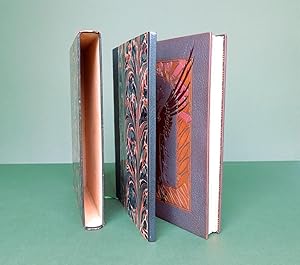
In den WarenkorbEin Kultbuch des Fin de siècle (Nr. 107 von insgesamt 220 Stück) in prunkvoller Bindung von R. D. Canape. Bestehend aus: Schuber: Bordüren aus schwarzem Leder, innen feines Sämischleder, außen Marmorpapier; Schutzumschlag: Marmorpapier, Laschen und Rücken aus schwarzem Leder mit fünf Bünden, goldgeprägter Titel, innen Sämischleder; Buch selbst: fünf Bünde, graues Leder, goldgeprätgter Titel auf dem Rücken, Vorderseite: farbiger Blinddruck mit der Darstellung eines Phönix; Vorsätze (signiert : CANAPE R. D. 1900) mit ornamentaler Goldprägung am Rand, Brokatstoff, hinterer Vorsatz: Marmorpapier, goldener Schnitt; 133 Seiten, 4°, Exemplar in besonders gutem Zustand; Schuber etwas berieben, sonst hervorragender Zustand. Sehr selten! Book Language/s: French.
-
PALAIS INDIENS ORIGINAL LITHOGRAPH OF POSTER
Verlag: Les Affiches Etrangeres, Imprimerie Chaix, Paris, 1897
Anbieter: Sage Rare & Collectible Books, IOBA, Livonia, MI, USA
Verbandsmitglied: IOBA
Verkäuferbewertung 5 von 5 Sternen
Non-Book. Zustand: Very Good. Lithographer: Weiner. Size: 12.5" x 9". This original antique art nouveau lithograph of the poster is toned but the lithograph itself is bright and in beautiful condition. .
-
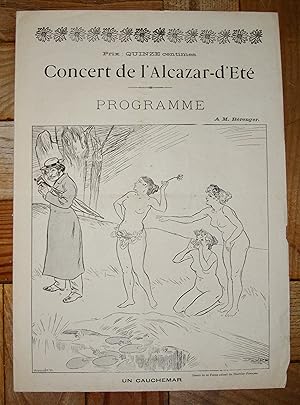
Un cauchemar
Verlag: Paris, 1894
Anbieter: Librairie Seigneur, VOINGT, Frankreich
Verkäuferbewertung 4 von 5 Sternen
Kunst / Grafik / Poster Erstausgabe
En feuille. Zustand: Très bon. édition originale. Programme de l'Alcazar-d'été. Le dessin de Feure est reproduit, gravé par Ch. Decaux, sur la couverture.
-
![Bild des Verkäufers für Oeuvres de Georges de Feure 1903 [LeatherBound] zum Verkauf von S N Books World](https://pictures.abebooks.com/inventory/md/md30638978993.jpg)
Oeuvres de Georges de Feure 1903 [LeatherBound]
Erscheinungsdatum: 2025
Leatherbound. Zustand: NEW. BOOKS ARE EXEMPT FROM IMPORT DUTIES AND TARIFFS; NO EXTRA CHARGES APPLY. Leatherbound edition. Condition: New. Leather Binding on Spine and Corners with Golden leaf printing on spine. Bound in genuine leather with Satin ribbon page markers and Spine with raised gilt bands. Pages: 76. A perfect gift for your loved ones. Reprinted from 1903 edition. NO changes have been made to the original text. This is NOT a retyped or an ocr'd reprint. Illustrations, Index, if any, are included in black and white. Each page is checked manually before printing. As this print on demand book is reprinted from a very old book, there could be some missing or flawed pages, but we always try to make the book as complete as possible. Fold-outs, if any, are not part of the book. If the original book was published in multiple volumes then this reprint is of only one volume, not the whole set. IF YOU WISH TO ORDER PARTICULAR VOLUME OR ALL THE VOLUMES YOU CAN CONTACT US. Resized as per current standards. Sewing binding for longer life, where the book block is actually sewn (smythe sewn/section sewn) with thread before binding which results in a more durable type of binding. Pages: 76.
-
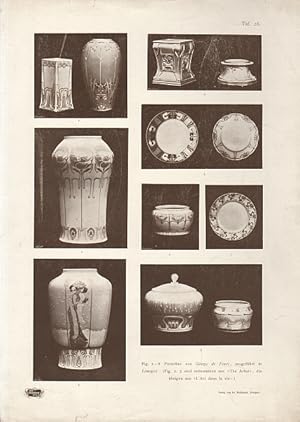
Porzellan von Georges de Feure, ausgeführt in Limoges.
Verlag: Stuttgart (Hoffmann) (1902)., 1902
Anbieter: Antiquariat A. Suelzen - Angela Sülzen, Berlin, Deutschland
Verkäuferbewertung 5 von 5 Sternen
1 Blatt (Taf. 26), 35 x 25 cm (mit kl. Randschäden) * Aus "Der moderne Stil", IV.
-
Féminies.
Sprache: Französisch
Anbieter: Librairie Trois Plumes, Angers, Frankreich
Verkäuferbewertung 4 von 5 Sternen
Couverture rigide. Zustand: Bon. [Collectif] Octave Uzanne, Marcel Schwob, Abel Hermant, Gyp et Henri Lavedan ; Félicien Rops & Georges de Feure (illustrateurs) ; Féminies. Paris, pour les bibliophiles contemporains, Académie des beaux livres, 1896. In-8, IV-208p. Magnifique édition illustrée de huit gravures de Félicien Rops, chacune en 2 états, soit 16 gravures. Chaque conte commence par un frontispice en deux états. Les gravures de L'amour comme un sport ont été placées par erreur au début de La femme comme Paragon d'art. La couverture est de Georges de Feure, les encadrements de Léon Rudnicki, le titre de Krutké (gravé par Emile Gaujean). Tirage unique à 183 exemplaires, ici le n°179, tous sur papier japon. Ouvrage nominatif (nom gratté). Exemplaire enrichi d'un papier annonçant l'envoi de l'ouvrage aux membres non démissionnaires des bibliophiles contemporains ainsi que l'envoi prochain du dictionnaire bibliophilosophique. Exemplaire enrichi d'un dessin ou d'une gravure, 68*26mm, sur papier japon, enchâssé(e) sur l'extérieur du premier plat, sous une feuille de mica (ou similaire), dans le goût de ce que faisait Rops au moment de Féminies sans que nous puissions attribuer un auteur à cette illustration. Lorsque l'exemplaire passé dans la vente Crisp, la fiche faisait bien état d'un dessin original, comme cela semble assez logique quand on enchâsse ainsi un dessin sur le plat. A l'inverse, l'aspect fait plutôt penser à une gravure. Aussi, sans démonter la reliure, il nous semble impossible d'être affirmatif, nous dirons donc gravure. Provenance : Frederick Arthur Crisp (1851-1922) avec son ex-libris gravé (vente à Londres, Sothebys, 4 décembre 1922, n°69). Reliure signée Dubois, probablement le relieur belge Dubois d'Enghien, plein maroquin bleu vert, dos à nerfs, filets sur les coupes, large roulette en bordure des contreplats, couvertures conservées. Dos passé, frottements et légers accrocs aux coupes. Très bel exemplaire.
-
LE PECHEUR D'ANGUILLES légendes.
Erscheinungsdatum: 1894
Anbieter: Nouvene Sylvie, MARSEILLE, Frankreich
Verkäuferbewertung 4 von 5 Sternen
georges de feure (illustrator). Paris Bibliothèque de la Plume sans date (1894). Petit in-8 broché 45pp. Orné d'un frontispice de l'artiste symboliste Georges de Feure. Tirage unique à 154 exemplaires portant la mention "cette édition ne sera pas réimprimée", ici l'un des 150 exemplaires numérotés sur simili Hollande. Bel exemplaire frais, complet du texte et du frontispice. Poème inspiré d'une légende hollandaise. (4480).
-
La Décoration Peinte, Album général de la décoration peinte, en couleurs opaques pour toutes surfaces lavables et en couleurs transparentes.
Verlag: KALLYS, Paris, 1911
Anbieter: Librairie Pierre Chretien - Jean Izarn, PARIS, Frankreich
Verbandsmitglied: ILAB
Verkäuferbewertung 5 von 5 Sternen
. Illustrateur : FEURE (Georges de). (illustrator). Paris, Kallys, (1911), in-8, couv. ornée d'un desssin en couleur de Georges de FEURE représentant une jeune femme déroulant une frise de papier peint, 32 pp. Nombreux modèles de frises décoratives, papiers peints, céramiques, vitraux, en couleur, dans un style Art Nouveau et parfois symboliste, réalisés par différents artistes, dont Georges DE FEURE. Légers plis, usures, déchirures, annotations au crayon, une page détachée. Livres.